
Ontario’s Express Entry Skilled Trades Stream used to be one of the fastest “Ontario nomination” routes for tradespeople already working in the province. But right now, you can’t apply through it.
Ontario suspended the stream on November 14, 2025, stopped taking new applications, and began returning in-process applications with refunds. There’s been no confirmed date for reopening. If you’re a trades worker in Ontario, the best move is to prepare your file as if it could reopen, while also pursuing a back-up pathway through federal Express Entry or another OINP stream.
Current status: suspended
- You cannot submit a new Skilled Trades Stream application today.
- If you had an application in process, Ontario’s decision means it may be returned and fees refunded (based on the 2025 suspension announcement coverage).
- Ontario did not confirm when, or if, the stream will reopen.
This matters because the stream was “enhanced” (Express Entry-aligned): a provincial nomination typically adds 600 CRS points, which almost always leads to an Invitation to Apply (ITA) for permanent residence in a later Express Entry draw.
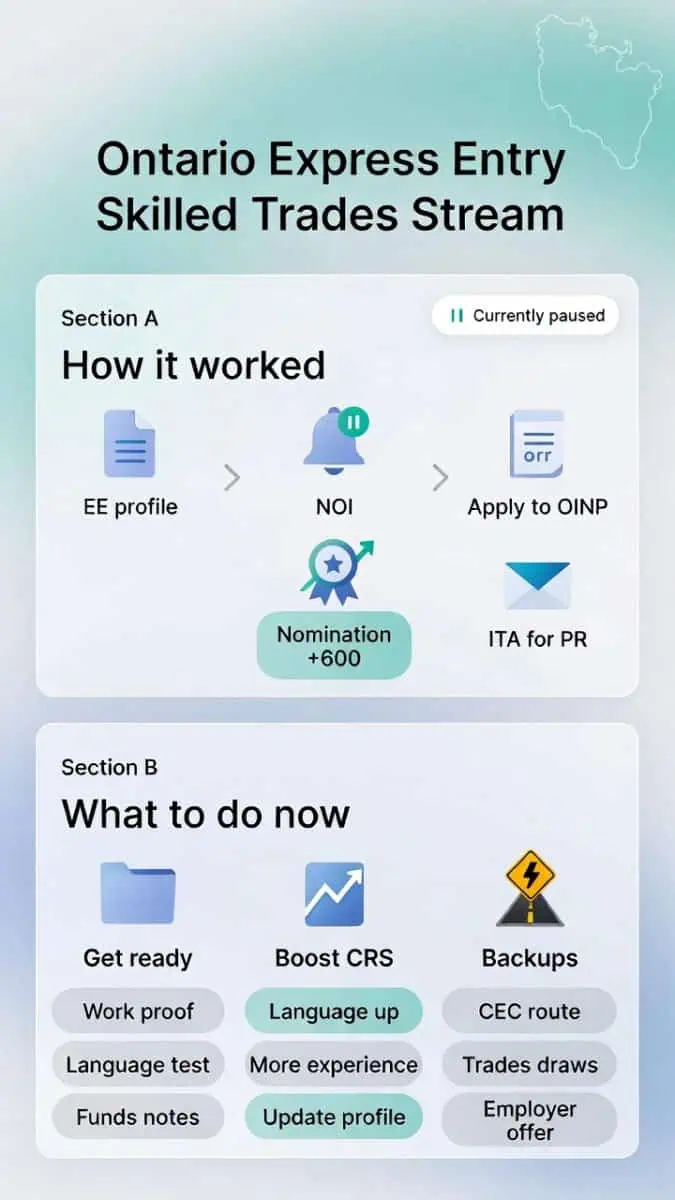
Who the stream was for (eligibility snapshot)
Before the suspension, Ontario generally targeted people who were:
- Already in Express Entry (you needed a valid EE profile)
- Eligible under Canadian Experience Class (CEC) (common requirement for this stream)
- Working in Ontario in an eligible skilled trade and able to prove at least 1 year of paid, cumulative Ontario work experience within a recent window
- Meeting minimum language around CLB 5 in English or French
- Legally in Canada (valid status / work permit)
- Able to show settlement funds (often satisfied through a mix of savings and ongoing Ontario earnings)
- Able to show real ties and intent to live in Ontario
One key detail people miss: you typically couldn’t apply directly. Ontario had to select you first by sending a Notification of Interest (NOI) through your Express Entry account, then you had a deadline (often 45 days) to submit the full OINP application.
Before you estimate your Express Entry score, convert IELTS to CLB so your language level lines up with IRCC’s benchmarks.
Trades licensing: use “Skilled Trades Ontario” language (not the old name)
A lot of older pages still mention the “Ontario College of Trades.” That body was wound down and replaced by Skilled Trades Ontario (STO). If your trade is compulsory in Ontario, you generally need the right authorization to legally work (for example, a Certificate of Qualification, provisional certificate, or registered training agreement, depending on your situation). This is separate from immigration—but it often becomes part of your “proof you’re legitimately working in the trade” story.
Eligible occupations: how to think about it without memorizing lists
Ontario’s Skilled Trades stream historically focused on construction, industrial, and maintenance trades (plus a small set of other trade groups). Lists have been published using NOC groupings, but NOC codes changed under NOC 2021, and different programs can exclude certain occupations even inside a “trade” umbrella.
A safe way to handle this:
- Find your NOC based on your actual duties (not your job title).
- Confirm the trade is treated as a skilled trade for the pathway you’re using (OINP vs federal).
- If your trade is compulsory, confirm your STO authorization.
For comparison: IRCC’s Federal Skilled Trades Program (FSTP) lists specific NOC groups that count as “skilled trades” for federal eligibility, which is useful when you pivot to a federal option.
How the process worked (step-by-step)
When it was open, the workflow looked like this:
- Create / update your Express Entry profile
Pick Ontario (or “all provinces”) as an intended destination. - Receive a Notification of Interest (NOI)
Ontario searched the pool and invited candidates it wanted. - Submit your OINP application by the deadline
This meant uploading a full document package: identity/status, language results, detailed Ontario work proof, and funds proof. - Get nominated (if approved) → gain 600 CRS points
You accepted the nomination in your Express Entry account. - Receive ITA for PR, then apply to IRCC
You submitted your federal PR application after the ITA.
Example (why nomination mattered)
- Candidate CRS score: 420
- Ontario nomination: +600
- New CRS score: 1,020
That jump typically moves you from “waiting” to “invited” in Express Entry.
If your trade is compulsory, a Certificate of Qualification in Ontario can matter for both legal work and some federal trades eligibility.

The documents that usually made or broke an application
Even when programs are open, most refusals come from weak proof, not “bad luck.” Strong files usually include:
- Work proof: consistent pay stubs, T4s/NOAs, job letter with duties, hours, wage, and matching NOC duties
- Status proof: current permit/status documents
- Language: valid test results (don’t let them expire mid-process)
- Trade authorization (if compulsory): STO documentation
- Funds proof: clean bank statements + explanation for large deposits + current Ontario earnings evidence
- Consistency: job title, duties, pay, and dates match everywhere (resume, letters, tax docs, EE profile)
What to do right now (while the stream is suspended)
1) Build a “ready to submit” folder
If the stream reopens, timelines can be tight. Prepare:
- Updated employer letter (duties + hours + wage)
- Last 12 months of pay stubs
- T4 + Notice of Assessment (if you have them)
- Updated resume matching your EE history
- Bank statements and a short funds explanation
- STO proof if your trade is compulsory
Use an Ontario paycheque calculator to estimate take-home pay when you’re planning settlement funds and monthly costs.
2) Pursue an alternative pathway in parallel
Here are the most common pivots trades workers in Ontario look at:
| Pathway | Best for | What you still need |
|---|---|---|
| Express Entry “Trades” category draws | Tradespeople with eligible experience who want a federal invite | An eligible EE profile + the right work experience mix for the category |
| Canadian Experience Class (CEC) | People with solid Canadian work experience and competitive CRS | Strong language + enough Canadian experience + clean documentation |
| Federal Skilled Trades Program (FSTP) | People who meet the federal skilled trades criteria | Federal trade eligibility rules + job offer or certificate of qualification (per IRCC rules) |
| OINP Employer Job Offer streams | People with a supporting Ontario employer | Employer requirements + job offer + EOI scoring (varies by stream) |
Verdict: If you already have Ontario trade experience and an EE profile, the fastest “backup” is usually federal Express Entry, especially if you can benefit from trades category draws or you’re already strong under CEC. Use OINP employer streams when you have a genuinely supportive employer and your EOI score is competitive.
When you’re building your PR document folder, start with a police record check in Ontario so you understand what type you’ll need and where to get it.
