
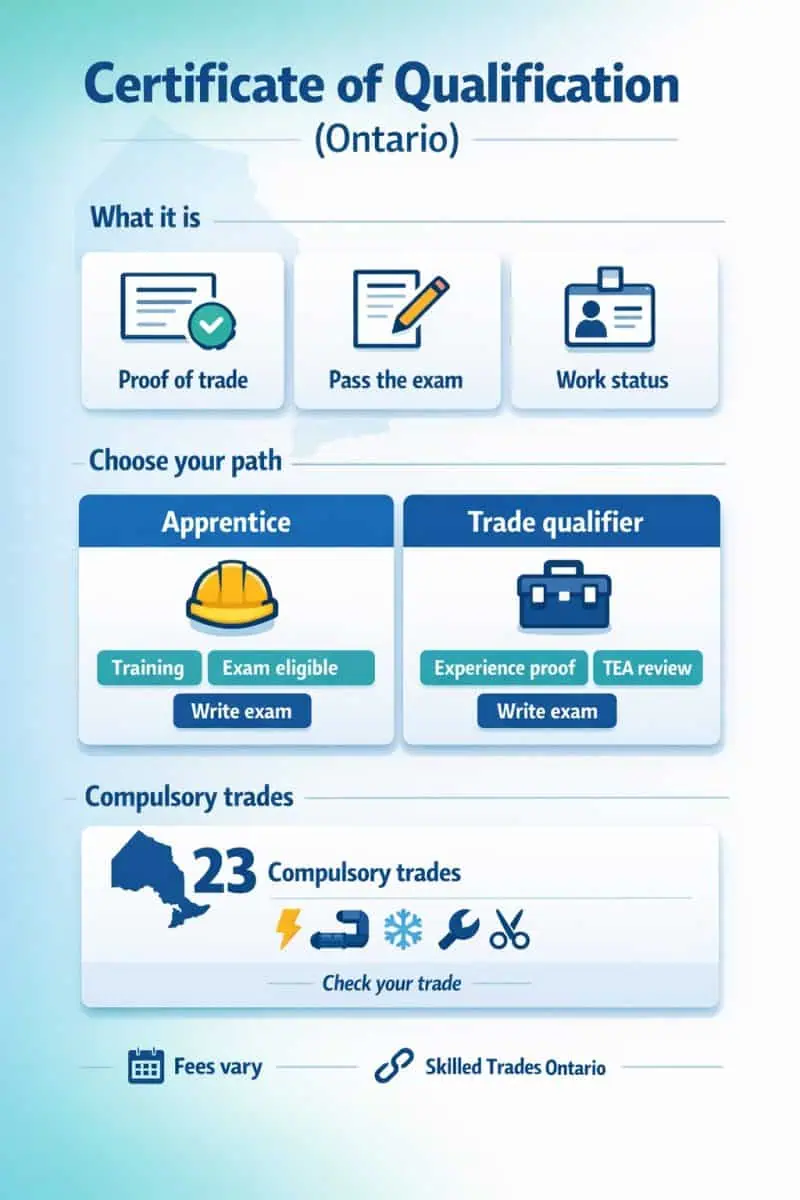
A Certificate of Qualification (C of Q) is Ontario’s proof that you’ve met the requirements and passed the trade’s certifying exam. If your trade is compulsory, you generally need the right status (registered apprentice, provisional C of Q, or C of Q) to work legally. If your trade is non-compulsory, a C of Q isn’t required to work—but it can still help with hiring, pay, and credibility.
This guide covers:
- who needs a C of Q in Ontario (and who doesn’t)
- the fastest path to get one (apprentices vs experienced workers)
- exam booking + common costs
- certificate of qualification Ontario list (the 23 compulsory trades)
Step 1: Check if your trade is compulsory or non-compulsory
Before you apply, confirm these three things on Skilled Trades Ontario (STO):
- Is your trade compulsory?
- Does it have a written certifying exam? (C of Q is issued in trades with certifying exams)
- Is it Red Seal? (optional endorsement that can help you work across Canada)
Why this matters: people waste weeks applying under the wrong pathway (or chasing a C of Q for a trade that doesn’t have an exam).
Certificate of qualification Ontario list: the 23 compulsory trades
If you work in one of these compulsory trades, your legal ability to work is tightly connected to your STO status (apprentice / provisional C of Q / C of Q).
| Compulsory trade (Ontario) | Trade code |
|---|---|
| Alignment and Brakes Technician | 310E |
| Auto Body and Collision Damage Repairer | 310B |
| Auto Body Repairer | 310Q |
| Automotive Electronic Accessory Technician | 310K |
| Automotive Service Technician | 310S |
| Electrician — Construction and Maintenance | 309A |
| Electrician — Domestic and Rural | 309C |
| Fuel and Electrical Systems Technician | 310C |
| Hairstylist | 332A |
| Hoisting Engineer — Mobile Crane Operator 1 | 339A |
| Hoisting Engineer — Mobile Crane Operator 2 | 339C |
| Hoisting Engineer — Tower Crane Operator | 339B |
| Motorcycle Technician | 310G |
| Plumber | 306A |
| Refrigeration and Air Conditioning Systems Mechanic | 313A |
| Residential (Low Rise) Sheet Metal Installer | 308R |
| Residential Air Conditioning Systems Mechanic | 313D |
| Sheet Metal Worker | 308A |
| Sprinkler and Fire Protection Installer | 427A |
| Steamfitter | 307A |
| Transmission Technician | 310D |
| Truck and Coach Technician | 310T |
| Truck-Trailer Service Technician | 310J |
Step 2: Pick your pathway (apprentice vs experienced worker)
Here’s the decision that saves the most time:
| Pathway | Best for | What you do | What you get |
|---|---|---|---|
| Apprenticeship route | You’re registered as an apprentice in Ontario | Finish required on-the-job + in-school training → become exam-eligible → write exam | C of Q after you pass |
| Trade qualifier route (experienced worker) | You have strong experience but didn’t complete an Ontario apprenticeship | Apply for a Trade Equivalency Assessment (TEA) → get approval to challenge exam → write exam | C of Q after you pass |
How to get a Certificate of Qualification in Ontario (apprentices)
- Finish your apprenticeship requirements (hours + in-school levels).
- Confirm exam eligibility through STO.
- Pay the exam fee (if it applies to you).
- Receive your Authorization to Test letter (you’ll need it to book).
- Book your exam through STO’s exam scheduling process.
- Pass the certifying exam → pay issuance steps (if required) → receive your C of Q.
A real-world tip
If you’re close to completing, start gathering your IDs, name-matching documents, and any training records early. Most delays come from missing paperwork or mismatched names.
How to get a Certificate of Qualification in Ontario (experienced workers / trade qualifiers)
If you learned your trade through work experience (Ontario, another country, informal training), you usually start with a Trade Equivalency Assessment (TEA):
- Choose the exact trade + code (very important).
- Apply for TEA and submit proof of your experience and skills.
- If approved, you’ll be allowed to challenge the certifying exam.
- Pay + schedule the exam, then write and pass.
- After passing, you can be issued a Certificate of Qualification (fee may apply).
Fees you should budget for
Common costs mentioned by STO (HST is 13% in Ontario):
- Certifying exam fee: $150 + HST = $169.50 per attempt
- Trade Equivalency Assessment (TEA): $235 + HST = $265.55
- Recognized Canadian certificate verification (if you already hold a Canadian trade certificate): $50 + HST = $56.50
Example (trade qualifier)
If you’re applying as an experienced worker and need TEA + one exam attempt:
$265.55 (TEA) + $169.50 (exam) = $435.05
(Plus any prep course or books you choose.)
Fee waiver note (apprentices)
Ontario introduced a fee waiver for the first written certifying exam attempt for certain apprentices who complete on/after January 1, 2025. If you fail the first attempt, the standard exam fee applies for re-tries.
Before you commit to a program, estimate your take-home pay as an apprentice so you can budget for tools, transit, and exam fees.
Booking the exam: what actually happens
In plain terms, STO’s flow is:
- confirm you’re eligible
- pay the exam fee
- get an Authorization to Test letter
- book your exam using STO’s booking instructions
- write the exam in English or French (no secondary-language dictionaries)
One extra detail to watch: STO notes that in-house exams began being offered starting February 1, 2026 (where available), and accommodations are handled through STO’s process.
If you’re booking training or exams around work, it helps to know the Ontario statutory holiday pay basics.
If you’re certified in another province (or already have Red Seal)
If you already hold a Canadian trade certificate, STO has a Recognized Canadian Certificates process. If your credential is verified through that route, you may not need more training or exams to obtain an Ontario C of Q (depending on the trade match).
This is often the fastest path for interprovincial movers—especially in Red Seal trades.
Renewal: do you need to renew your C of Q?
- Compulsory trades: STO indicates Certificates of Qualification need annual renewal for people active in compulsory trades.
- Non-compulsory trades: STO indicates C of Q does not need renewal.
(If you’re budgeting: STO’s transition materials have referenced an annual renewal fee of $60 + HST for compulsory trades—verify the current amount inside your STO Portal before publishing a hard number.)
Not sure the trades are your path? Compare it with other career routes like PSW training options in Ontario.
FAQs
What is a certificate of qualification in Ontario?
It’s an official Skilled Trades Ontario credential that shows you’ve met requirements and passed the certifying exam for a trade in Ontario.
Do I need a certificate of qualification to work in Ontario?
Only compulsory trades require the right legal status to work (apprentice / provisional C of Q / C of Q). Many trades are non-compulsory, where a C of Q is optional but still valuable.
How long does it take to get a certificate of qualification?
It depends on your path. Apprentices usually move faster once they’re marked exam-eligible. Trade qualifiers can take longer because TEA review happens before you can book the exam.
Can I challenge the exam without doing an Ontario apprenticeship?
Yes—experienced workers often do this through the Trade Equivalency Assessment (TEA) route.
