
Most people first notice OTPP on a pay stub. The pension line is bigger than expected, and it raises the same questions every time: “Where is my account?” “Is this like an RRSP?” “What happens if I leave?”
This guide answers the basics in plain language. It’s general information (not personal financial advice), but it should make your statement and pay stub feel a lot less mysterious.
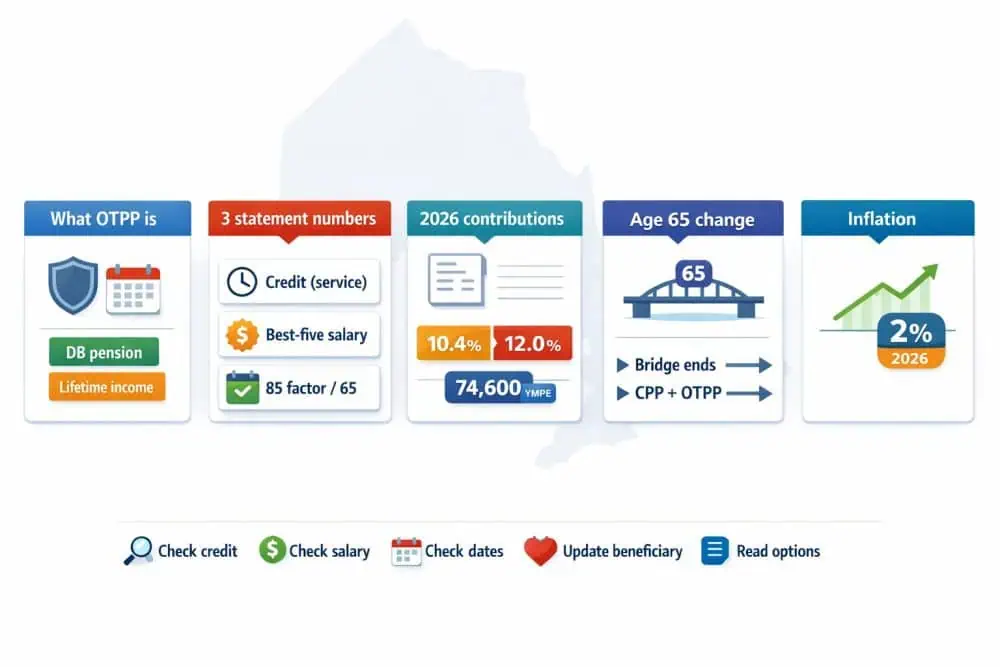
Quick meanings (so the rest is easier)
- Defined benefit (DB) pension: A pension based on a formula (service + salary), not a personal investment balance.
- YMPE: The CPP earnings ceiling for the year. OTPP uses it to set contribution tiers.
- Bridge benefit: An extra amount paid until 65; it ends after you turn 65 and your pension is adjusted.
- Locked-in account: A retirement account you generally can’t cash out anytime (it’s meant for retirement).
What Ontario Teachers’ Pension Plan is?
OTPP is built to pay you a monthly pension for life when you retire. That’s the purpose.
What it isn’t: it’s not a personal investment account where you watch a balance rise and fall. With OTPP, the main question is usually: “What income will I get in retirement?”
So instead of a “my balance” screen, you’ll mostly see things like:
- your service (credit),
- your salary used for the estimate,
- and what your pension could look like at different retirement dates.
Why people say OTPP is “so big”
OTPP is big for two simple reasons:
- It serves a lot of people (working members and pensioners).
- It manages a very large pool of assets.
In plain terms: that size lets the plan invest broadly and plan long-term. The goal is steady pensions over decades, not a perfect year every year.
OTPP vs RRSP vs a DC plan
Here’s the difference that matters in real life:
| If you have… | You usually watch… | Your biggest worry is… |
|---|---|---|
| OTPP (defined benefit) | your estimated pension at retirement | retiring too early / missing service |
| RRSP | your account balance | market returns + saving enough |
| Defined contribution (DC) plan | your account balance | market returns + fees |
If you’ve only ever used an RRSP, OTPP can feel “invisible” at first. That’s normal. It’s designed as income later, not a balance today.
The three numbers to find on your OTPP statement
Statements can have pages of detail. If you’re trying to make sense of yours quickly, start here:
1) Credit (service)
This is your actual time in the plan. Many members notice it’s shown in years and days (like “12 years, 143 days”). That’s normal.
2) Average salary used for the estimate
Often tied to your five highest salary years (“best five”). This can surprise people if they had leaves, part-time years, or salary changes.
3) Retirement eligibility (85 factor / age 65)
OTPP commonly describes an unreduced pension as being available when you reach your 85 factor (age + qualifying years = 85) or at age 65.
If you only remember one thing from this section: credit + salary + timing drive most outcomes.
The pay-stub part: what comes off your pay
OTPP uses a two-tier contribution setup:
- 10.4% of salary up to the CPP limit (YMPE)
- 12.0% of salary above the YMPE
Here’s what trips up a lot of new teachers: it’s not one flat rate. In 2026, you contribute 10.4% on the first $74,600, then 12% on anything above $74,600. People often do a quick “10.4% × full salary” estimate, see a bigger deduction, and assume something’s wrong—when it’s just the top slice being charged at the higher rate.
Also: OTPP explains that contributions are matched by the Ontario government and participating employers.
Quick math example (2026)
If salary is $85,000, OTPP’s example shows member contributions of $9,006.40:
- 10.4% × 74,600 = 7,758.40
- 12.0% × (85,000 − 74,600 = 10,400) = 1,248.00
- Total = 9,006.40
How the pension is calculated
A simple way to understand the basic pension idea is:
Basic annual pension ≈ 2% × years of credit × best-five average salary
Example with clean numbers:
- Best-five average salary: $85,000
- Credit: 30 years
Basic annual pension:
2% × 30 × $85,000 = $51,000/year
Real estimates can include more detail (especially because OTPP is designed to work alongside CPP), but this gives you the shape of the math.
The age-65 change (bridge benefit + CPP coordination)
This is the #1 “wait… what?” moment for many members.
OTPP is designed to work with the Canada Pension Plan (CPP). OTPP provides a bridge benefit meant to supplement income until age 65. The month after you turn 65 (or immediately if you start a CPP disability pension), the bridge benefit ends and your pension payment is adjusted.
This doesn’t automatically mean your total retirement income drops by the same amount. It means the plan expects retirement income to be a package: OTPP + CPP working together.
Inflation increases (what 2026 says)
OTPP’s published 2026 cost-of-living adjustment is 2%, effective January 2026 (based on CPI).
One important nuance: inflation protection can depend on when you earned your pension credit and the plan’s funded status:
- Credit earned before 2010: 100% CPI
- 2010–2013: 50% to 100% CPI (depends on funded status)
- After 2013: 0% to 100% CPI (depends on funded status)
So two retirees can both get an increase, but not always on the same portion of their pension.
If you leave teaching before retirement
People often rush this decision because it feels urgent. A calmer approach is: don’t pick an option until you’ve read the comparison in your options package and checked the deadlines.
OTPP describes benefit options that can include:
- keeping a deferred pension (start later),
- a commuted value transfer (where you take responsibility for investing within locked-in rules, when allowed),
- transfers under certain agreements (where eligible).
Because dates and rules matter, your best next step is usually to compare the options in your package and, if needed, get personal advice.
Mini checklist
- Do I want a lifetime monthly pension later, or am I comfortable managing investments myself?
- What deadlines apply to my options package?
- If I’m moving to another pension plan, is there a transfer agreement and a time limit?
- Do I understand the survivor options and what happens if I return to teaching?
Three mistakes new members make (and easy fixes)
1) They look for an “account balance” and assume something is missing.
Fix: OTPP is DB. Focus on your estimated pension and the three statement numbers: credit, salary, timing.
2) They ignore the age-65 bridge benefit change.
Fix: Build expectations around the bridge ending after 65, plus CPP.
3) They never update beneficiaries / profile details.
Fix: Make it a once-a-year habit—especially after life changes.
FAQs
Is OTPP guaranteed?
OTPP is designed to pay lifetime pensions and is managed under funding rules, contributions, and long-term investing. It aims for stability, but your exact benefits depend on plan rules and your personal details.
Can I “cash out” OTPP whenever I want?
Not like a bank account. If you leave, you may have options, but they come with rules and deadlines.
Why does my pension change at 65?
Because OTPP is coordinated with CPP. Many members have a bridge benefit that ends at 65, and the payment is adjusted.
Does everyone get the same inflation increase?
Not always. Inflation protection can depend on when you earned your pension credit and the plan’s funded status.
Where do I get the exact numbers for my situation?
Your member statement/portal and OTPP’s official tools are the best place for your credit, salary used, and pension estimates.
