
Toronto’s Ontario Line hit a real construction milestone on Thursday as tunnelling officially began on the downtown section of the long-promised subway. Two tunnel boring machines are now starting the underground push east from Exhibition Station. For a project that has spent years in maps, renderings and staged announcements, this is the kind of progress people can actually picture.
But the bigger question for riders has not changed.
Ontario Line tunnelling starts in Toronto
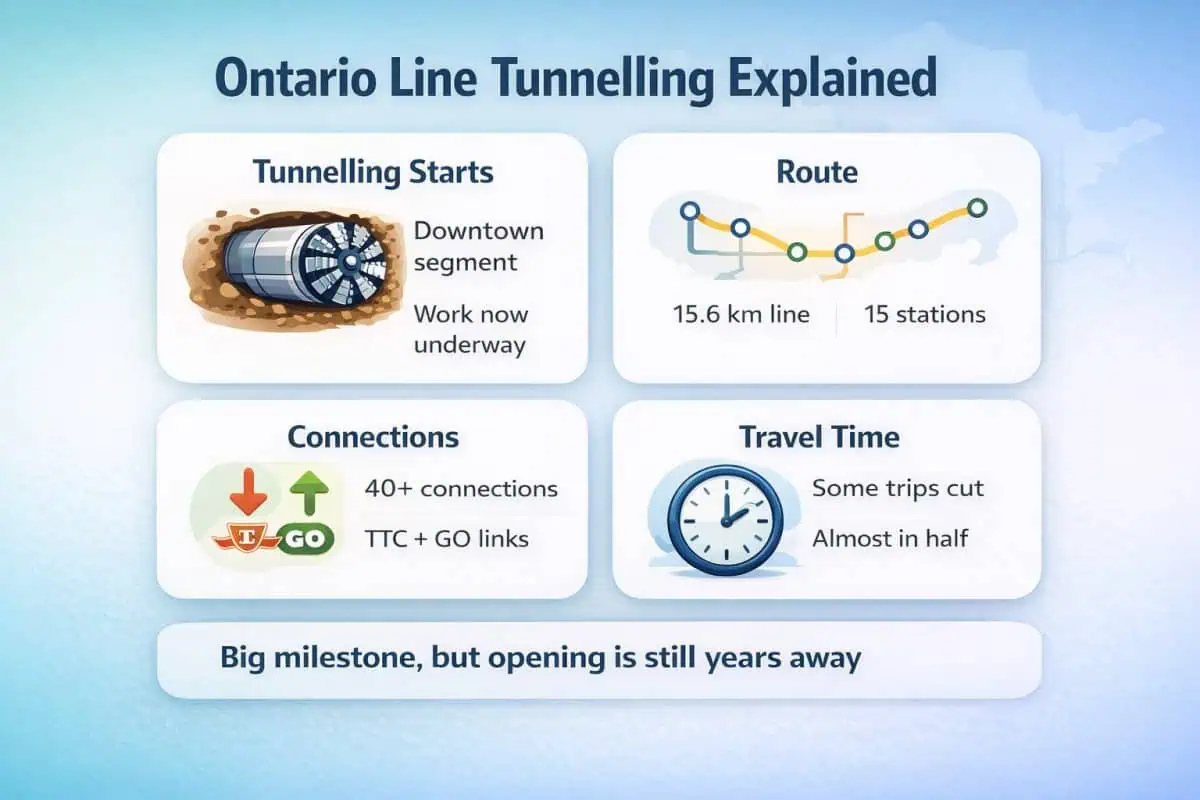
Metrolinx says the line is still expected to open in the early 2030s. So while this is one of the clearest signs yet that the Ontario Line is moving deeper into the hard-build phase, it is not a sign that passengers will be riding it anytime soon.
The new tunnels will run about six kilometres from the launch shaft near Exhibition Station to just west of the Lower Don River. Once trains reach the Don Yard area, they will continue east above ground across the Lower Don Bridge. Officials framed the start of tunnelling as a historic moment, saying it is the first time in more than 60 years that a subway is being tunnelled through Toronto’s downtown core.
That matters because the Ontario Line is not a small extension or a station upgrade. It is planned as a 15.6-kilometre route from Exhibition Place to Line 5 Eglinton at Don Mills Road, with 15 stations and more than 40 transit connections. Metrolinx says the full trip from one end to the other should take less than 30 minutes, compared with about 70 minutes on transit today. It also says the project is designed to bring roughly 227,500 more people within walking distance of transit and support about 388,000 daily boardings once the line is operating.
For Toronto riders, the sales pitch is simple: less time lost moving across the city. Officials say the line could cut a trip from Thorncliffe Park to downtown from about 40 minutes to 25. Another example used at Thursday’s event was Pape and Danforth to Queen and University, which is expected to drop from about 25 minutes to 12. The province also says the line should reduce crowding on one of the busiest stretches of TTC Line 1 during peak periods.
That is the promise.
The timeline is the tension.
During the media availability, Metrolinx CEO Michael Lindsay was asked whether this milestone changes the completion outlook. His answer was no. The opening window remains the same: early 2030s. That makes Thursday’s announcement important, but it also keeps the story grounded. Toronto has heard big transit promises before. What commuters want most now is not another celebration of progress, but a clearer sense of when the line will actually open.
Read: Northlander train fares revealed
There were also a few rider-facing updates that may stick faster than construction statistics. Four downtown station names have now been finalized to better match the neighbourhoods they serve. King-Bathurst will be called King West. Queen-Spadina becomes Chinatown. Corktown becomes Distillery District. Riverside-Leslieville is shortened to Leslieville. The province says the goal is to make the line easier to navigate and more intuitive for everyday users.
Construction is already active at multiple parts of the route. The province says major work is underway at Exhibition Station, where crews are building platforms and station entrances on both sides of the corridor. Excavation is complete at King West, Moss Park and Distillery District, and nearing completion at Chinatown. Exhibition Station is also expected to become one of the busiest transfer points on the line, linking the subway with GO Transit and serving the fast-growing Liberty Village area.
There is also a bigger funding and policy story behind the event. The federal government says it is contributing more than $4 billion to the Ontario Line as part of a wider transit investment in the GTA. At Thursday’s announcement, all three levels of government leaned hard on the same message: more housing, more jobs, less congestion and a transit network that is easier to use. That political unity may not answer every question about delivery, but it does suggest the line remains one of the region’s top transit priorities.
Read: Toronto’s Eglinton Crosstown LRT opens
For now, Toronto is left with two truths at the same time. The Ontario Line is no longer just a plan on paper. Downtown tunnelling is underway, station names are becoming final and the route is taking more visible shape. But riders still do not have a firm opening year, only a broad window that starts in the early 2030s.
That is why this milestone matters, but also why it is not enough on its own. The machines are finally digging. The harder part now is turning that visible progress into a transit line people can actually ride.
