
Maternity leave in Ontario gives birth parents protected time off work and access to EI payments.
Most confusion comes from mixing up job protection (Ontario law) and income support (federal EI). This guide keeps them separate and clear, with updated 2026 numbers.
What maternity leave means (Ontario vs EI)
There are two systems working together:
- Ontario ESA (job protection) → your employer must hold your job
- Employment Insurance (EI) → replaces part of your income
You can qualify for one without the other.
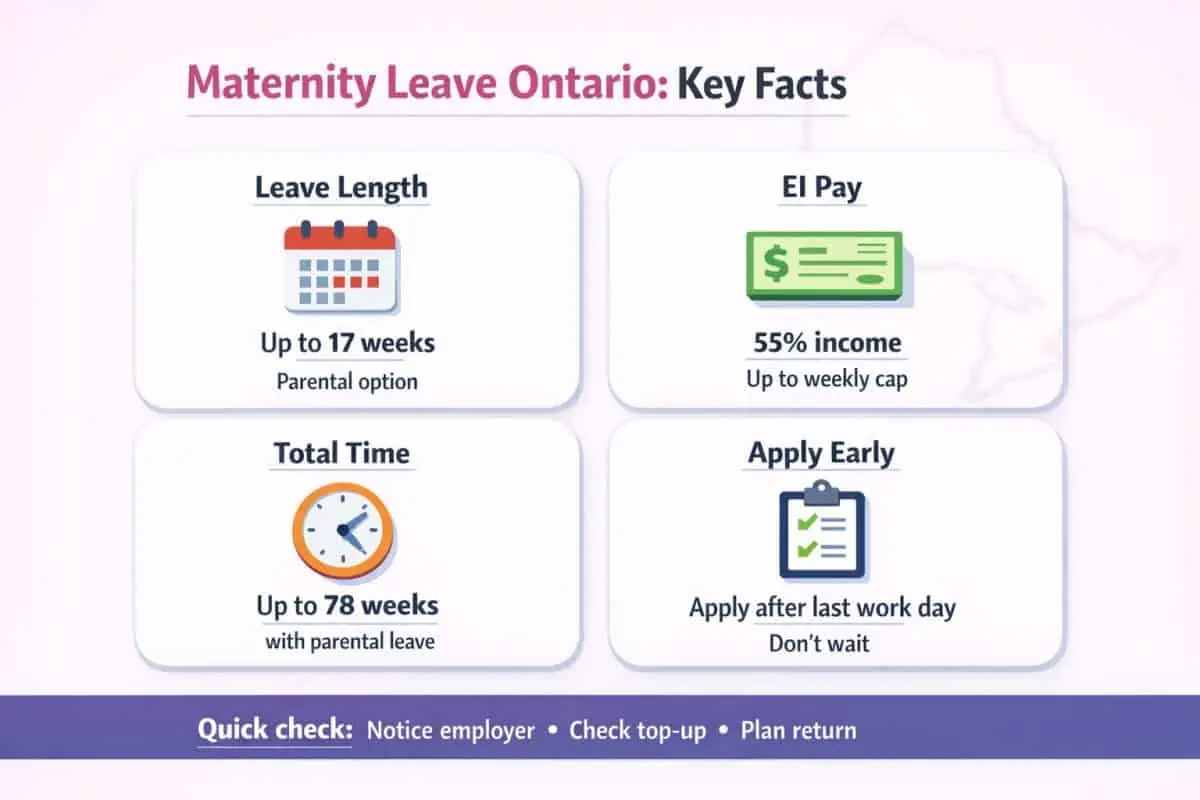
How long is maternity leave in Ontario
1) Maternity (pregnancy) leave — ESA
- Up to 17 weeks
- Usually starts up to 17 weeks before due date
- Tied to birth (early or late birth does not reduce your entitlement)
The “13 weeks” you often see online is outdated or simplified.
2) Parental leave — ESA
After maternity leave, you can take:
- Up to 61 weeks (if you took maternity leave)
Total job-protected time = up to 78 weeks
Read: To understand how income replacement works, this guide on EI benefits for students explains eligibility and payments clearly.
Who is eligible for Maternity Leave
ESA (job protection)
You qualify if:
- You are pregnant
- You are an employee covered by ESA
- You started your job at least ~13 weeks before due date
No minimum hours — but this service period matters.
EI (payments)
You qualify if:
- You worked 600 insured hours
- Your income drops by more than 40%
- You paid into EI
Read: Many new parents also qualify for extra support like the Ontario Trillium Benefit depending on income.
How much EI pays in 2026
Maternity benefits
- Up to 15 weeks
- 55% of average weekly earnings
- Max: $729/week (2026)
Parental benefits
| Option | Weeks | Pay | Max weekly |
|---|---|---|---|
| Standard | 35 | 55% | $729 |
| Extended | 61 | 33% | $437 |
Example
Let’s say:
- Salary: $60,000/year
- Weekly income: ~$1,154
Maternity (15 weeks)
- 55% → ~$635/week
- Total → ~$9,525
Parental (35 weeks standard)
- Same ~$635/week
- Total → ~$22,225
Combined EI ≈ $31,750
Important: Higher earners can receive up to $729/week cap.
You may also be eligible for child-related payments such as the Ontario child tax benefit.
When to apply
- Apply for EI as soon as you stop working
- Do not wait for ROE
Typical flow:
- Stop work
- Apply within a few days
- First payment: ~2–4 weeks
Notice to employer
- Give at least 2 weeks notice
- Written notice (email works)
Include:
- Start date
- Expected return (optional but helpful)
Read: If you’re new to the workforce, understanding work culture in Ontario can help you navigate leave discussions with employers.
Can your employer refuse maternity leave?
No.
If you qualify:
- Your job is protected
- You return to same or comparable role
- Benefits must continue
Employer top-up (often missed)
Some employers offer:
- 75%–95% salary for part of leave
- Additional paid weeks
Always check your HR policy before leave.
Common mistakes (quick fixes)
| Mistake | Quick fix |
|---|---|
| Waiting to apply for EI | Apply right after last work day |
| Choosing wrong EI option | Decide standard vs extended early |
| Ignoring top-up benefits | Check employer policy |
| Mixing maternity vs parental | Keep them separate |
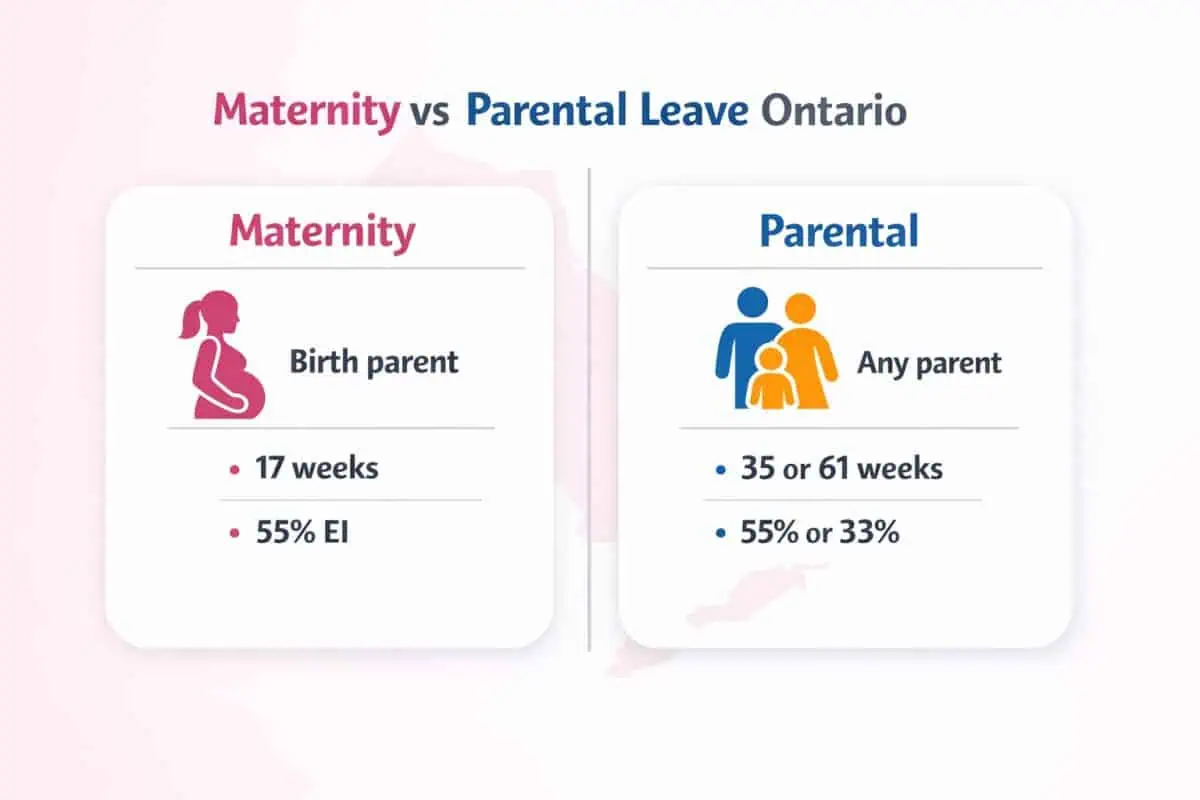
Maternity vs parental
| Feature | Maternity | Parental |
|---|---|---|
| Who | Birth parent | Any parent |
| Length | 17 weeks | 35 or 61 weeks |
| EI pay | 55% | 55% or 33% |
Checklist before your leave
- Confirm due date
- Check employer top-up
- Give notice (2 weeks)
- Apply for EI immediately
- Plan return timeline
FAQs
Can I start maternity leave early?
Yes. Up to about 17 weeks before due date.
Can I change EI type later?
No. Once payments start, your choice is locked.
Can both parents get EI?
Yes. Parental benefits can be shared.
Is EI taxable?
Yes. Tax is deducted.
