
Ontario doesn’t work like places where anyone can get “ordained online” and start signing marriage licences. A legal wedding here must be solemnized by someone authorized under Ontario’s Marriage Act. If the wrong person performs the legal part, it can create major paperwork problems later.
This guide lays out the real routes, what you need for each, and the common mistakes that can invalidate a marriage.
The quick answer
In Ontario, you can legally solemnize a marriage if you are authorized as one of the following:
- A registered marriage officiant (typically through a religious body, or through an Indigenous governing body route)
- A municipal clerk or clerk’s designate (civil ceremonies)
- A judge or justice of the peace (in their authorized role)
If your goal is “I want to officiate weddings as a side business,” the most common route is becoming a registered marriage officiant through an eligible organization that can request your registration.
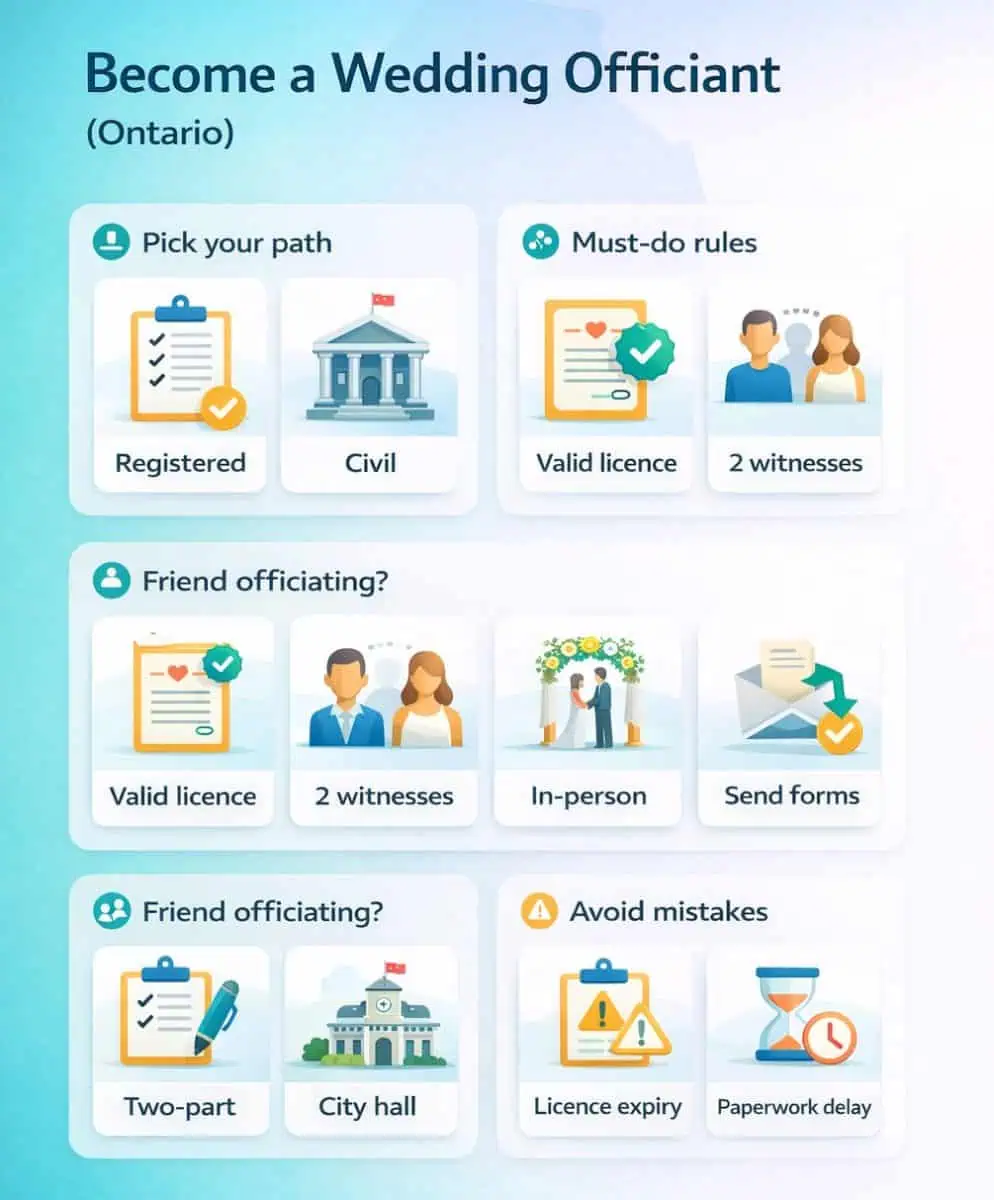
Pick your path
Path 1: Registered marriage officiant
Best for: People who want to officiate regularly.
Typical requirement: You’re recognized by a body that can support registration under the Marriage Act.
There are a few registration pathways in the Act. The two most relevant for most people are:
- Religious body pathway (being duly recognized by a religious body to perform marriages)
- Indigenous governing body pathway (being duly recognized by a band, First Nation, Métis or Inuit organization/community, or other permanently established Indigenous entity in Ontario, according to that community’s customs and traditions)
Important nuance: You don’t “self-apply” in most cases. The sponsoring body plays a central role in the registration process.
Path 2: Civil officiant (municipal clerk or clerk’s designate)
Best for: People working with a municipality or delivering city hall-style ceremonies.
Reality check: This is generally not an open “public licensing program.” Municipalities decide how they staff and deliver civil ceremonies.
Path 3: Judge / justice of the peace
Best for: Not a general public path. This is tied to the role itself.
How to become a registered wedding officiant in Ontario
Step 1: Confirm you’re aiming for the legal role
To be clear: writing a beautiful ceremony script is not the same as being allowed to sign legal marriage documents. Your job, legally, is paperwork-heavy.
Step 2: Choose a sponsoring body that can actually support registration
Before you pay any fees or training costs, get a straight answer to this:
- Are you able to support registration of marriage officiants in Ontario under the Marriage Act (and which pathway)?
- What are the requirements and timeline to be recognized and registered?
Trip-saver: Don’t assume that an organization’s website language equals Ontario authorization. You want confirmation that they can support registration in Ontario.
Step 3: Complete the body’s requirements (varies a lot)
Depending on the organization, you may need:
- training and assessments
- membership in good standing
- code of conduct and complaint process
- ongoing education or renewal steps
Timelines can be weeks to months, not same-day.
Step 4: Registration request is submitted through the body
Once the registration is approved, you’re authorized to solemnize marriages in Ontario as a registered officiant.
Step 5: Learn your legal responsibilities before you book your first couple
New officiants get burned by the same few rules. Learn these early.
Indigenous officiants in Ontario
Ontario’s Marriage Act includes a specific route for marriage officiants who are duly recognized by an Indigenous governing body. In plain terms, the Act allows the province to register marriage officiants who are recognized by a:
- band, First Nation, Métis or Inuit organization or community, or
- other permanently established Indigenous entity in Ontario
Recognition is based on the customs and traditions of the community or entity. This route is distinct from the “religious body” structure and does not require a church-style framework.
If your friend wants to officiate your wedding (the legal-safe way)
A very common Ontario mistake is trying to do this:
- Friend runs the ceremony
- Authorized officiant “signs after”
That can create serious legal problems because the people who must sign must be present at the legal ceremony.
What does work:
Option A: Two-part ceremony (most popular)
- Legal officiant completes a short legal ceremony and handles signing
- Friend leads the personal ceremony immediately after (or later)
Option B: City hall legal marriage + personal celebration ceremony
- Couple completes the legal marriage via municipal civil ceremony
- Friend leads the “wedding ceremony” as a celebration (no legal signing)
This keeps the wedding personal without risking the legal registration.
If they’re planning around a long weekend, check Ontario statutory holidays so vendors and travel don’t get overbooked.
What you must do correctly as an Ontario officiant
These are the non-negotiables that affect legality and registration.
Before the ceremony
- Confirm the couple has a valid Ontario marriage licence (or banns, where permitted)
- Confirm the names match the licence
- Confirm you have the correct forms for the ceremony type
During the ceremony
- The people who must sign must be physically present
- Two witnesses must be physically present
- You solemnize the marriage in a way that meets Ontario’s legal requirements
After the ceremony
- Complete the required documents accurately
- Send the Statement of Marriage to the Office of the Registrar General within the required timeframe (Ontario’s guide emphasizes this strongly)
- Give the couple their Record of Solemnization (this is not the same as the official marriage certificate)
Rules that surprise new officiants
In-person signing really matters
Guests can watch virtually, but the required signers must be physically present for the legal ceremony.
Licences expire
An Ontario marriage licence expires after a set period (commonly three months). If the wedding is postponed, this can force the couple to re-apply.
Paperwork delays become your problem
If paperwork is late or incorrect, couples can’t easily obtain proof of marriage later. That’s when officiants get panicked calls.
Mini scenario: “I want to officiate weddings this summer”
If you want to do this professionally:
- Start the registration path early
- Don’t take bookings until you’re sure you’re authorized and you understand the paperwork timeline
- Build a simple checklist you follow every single ceremony
If you only want to officiate one wedding as a friend:
- Use the two-part ceremony method and keep the legal signing clean
Before the ceremony, make sure the couple understands the steps for an Ontario marriage licence, including what to bring and how long it’s valid.
FAQs
Can I become a wedding officiant in Ontario online?
You can do training online, but Ontario authorization depends on being registered under the Marriage Act through an eligible pathway. “Online ordination” alone doesn’t guarantee legal authority in Ontario.
Is there a “marriage commissioner” licence in Ontario?
Ontario civil ceremonies are typically delivered through municipalities (clerks or their designates) rather than a province-wide, open public commissioner program.
How can a couple verify an officiant is legitimate?
Couples can verify a registered officiant through Ontario’s published list/dataset of registered marriage officiants, or they can ask the officiant for their registration details and affiliation.
What documents does the officiant handle?
The officiant completes and submits the Statement of Marriage and provides the couple with the Record of Solemnization. The official marriage certificate is requested later once the marriage is registered.

I’ve read through a few different online sites with advice on how to become a legal officiant in Ontario and they all say the same thing; it has to be done under the umbrella of a registered religious organization. That’s what I understand. Am I wrong? I am a member of the United Church of Canada, I don’t have a problem with Christianity, but I don’t want to go to seminary school for years, or become a member of a different church ie. Humanist or Unitarian.
I do want to obtain my license for part-time officiant work, it’s all part-time anyway, I don’t know any ministers who are conducting weddings every weekend. And I have a lead on a future event location that would offer full-service weddings, so that is the perfect location for me to become a permanent employee at.
Also, I had thought of the idea too, about suggesting couples get their legal marriage done at the municipal office before the official “big day” at the venue, like you mentioned in the article.
If you have anything to add, I’d love to hear it. Any leads on other avenues, etc.
Thanks for the thoughtful comment — and you’re basically right about Ontario.
Ontario doesn’t have a general “public licence” where you can self-apply (like online ordination). To legally solemnize a marriage and sign the Ontario marriage documents, you must be authorized under the Marriage Act — most commonly by being registered through a religious body (or an Indigenous governing body), or by being a municipal clerk/designate (civil ceremonies).
For the United Church, membership is great, but membership alone usually isn’t what triggers registration — it’s typically tied to specific ministry/recognized roles and the Regional Council is the office that can give a real yes/no for your situation. In Toronto, that’s Shining Waters Regional Council.
However, there is another avenue you asked about: Since you want to work legally as a venue officiant but avoid seminary, look into Clergy Support Memorial Church or Celebrating Life Ministries. These are recognized religious bodies in Ontario that ordain and license individuals who are serious about officiating but don’t fit the traditional ‘minister’ mold. Many ‘professional’ officiants in Ontario are licensed through them.
Otherwise, your workaround idea is exactly what many couples do: legal ceremony at city hall (or a quick legal ceremony with a registered officiant), then you lead the full “big day” ceremony as a celebrant. If you want civil options in Toronto, the City Clerk’s marriage services line is 416-392-7036.
Question?
If I become wedding officiant in Ontario I can only perform my duties to do “civil marriage” in Ontario and cannot do it outside Ontario say in USA? The couple are from Ontario.
Please advise.
Thank you,
Sixto