
People still search “how to become a fireman,” but most Ontario departments use firefighter. In Ontario, there isn’t one single “firefighter licence” you get and you’re hired. Hiring is done by municipal fire services, and they decide the requirements, testing, and interview process.
If you want the shortest, most reliable path, build your plan around three things:
- The certifications most Ontario departments expect
- The testing steps you’ll have to pass
- The “assets” that make you competitive in the GTA
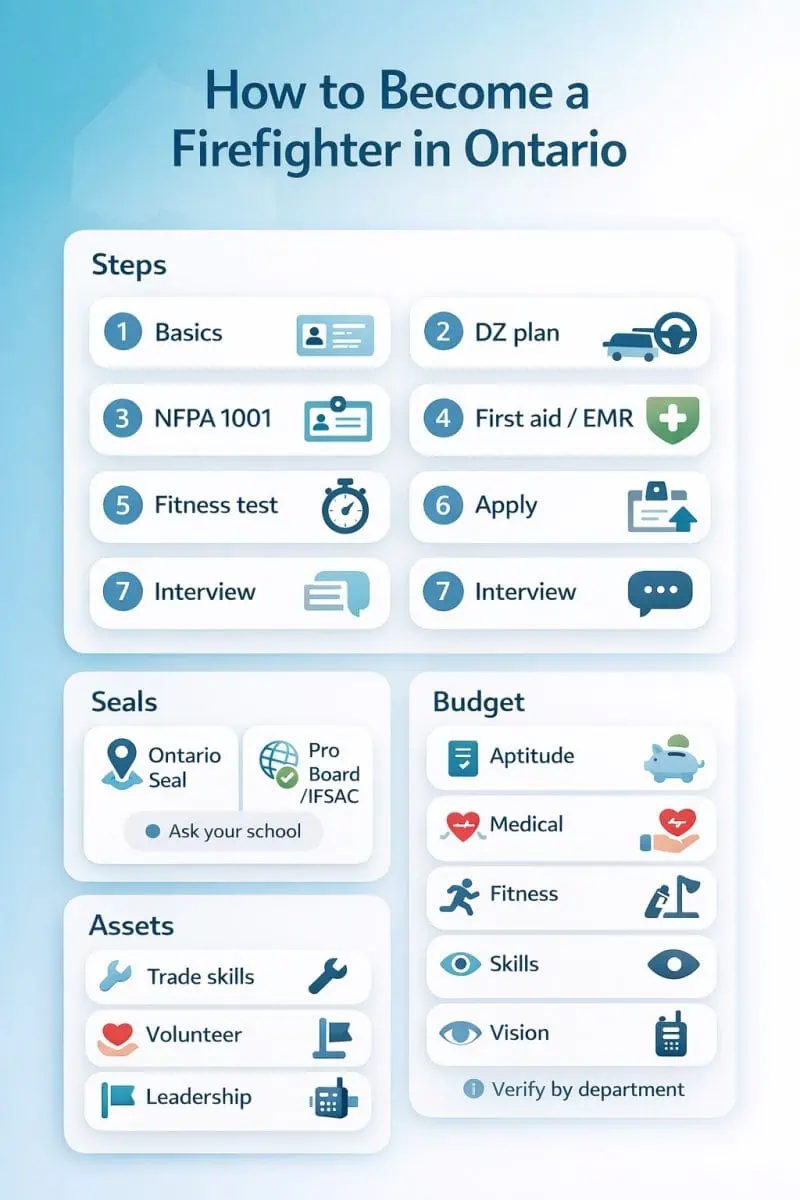
The 7-step path most applicants should follow
- Meet basic eligibility (18+, high school, legal to work, clean background).
- Get your driver’s licence plan right (often DZ, but timing varies).
- Earn NFPA 1001 Firefighter I & II (this is the big one).
- Add medical/first aid (in some places, EMR is now required).
- Complete recognized firefighter testing (aptitude + fitness + medical).
- Apply only when postings are open (and submit every document on time).
- Interview + clearances (medical, background, references) → recruit training → probation.
Before you apply, make sure you know which police record check in Ontario your target department accepts (and how long it stays valid).
Step 1: Understand the common minimum requirements in Ontario
Exact rules differ by department, but these show up repeatedly:
- Age: usually 18+
- Education: Ontario Secondary School Diploma (or equivalent)
- Work status: legally entitled to work in Canada
- Driver’s licence: often Class D with Z endorsement (DZ), sometimes required at application
- Firefighting certification: commonly NFPA 1001 Firefighter I & II
- Hazmat: commonly Awareness/Operations level
- Testing: aptitude, medical fitness, hearing/vision, and a job-related physical test
- Background checks: criminal record screening (sometimes more, depending on employer)
A practical rule: don’t collect random certificates. Pick 5–10 target departments and match their checklist exactly.
Step 2: Get clear on “Ontario Seal” vs IFSAC/Pro Board (this trips people up)
Applicants often see different “stamps” on certificates and aren’t sure what matters.
Here’s the plain-English version:
- Ontario Seal is a provincial pathway tied to Ontario’s training and testing system. You’ll sometimes see it described with “Interior” or “Exterior” scopes, depending on the role.
- IFSAC / Pro Board seals are international accreditation seals that often appear on NFPA certificates (like NFPA 1001). Some departments explicitly want proof that your NFPA training includes IFSAC or Pro Board seals.
- What to do before you pay tuition: Ask the school one direct question:
“Will I graduate with NFPA 1001 Firefighter I & II with IFSAC/Pro Board seals, or only an Ontario Seal pathway?”
If you might apply outside Ontario someday, the international seals can matter even more.
Step 3: Certifications that actually move your application forward
NFPA 1001 Firefighter I & II
This is the most common “must-have” for Ontario career applications. Many candidates take a pre-service program or an accredited training route to earn it.
Medical/first aid (and the EMR reality)
Some large services now require Emergency Medical Responder (EMR), while others accept Standard First Aid + CPR at specific levels. This is one of the biggest “department-to-department” differences, so verify early.
Hazmat (Awareness/Operations)
Often listed as required or expected, especially when departments align to modern certification standards.
Driver training
Even if a department allows a G licence at first, you’ll often be expected to upgrade quickly.
Step 4: Driver’s licence nuance (don’t assume)
You’ll hear “DZ is mandatory in Ontario.” It’s often true, but the timing can differ:
- Some departments require DZ at the time you apply.
- Some accept G initially and expect you to obtain DZ shortly after hire (a set number of months is sometimes stated).
Your plan should be: treat DZ as a near-term goal, then confirm whether it must be in-hand before you submit an application.
Step 5: Understand the testing pipeline (and budget for it)
Most Ontario applicants face a similar testing bundle:
- Aptitude and character-style testing
- Hearing and vision
- Medical fitness testing (often treadmill-based)
- Job-related physical testing (firefighter physical ability test)
- Interview
- Background and medical clearance
Realistic testing cost example (ballpark)
A common Ontario testing set (fees can change) looks like this:
- Aptitude/character: $75
- Hearing: $50
- Encapsulated treadmill: $110
- Physical ability test (FPAT): $212
- Technical skills assessment: $270
Subtotal: $717
With 13% HST: $810.21
Plus: Vision assessment (set by your optometrist)
Important: some departments also add their own admin or assessment costs. The exact combination depends on where you apply.
Step 6: The “point system” reality (minimums aren’t enough in the GTA)
In competitive areas (especially the GTA), meeting the minimums often only makes you eligible, not interviewed. Many big services screen applicants using structured scoring or ranking.
Think of “assets” as hidden requirements. Examples that can move you up:
- Trade background (mechanic, electrician, millwright, etc.)
- Strong emergency services experience (EMS, military, lifeguarding, security with real responsibility)
- Consistent volunteering with leadership (not one-off events)
- Clear teamwork and coaching history
- Language skills (if relevant to the community)
- Strong local familiarity (some places value community connection)
You don’t need all of these. You do need a plan to stand out beyond the minimum checklist.
If you’re taking a pre-service program, check whether OSAP eligibility and deadlines could help cover tuition and testing fees
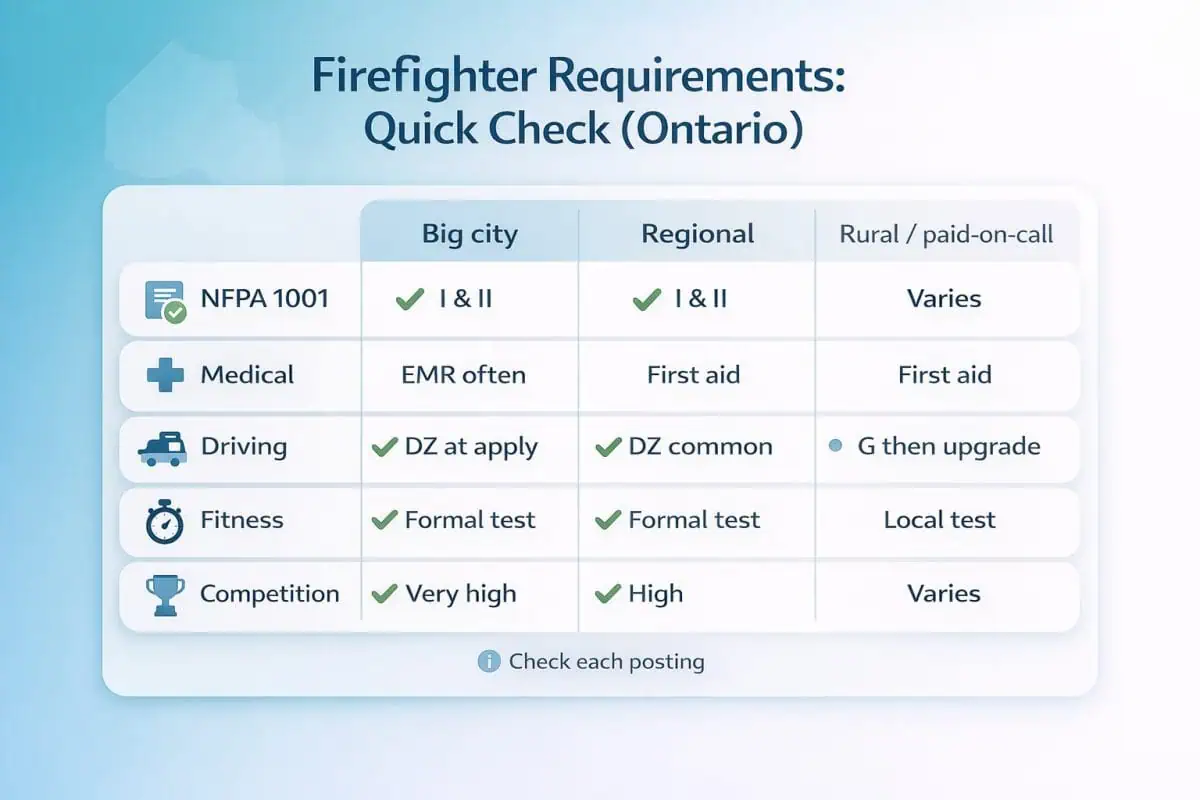
Quick check: Are you ready to apply in your target region?
This table is a fast way to see what “ready” looks like. Always verify the exact posting.
| Requirement | Toronto-style career service | Peel-area career services (example) | Rural / volunteer or paid-on-call (typical) |
|---|---|---|---|
| NFPA 1001 I & II | Commonly required; often expects strong proof of certification quality | Commonly required; may ask for international seals | Moving toward province-wide standards; training expectations rising |
| Medical | EMR may be required in some large services | Often accepts Standard First Aid/CPR (EMR can still be an asset) | Often Standard First Aid/CPR; EMR can help |
| Driving | DZ often required at application | DZ commonly required | Sometimes G to start, with upgrade expectations later |
| Fitness testing | Formal physical ability testing | Formal testing plus department assessments | Local testing varies (can still be demanding) |
| Competition level | Very high | High | Varies; availability and commitment matter a lot |
If you’re returning to school after working, start with mature student grants in Ontario before you pay out of pocket.
A beginner-friendly “certification ladder”
If you’re new to this, use this mental model:
- Eligibility: age, education, work status, clean record
- Driving plan: DZ timing confirmed for your target departments
- Core firefighting: NFPA 1001 Firefighter I → Firefighter II
- Hazmat: awareness/operations level
- Medical: Standard First Aid/CPR or EMR (depends on department)
- Testing readiness: fitness, medical testing, interview prep
- Competitive assets: trade skills, leadership, service history
How long does it take?
Most people land in one of these timelines:
- Fast track (already fit, already DZ, quick access to training): 6–12 months to build a solid application package
- Typical: 12–24 months (training + testing + applying to multiple postings)
- Longer: if you’re working full-time and stacking requirements gradually
Hiring is also posting-dependent. Many departments only accept applications when recruitment opens.
Firefighter salary in Ontario (what to expect in 2026)
Salary depends heavily on:
- the department and collective agreement
- whether you’re full-time or paid-on-call
- overtime and premiums (which can change total earnings a lot)
A safe way to think about it:
- Probationary pay is noticeably lower than full rate.
- First-class base pay in larger Ontario services is often in the $110,000–$125,000 range by the mid-2020s.
- Smaller or rural full-time services can be lower (often roughly $80,000–$100,000 for some grids), and paid-on-call is typically hourly + call-outs, not a single annual salary.
Best practice: use the salary grid in the posting or the collective agreement as your “source of truth,” and treat overtime as a bonus, not a guarantee.
Mini case: A smart plan if you’re applying to Toronto, Mississauga, and a smaller town
If your goal is “apply everywhere,” your checklist usually becomes:
- NFPA 1001 Firefighter I & II (ideally with the seals your target cities want)
- Hazmat awareness/operations
- A medical credential that satisfies the strictest department you want (often EMR if you’re aiming big-city)
- DZ licence in-hand if your top target needs it at application
- Fitness prep for the most demanding physical test you’ll face
- A resume built around assets (trade skills, leadership, long-term volunteering)
That approach costs more upfront, but it prevents you from redoing training or being blocked by a single requirement.
Copy-and-paste checklist
- Pick 5–10 target departments
- Write their requirements into one checklist
- Plan your DZ timing (required at application or post-hire)
- Confirm your training will give the certification “seals” your targets recognize
- Budget for testing (often hundreds, sometimes over $1,000 with add-ons)
- Build 2–3 real “assets” (trade skill, long-term volunteering, leadership role)
- Apply only when postings open, and submit every document before the deadline
If you’re still deciding between paths, compare firefighting with other high-demand Ontario careers that also value fitness, teamwork, and emergency response.
FAQs
Do I need college to become a firefighter in Ontario?
Not always, but many candidates choose pre-service training because NFPA 1001 and structured testing prep are common expectations.
Can I become a firefighter at 18 in Ontario?
Often yes, but you still need the required certifications, tests, and documents by the application deadline.
Is DZ always required?
DZ is very common, but some departments allow a G licence at application with an upgrade requirement after hire. Verify per posting.
Is EMR required everywhere?
No. Some larger services require EMR; others accept Standard First Aid/CPR levels. Always check the department you’re targeting.
