
Becoming a travel agent in Ontario is not just about booking trips or posting vacation deals online. If you sell travel services to the public, Ontario has rules around certification, registration, advertising, invoices, and how customer money is handled.
The most important point is simple: passing TICO certification does not let you sell travel on your own.
To legally sell or advise on travel in Ontario, you usually need to work through a TICO-registered travel agency, booking website, or tour operator. The other option is to register your own travel business with TICO.
Read: Regulated career paths in Ontario
For most beginners, the easiest path is to start as an employee or outside sales representative with a registered agency. Opening your own agency gives you more control, but it also brings higher costs and more compliance work.

How to become a travel agent in Ontario?
To become a travel agent in Ontario, you normally need to:
- Complete the TICO Certification Program.
- Sell travel through a TICO-registered agency, host agency, booking website, or tour operator.
- Follow Ontario rules for disclosure, invoices, advertising, and customer payments.
- Register your own business with TICO only if you want to operate your own travel agency.
TICO certification proves you understand Ontario travel rules. It is not the same thing as registering your own travel agency.
The three main paths
| Path | Best for | Do you need your own TICO registration? | Main cost |
|---|---|---|---|
| Employee at a TICO-registered agency | Beginners who want structure | No | TICO Certification Program |
| Outside Sales Representative with a host agency | Home-based or part-time sellers | No, if selling under the host | Certification plus host fees |
| Your own TICO-registered agency | Business owners ready for full compliance | Yes | Application fee, security deposit, accounting, bank setup |
The right choice depends on how much control, cost, and responsibility you want.
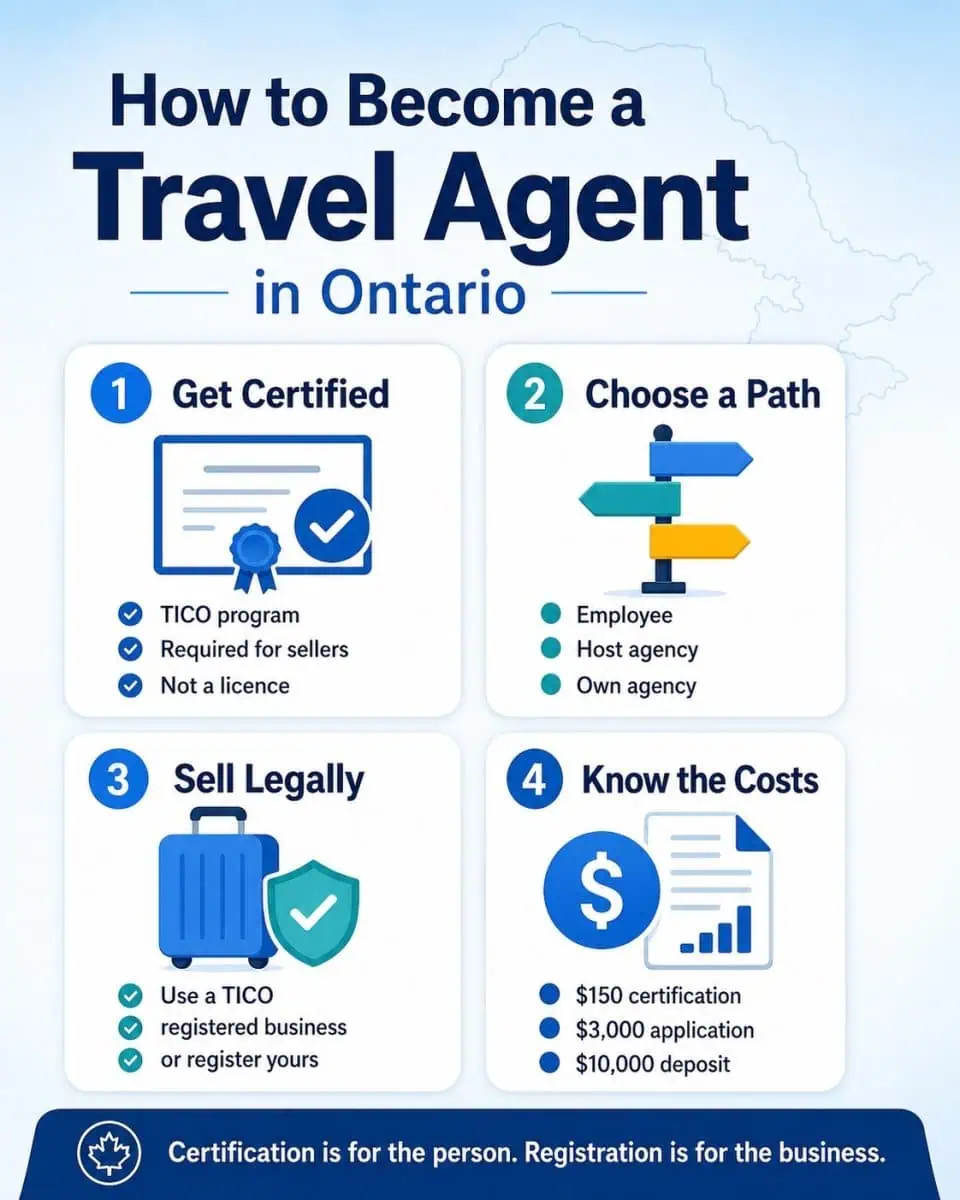
What TICO certification does and does not do
TICO certification is required for travel professionals who sell travel services or give travel advice to consumers in Ontario.
It shows that you understand Ontario’s travel consumer protection rules. That includes things like disclosure, invoices, advertising, and how consumer money is protected.
But certification does not make you a registered travel agency.
That is where many new sellers get confused. You can pass the TICO program and still be unable to sell independently. You must sell on behalf of a TICO-registered business unless you register your own agency with TICO.
Think of it this way:
TICO certification applies to the person.
TICO registration applies to the business.
You usually need both in the system, but they are not the same thing.
Path 1: Work as an employee
This is the simplest path for most beginners.
You complete TICO certification, then work for a TICO-registered travel retailer, wholesaler, agency, or booking website. The employer already has the registration, trust account, business records, and financial reporting structure.
This route works well if you are new to the industry because you can learn inside a real travel business before taking on your own compliance risk.
As an employee, you may help clients compare packages, book flights, arrange cruises, or explain cancellation rules. The agency handles the larger business requirements in the background.
You still need to follow the rules. You cannot make misleading claims, skip required disclosures, or collect customer money in a personal account. But the registered agency is the business behind the sale.
This path is best if you want training, supplier access, and a lower-risk start.
Path 2: Work with a host agency as an OSR
Many people search for “home-based travel agent Ontario” because they want flexible work.
In Ontario, that usually means working as an Outside Sales Representative, often called an OSR, under a host agency.
An OSR may work from home and may be paid as a contractor. But the travel sales still go through the host agency’s TICO registration.
That means the host agency’s name, TICO registration, payment process, and records matter. Customer money should flow through the host agency’s proper account system, not through your personal bank account.
This path can be a good middle ground.
You get more flexibility than a regular employee. You may also be able to build your own client base or niche, such as destination weddings, cruises, family trips, or group travel.
But you still need to follow the host’s rules. Your advertising, social media pages, website, invoices, and payment process must match TICO requirements.
Before joining a host agency, ask:
- Is the host agency registered with TICO?
- What name can I advertise under?
- Who issues invoices and receipts?
- How do customer payments work?
- What commission split or monthly fee applies?
- What training and booking tools are included?
A host agency can lower your startup cost, but it does not remove regulation.
Path 3: Register your own TICO travel agency
Opening your own TICO-registered agency is the most serious path.
You are no longer just selling under someone else’s business. You become responsible for the business structure, application, trust accounting, financial statements, records, advertising, renewals, and compliance.
TICO’s registration requirements include a non-refundable application processing fee, a security deposit, business information, a sample consumer invoice, and other supporting documents.
A new head office application fee is listed at $3,000. A branch office fee is listed at $800. TICO also lists a $10,000 security deposit for head office registration applications, unless an exception applies.
TICO says its target processing time is 30 days or sooner for a completed application with no missing information or concerns. In real life, you should still give yourself extra time.
Bank accounts, business registration, merchant setup, document collection, and follow-up questions can add weeks.
This path makes sense if you want your own brand, your own systems, and full control over your business. It is not the best first step for everyone.
If you have never worked in travel before, starting with an employer or host agency may be safer.
Current TICO Certification Program
TICO’s updated Certification Program launched on January 5, 2026.
New candidates now complete one comprehensive program and exam. The old separate Travel Counsellor and Supervisor/Manager exams have been replaced for new sign-ups.
The current program includes:
| Item | Current detail |
|---|---|
| Program type | Interactive online learning |
| Exam format | One comprehensive exam |
| Questions | 80 |
| Time limit | 150 minutes |
| Fee | $150 |
| Rewrite fee | $50 |
People who were already certified before the change do not need to rewrite the exam. TICO says certification does not expire.
The old $35 and $50 exam fees only matter for people who signed up before the transition deadline. New readers should plan around the current $150 program.
Cost comparison
Here is the practical cost difference between the three paths.
| Cost item | Employee | OSR with host agency | Own TICO agency |
|---|---|---|---|
| TICO Certification Program | Yes | Yes | Yes |
| Host agency fee | No | Often yes | No |
| TICO head office application fee | No | No | Yes |
| Security deposit | No | No | Usually yes |
| Trust account setup | No | Host handles it | Yes |
| Accounting and financial statements | No | Host handles it | Yes |
| Website and marketing | Usually low | Medium | Higher |
The cheapest legal route is usually employment.
The most flexible route is often the host agency model.
The most expensive route is opening your own TICO-registered agency.
Home-based travel agent rules in Ontario
A home-based travel business can be legal in Ontario, but it still has to follow TICO rules.
If you are an OSR, you are not operating your own independent travel agency. You are selling through the host agency.
If you open your own home-based agency, your business may still need TICO registration. You may also need to check local rules for operating a business from a residential address.
Do not assume that working from home means you can skip registration.
A home office, Instagram page, Facebook page, or website can still count as part of a travel business if you are advertising or selling travel services.
Before launching anything publicly, make sure your TICO structure is clear.
Common mistakes to avoid
Thinking the TICO exam is a licence
People often say “travel agent licence,” but Ontario’s system is more specific.
The person gets certified. The business gets registered.
You need to know which one applies to you.
Taking customer payments personally
This is a serious mistake.
If you are working under a host agency, customer money should be handled through the host agency’s approved process. Do not collect payments into your personal account and sort it out later.
Advertising under an unapproved business name
Your social media page, website, business card, and email signature should match the structure you are allowed to use.
Do not create a separate travel brand and start advertising before confirming how it connects to the TICO-registered agency.
Opening your own agency too early
Starting your own agency sounds attractive because you control the brand and keep more of the margin.
But you also take on the paperwork, accounting, deposits, customer money rules, and inspections.
If you are new, get industry experience first.
Forgetting disclosure rules
Before taking payment, customers need clear information about price, dates, services, cancellation terms, travel documents, insurance availability, and other important details.
A rushed invoice or vague social media deal can create problems.
How to become a travel agent Step-by-step checklist
If you want the lowest-risk start
- Complete the TICO Certification Program.
- Apply to TICO-registered agencies.
- Confirm the agency is registered and in good standing.
- Learn the agency’s booking, invoice, and payment process.
- Start selling only through the agency’s approved system.
If you want to work from home
- Complete TICO certification.
- Research host agencies that are TICO registered.
- Ask how OSR payments, advertising, and invoices are handled.
- Review the commission split and monthly fees.
- Use only approved business names, websites, and payment channels.
If you want your own agency
- Choose your business structure and name.
- Review TICO registration requirements.
- Prepare the application, sample invoice, business information, and financial documents.
- Set up required business banking.
- Prepare the application fee and security deposit.
- Submit the application.
- Wait for approval before publicly selling travel.
Which path should you choose?
Choose the employee path if you want the simplest start.
Choose the OSR or host agency path if you want flexibility and lower startup cost.
Choose your own TICO agency only if you are ready to operate a regulated business, not just sell trips.
A good rule: if you are still learning how travel suppliers, invoices, commissions, and cancellations work, start under someone else’s registration first.
FAQs
Do I need TICO certification to become a travel agent in Ontario?
Yes, if you sell travel services or give travel advice to consumers in Ontario, TICO certification is part of the requirement.
Can I sell travel after passing the TICO exam?
Not by yourself. Passing TICO certification lets you sell through a TICO-registered business. To sell independently, your business must be registered with TICO.
Can I be a home-based travel agent in Ontario?
Yes, but you still need the right TICO structure. Many home-based agents work as OSRs through a host agency. If you operate your own agency from home, registration rules can still apply.
How much does TICO certification cost now?
For new candidates, the TICO Certification Program fee is $150. The rewrite fee is $50.
How much does it cost to register your own travel agency with TICO?
TICO lists a $3,000 head office application processing fee, $800 for a branch office, and a $10,000 security deposit for head office applications unless an exception applies.
Does TICO certification expire?
TICO says certification does not expire, and certified travel professionals do not need to rewrite the exam only because the program changed.
Last reviewed: April 30, 2026
