

Most Canadians don’t actually want “gold.” They want one of three things: a simple diversifier, a 24/7 tradeable position, or a piece of metal they can hold without an app. Those are different jobs—and they point to different products.
If you asked me for a default pick for a regular TFSA/RRSP investor, I’d start with a physically backed gold ETF. The other two can be great, but they’re “for a reason.”
If you’re specifically looking at the app option, see how Wealthsimple’s gold fees and redemption work before you buy.
Quick answer:
For most Canadians, a physical gold ETF is the cleanest way to add gold (especially in a TFSA/RRSP). Wealthsimple Gold is a convenience play: fractional buys, 24/7 trading, and optional coin redemption from non-registered accounts. Bullion makes sense when self-custody is the whole point—but spreads and storage risk are the price.
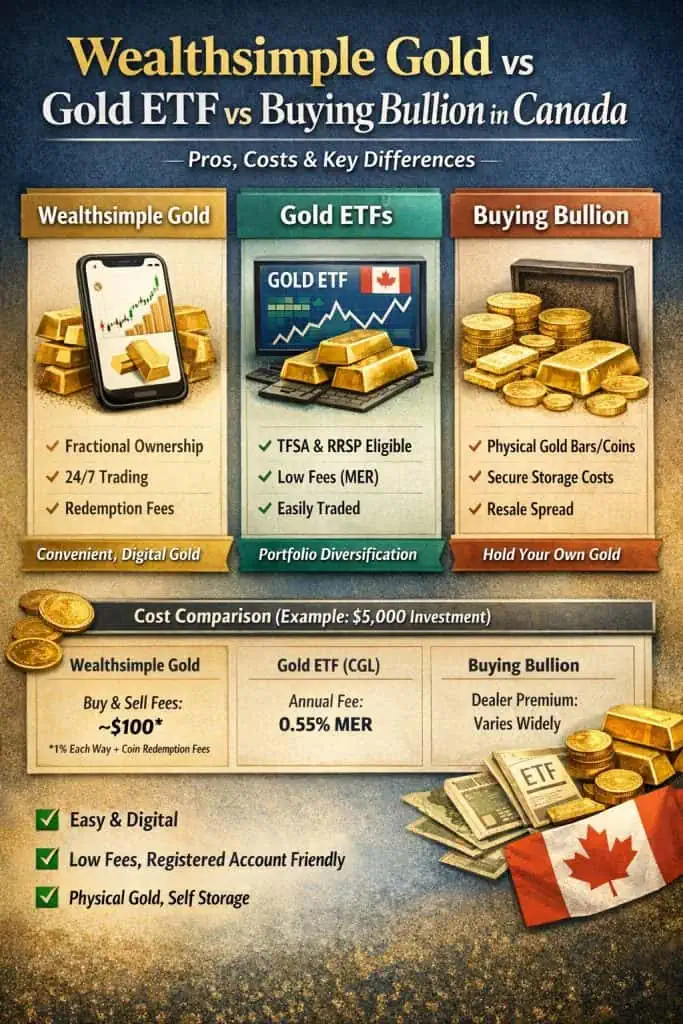
The fast comparison: Wealthsimple Gold vs gold ETF vs bullion
| Option | What you’re really buying | Where it shines | The cost you’ll feel first |
|---|---|---|---|
| Gold ETF (physical bullion) | ETF units backed by bullion held by the fund | Simple, registered-account friendly | MER + bid/ask spread during market hours |
| Wealthsimple Gold | Fractional ownership of physical bullion held with custodians | 24/7 access + tiny buys | Trading fee/spread; coin redemption is extra |
| Bullion (coins/bars) | Coins/bars you control | Offline/self-custody | Dealer premium + resale spread + storage |
Start with one question
Do you want gold to be:
- a line item in your portfolio (rebalance, forget about it), or
- something you can physically store?
If it’s the first one, you’re already leaning ETF. If it’s the second, you’re deciding between Wealthsimple redemption vs buying bullion outright.
Why the ETF is the “boring but correct” choice for many people
A physical gold ETF is boring in the best way: it behaves like an investment product. You can buy it in a TFSA/RRSP, sell it when markets are open, and you don’t have to think about shipping, insurance, or whether a bar looks… suspicious.
Two quick checks before buying:
- Hedged vs unhedged: hedged funds try to reduce CAD/USD currency swings; unhedged funds will move with both gold and the currency.
- Fees: you’ll see an MER. Example: BlackRock lists CGL with a 0.50% management fee and 0.55% MER on its fund page.
If your goal is “5% gold as a diversifier,” this is the cleanest route for most portfolios.
Where Wealthsimple Gold fits (and where it doesn’t)
Wealthsimple’s gold product is built for people who like the app experience: fractional buys, real-time pricing, and 24/7 trading.
What the official pages make very clear:
- Trading fee: Wealthsimple lists 1% on top of spot price (and notes it can change).
- Storage: Wealthsimple says $0 storage fees, with storage facilities including the Royal Canadian Mint and Brink’s.
- Coin redemption: only from non-registered accounts.
- Redemption fees: 2.25% for 1 oz and 11% for 1/10 oz (this is the big “surprise cost” for people who dream of redeeming small coins).
- Protection detail many miss: Wealthsimple says precious metals held in the account are covered under CIPF, but once you redeem for coins, that coverage no longer applies and you’ll need your own insurance.
My take: Wealthsimple Gold is strongest when you plan to hold digitally (and maybe trade). If you’re already planning to redeem small coins, price that out first—11% is not a rounding error.
Bullion: the spreads are the fee (and they’re not small)
Buying coins/bars is simple to understand and annoying to execute well.
Here’s what makes people regret it:
- Small sizes cost more per dollar: tiny coins tend to have bigger premiums and worse resale spreads.
- Selling is not “tap and done”: you’re calling a dealer, comparing buyback prices, and possibly shipping/insuring.
- Storage is a real project: safe, deposit box, insurance—pick your risk.
Bullion is still the right move when the point is self-custody (not convenience). Just treat dealer spreads like a fee you pay twice: once when you buy, again when you sell.
A simple cost reality check (worked example)
Say you put $5,000 into gold and sell later. Ignore gold’s price movement for a second and look only at friction:
- Wealthsimple Gold: 1% to buy + 1% to sell is about $100 on $5,000 (before any spread). If you redeem coins, add redemption fees: 2.25% (1 oz) or 11% (1/10 oz).
- Gold ETF: you’ll pay MER yearly. Example: CGL MER 0.55% listed by BlackRock.
- Bullion: premiums/spreads vary by dealer and product; your “fee” shows up as a worse buy price and a worse sell price.
That’s why ETFs win for “portfolio gold.” Bullion wins for “I want it in my hands.” Wealthsimple sits in the middle.
Taxes
- TFSA/RRSP: you’re using the account structure for tax advantages.
- Non-registered: gains are generally treated as capital gains, and CRA’s guidance explains how taxable capital gains are calculated and reported.
(If you’re investing as a teen, do it through a parent/guardian account setup and keep records—tax reporting follows the account holder.)
FAQ
Can I trade Wealthsimple Gold in a TFSA/RRSP?
Wealthsimple says you can trade gold in registered and non-registered self-directed accounts, but coin redemption is non-registered only.
Does Wealthsimple charge storage fees?
Wealthsimple states $0 storage fees and describes Canadian storage partners.
What are the coin redemption fees?
Wealthsimple lists 2.25% (1 oz) and 11% (1/10 oz).
What does CGL cost?
BlackRock lists 0.50% management fee and 0.55% MER for CGL on its fund page.
