

A lot of people say “Ontario” but mean “Toronto.” That’s the first mistake—and also the first reason Ontario works for so many students. Ontario is a whole menu: big-city campuses, quieter student towns, applied college programs, research-heavy degrees, and co-op ecosystems that can turn a resume from “new grad” to “already did the job once.”
Before the list, two quick reality checks:
- Ontario can be expensive in the GTA. If you’re budget-sensitive, the city you choose matters as much as the school.
- If you’re an international student planning for a PGWP, you must treat eligibility like a checklist item, not a vibe. (More on the CIP-code pro-tip below.)

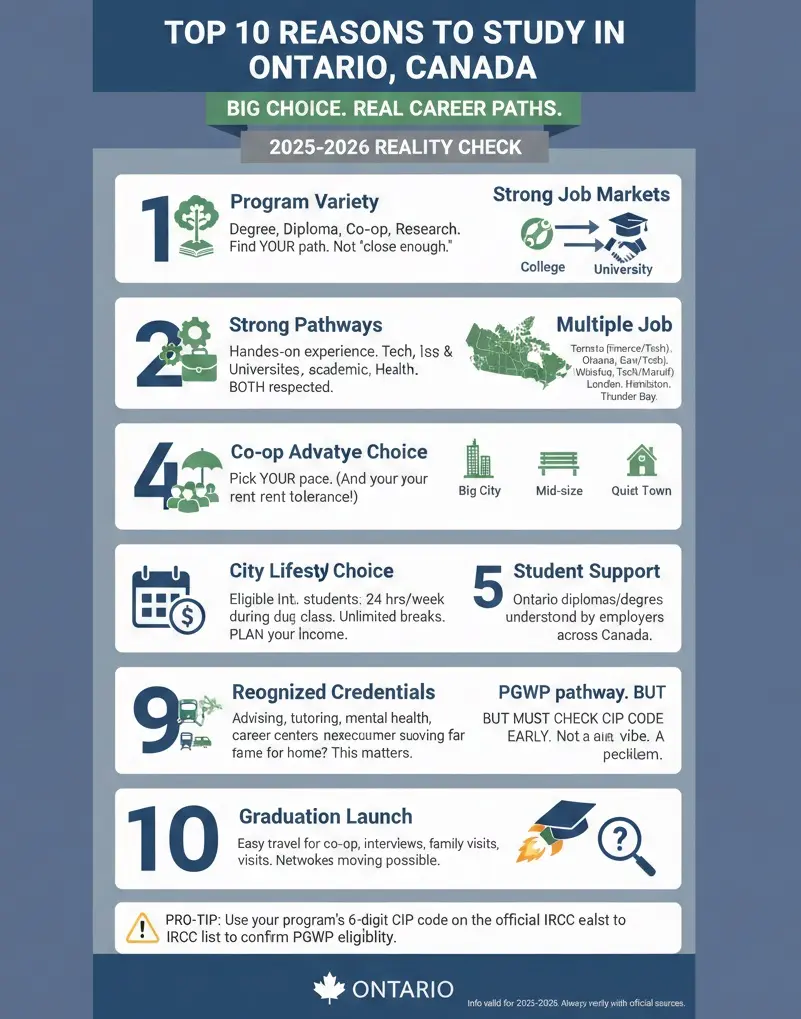
The top 10 reasons to study in Ontario
1) Ontario gives you program choice without boxing you in
If you’re still deciding between paths—degree vs diploma, co-op vs no co-op, hands-on vs research—Ontario’s size helps. You’re more likely to find the exact program you want instead of “close enough.”
2) Colleges and universities both have strong, employer-friendly lanes
Ontario colleges often lean practical (labs, placements, industry certs). Universities often lean academic and research. Neither is “better.” The win is that Ontario supports both styles, so you can match the credential to your goal.
3) Co-op and work-integrated learning can speed up your first real job
Ontario has a deep culture of co-op and placements in many fields. Even when programs don’t call it “co-op,” you’ll often see internships, practicums, clinicals, and capstone projects that employers recognize.
Small, underrated benefit: your first job hunt feels less scary when you’ve already had one structured work term.
4) You’re studying inside multiple job markets, not just one
Ontario isn’t a single “career city.”
- Toronto: finance, media, retail HQs, startups
- Ottawa: government, tech, policy-adjacent work
- Waterloo region: tech + advanced manufacturing
- Other strong centres: Hamilton, London, Windsor, Kingston, Thunder Bay (each has its own industry mix)
So you can study in one place and still aim for work terms in another.
5) You can pick a city that fits your personality (and your rent tolerance)
Some students do best in a fast, crowded city. Others do better where they can walk to class and still find quiet. Ontario gives you options: big-city pace, mid-size balance, or smaller communities where “commute” means 12 minutes, not 70.
Here’s the honest part: your day-to-day life affects your grades more than people admit.
6) If you’re eligible to work off campus, the hour limit is clear
Canada’s rule for eligible international students is up to 24 hours per week off campus while classes are in session, and you can work unlimited hours during scheduled breaks (winter break, summer, reading week) if you meet the conditions.
That clarity helps you plan. It also helps you avoid the “I’ll just work more and figure it out” trap.
7) There are supports that matter when you’re new (not just “nice to have”)
Most Ontario campuses have built-out support systems because they serve a wide range of students: advising, tutoring, accessibility services, mental health supports, career centres, newcomer supports, and student clubs that actually meet. If you’re moving away from home for the first time, that structure is worth real money and stress savings.
Read: Best Free Digital Skills for Ontario Students
8) Ontario credentials travel well across Canada
If you end up relocating later, Ontario credentials tend to be widely understood by employers—partly because Ontario is so big, and partly because hiring managers across Canada have hired Ontario grads before.
9) Travel and connectivity make life easier than you’d expect
Flights, trains/buses, and major highways matter more than you think—especially when you’re doing interviews, co-op terms, conferences, or quick family trips. Ontario’s network makes switching cities for opportunity feel possible (not heroic).
10) Ontario can be a strong “after graduation” launch point—if you verify the details early
Ontario is popular because graduates often plan for Canadian work experience after school. The catch: PGWP eligibility can depend on your program, and for some students a field-of-study requirement applies.
The small pro-tip that saves headaches: use your program’s 6-digit CIP code to check eligibility on the official list. IRCC uses 6-digit CIP codes for the field-of-study requirement, and the “currently eligible CIP codes” list is updated over time. Don’t rely on screenshots from random forums. Use the code.
Read: Ontario international student cap
A simple habit that works:
- Find your program’s 6-digit CIP code (schools often display it, or can tell you).
- Check that code on IRCC’s “currently eligible” CIP list.
- Save the date you checked. Rules can update.
Two student snapshots
These are composites based on common decisions students face—use them like mini-scenarios, not as “proof.”
Snapshot A: “I thought Toronto was my only option.”
A student chooses a program in a mid-size Ontario city, keeps living costs manageable, and targets a summer work term in a larger market once they’ve built a basic Canadian resume.
Snapshot B: “I picked the program first, then checked PGWP.”
A student loves a program, then pauses to verify the CIP code against the official list before paying a deposit—because changing programs later can cost time and money.
Read: Free PSW program Ontario
A practical money example (quick and real-world)
Ontario’s general minimum wage became $17.60/hour (effective Oct 1, 2025).
If you’re eligible to work 24 hours/week during classes:
24 hours/week × $17.60 = $422.40/week
$422.40 × 4.33 weeks/month ≈ $1,829/month gross
Not a tuition plan—but it can meaningfully cover day-to-day costs for many students. (Your take-home pay will be lower after deductions.)
Read: Reserve fund study Ontario
Where Ontario can be tough (and how to plan for it)
- Housing pressure in popular areas: consider nearby neighbourhoods or a different city with the same program quality.
- Competitive co-op postings: treat applications like a weekly routine, not a last-minute panic.
- Winter adjustment: warm boots and a realistic commute plan beat optimism. Every time.
How to choose your Ontario option without overthinking it
- Write your goal in one sentence (job-ready fast, pathway to grad school, licensing, etc.).
- Pick 3 programs that genuinely match that goal.
- Compare placement/co-op structure (not just “available” vs “not available”).
- If PGWP matters to you, do the CIP-code check early.
- Price the city basics: rent, transit, groceries, commute time.
- Talk to current students (one message can save you a semester of regret).
- Choose the best fit—even if it’s not the city your cousins keep naming.
Read: OSAP 2025: eligibility, deadlines, and how to apply
Reasons to study in Ontario FAQ
Is Ontario the best province to study in?
It’s often a top choice because of program variety and job markets, but it depends on your budget, your field, and (for international students) program eligibility details.
Can international students work while studying in Ontario?
If you meet IRCC conditions, you can work off campus up to 24 hours/week during classes, and unlimited hours during scheduled breaks.
What is a CIP code and why should I care?
A CIP code is a 6-digit classification for your program’s field of study. IRCC uses these codes for the PGWP field-of-study requirement list, so it’s the cleanest way to verify eligibility when that requirement applies.
Do I have to study in Toronto to get good opportunities?
No. Many students do well in Ottawa, Waterloo region, London, Kingston, Windsor, and other Ontario cities—often with a better day-to-day lifestyle and lower costs.
What’s the biggest mistake when picking Ontario?
Choosing a school name first and the city reality second. Your housing and commute can make or break your experience.
Key takeaways
- Ontario is big enough to give you real choice: programs, schools, and city lifestyles.
- Co-op/placements can be a major career shortcut when used well.
- Eligible international students have clear off-campus work limits: 24 hours/week in session.
- If PGWP matters, use your 6-digit CIP code to verify on the official list early.
- The “best Ontario city” is usually the one you can afford and stay consistent in.
