

Every fall we get some version of the same message: “I’m a student. Why am I paying adult?” Usually nothing is “wrong” with the reader—PRESTO-area transit just splits “student savings” into a few different buckets, and they don’t behave the same way on TTC, GO, or the surrounding PRESTO regions.
This guide covers Toronto, the GTA, and Hamilton—areas where PRESTO, GO, and One Fare transfers apply.
This page is a comparison cheat sheet (and yes, it’s a pain to keep perfectly updated). If something looks off for your exact school or city, double-check the agency page before you buy a pass.
Start here if you’re unsure what your PRESTO is supposed to be set to: PRESTO student fare types (Youth vs Post-Secondary).
For a broader overview across Ontario (not just GTA-ish systems): student transit discounts in Ontario.
What “PRESTO Student Discounts” usually means in Ontario
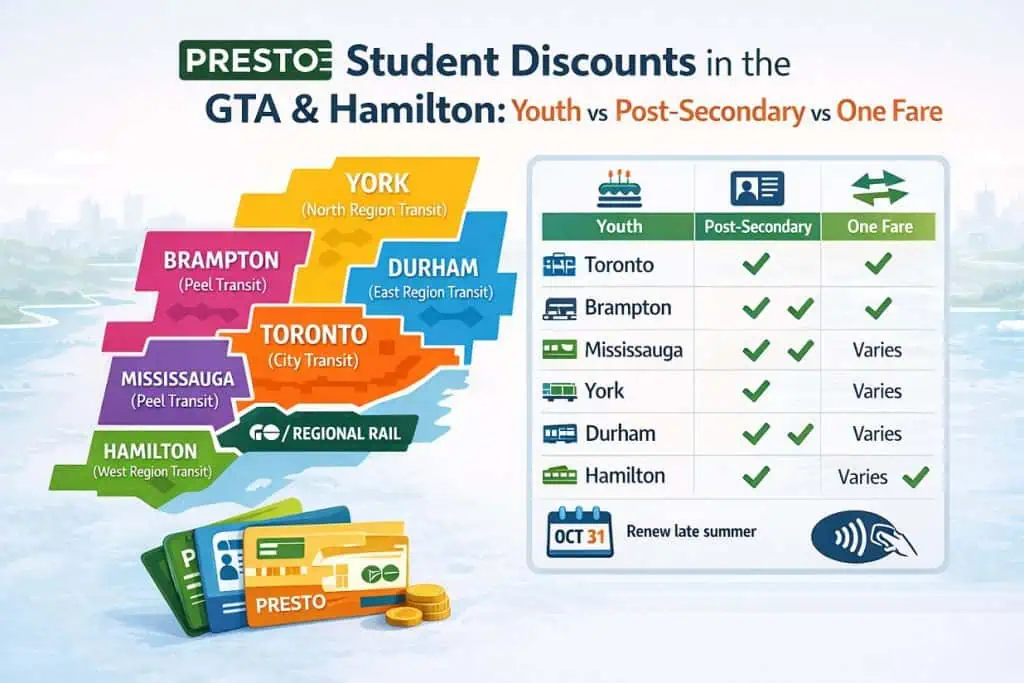
Most of the time it’s one of these:
- Youth fare (age-based): this is the cleanest discount—once it’s set, it just works until you age out.
- Post-secondary pass access (TTC-style): your tap fare isn’t cheaper, but you can buy a special monthly pass if your ID + PRESTO are set up.
- GO post-secondary discount: real savings per trip, but only after it’s actually loaded to the PRESTO you tap with.
- U-Pass / campus pass: school-linked, usually term-based, and often redeemed as a voucher to PRESTO.
- One Fare transfers: not a “student” program, but it can save you more than student settings on days you transfer.
PRESTO Student Discounts: by city / Transit
Legend: “Varies” means it depends on your school, route, or local agency rules.
| Area / system | Main student savings | Who it helps most | Setup you’ll actually do | Notes / “gotchas” |
|---|---|---|---|---|
| Toronto (TTC) | Post-Secondary Monthly Pass access (tap fare is adult) | Students who ride a lot in Toronto | Get TTC post-secondary photo ID, then set PRESTO to TTC post-secondary | If you only tap occasionally, the pass may not be worth it |
| GO Transit + UP Express | Post-secondary discount on GO/UP fares | Students commuting across the region | Apply for GO student ID, then load the discount to PRESTO | Approval ≠ loaded. Plenty of people stop at approval |
| Mississauga (MiWay) | Youth fare + loyalty/weekly ride programs + some campus passes | Youth riders, heavy weekly riders, U-Pass campuses | Varies (youth fare type / voucher) | School U-Pass rules vary a lot |
| Brampton Transit | Mostly youth fare + One Fare transfer savings | Youth riders + cross-region commuters | Set youth fare type on PRESTO | If you tap with credit/debit you’ll pay adult |
| Durham Region (DRT) | Often U-Pass style campus programs | Students at participating schools | Usually voucher-based | “Included in fees” doesn’t always mean “activated” |
| York Region (YRT/Viva) | Mostly youth fare + One Fare transfer savings | Youth riders + TTC/GO connectors | Set youth fare type on PRESTO | Post-secondary discounts aren’t the main lever here |
| Hamilton (HSR) | Often school pass / voucher programs | Students at participating schools | Voucher-based | Varies by school and term |
If you want the exact “do this, then this” guides:
- TTC setup (Bathurst → Shoppers): TTC Post-Secondary Photo ID + PRESTO setup.
- GO setup (apply → load → expiry): GO Transit post-secondary discount (how to apply, load, expiry).
Toronto (TTC): it’s not about cheaper taps
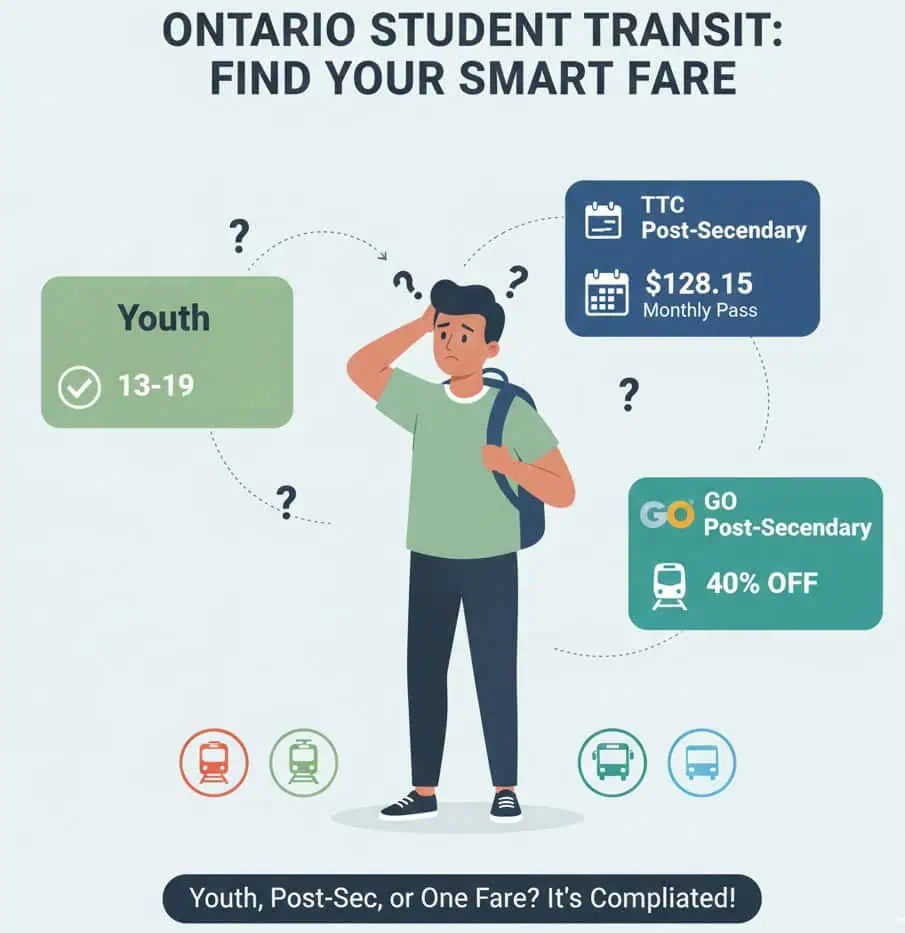
On TTC, post-secondary students don’t get a cheaper PRESTO tap than adults. The value is the TTC Post-Secondary Monthly Pass—but you only see it as an option if you have the TTC post-secondary photo ID and your PRESTO is set correctly.
Current TTC numbers: adult PRESTO fare is $3.30 and the TTC Post-Secondary Monthly Pass is $128.15. Break-even is roughly 39 paid fares in a month ($128.15 ÷ $3.30 ≈ 38.8). If you ride most days, it can be worth it. If you’re mostly on campus and only ride a few times a week, run the math first.
Bathurst line-up reality (early September)
If you’re doing the photo ID in the first week of September, plan for crowds. It can move slowly when everyone shows up at once. Bring headphones, a portable charger, and give yourself extra time so you’re not stressed about making a class or shift.
(If your school has an on-campus photo ID day, that can be a nicer experience. Not every school does it, so check.)
GO Transit: “approved” and “loaded” are different
GO’s post-secondary discount is a real discount. The common failure is boring: someone applies, gets approved, and assumes they’re done. Then they tap and still pay adult because the discount never got attached to the PRESTO card (or PRESTO in phone wallet) they’re using.
Also: if you tap with credit/debit, you’re generally paying an adult fare because student/youth fare types live on PRESTO, not on your bank card.
One Fare transfers: the savings people accidentally break
One Fare can remove the “double fare” pain when you connect between participating systems (for example, local transit ↔ GO). The rule that matters is simple:
Use the same payment method end-to-end. Same PRESTO card the whole trip (or the same PRESTO in your phone wallet). If you switch cards mid-trip, you can break the discount.
Timing-wise, the official guidance is:
- 2 hours for trips started on local transit
- within 3 hours of the start of a GO trip
A number you can actually use
If One Fare makes what would have been a TTC fare “free,” that’s $3.30 saved each time it happens. If that happens twice a day for 20 school days, that’s about $132/month ($3.30 × 2 × 20). Not everyone hits that pattern, but commuters who do notice it fast.
Physical PRESTO vs PRESTO in Mobile Wallet (and the two-card workaround)
If you ride both TTC and GO and you use a physical PRESTO card, you’ll eventually run into a limitation: a physical card can only have one fare type at a time.
Mobile Wallet PRESTO is often smoother for people who need multiple agency-specific fare types—but some people just don’t want to deal with phone battery anxiety or wallet glitches.
The “two physical cards” hack (works, with one warning)
If you hate Mobile Wallet, you can carry two physical PRESTO cards:
- one set to TTC Post-Secondary, and
- one set to GO Post-Secondary.
Label them (seriously) so you don’t tap the wrong one on autopilot.
The warning: if you’re relying on One Fare transfer discounts, switching between two different PRESTO cards mid-trip can break the discount because it’s no longer the same payment method end-to-end. This two-card approach is easiest when you’re using a TTC monthly pass anyway and you’re not depending on One Fare to wipe out a TTC fare.
Quick “which path am I on?” guide
- Mostly TTC inside Toronto + you ride a lot: TTC post-secondary monthly pass setup is the main lever.
- GO 2+ days a week: make sure GO post-secondary is loaded to the PRESTO you tap with.
- Mix of local transit + GO + TTC: One Fare rules + consistent tapping method can matter more than any “student” label.
- Under 20: Youth fare type can beat everything else because it’s automatic once set.
FAQ
Does TTC give a cheaper post-secondary pay-as-you-go fare?
No. TTC post-secondary is mainly about the monthly pass.
If I tap with credit/debit, will I still get student pricing?
Usually no. Student fare types are tied to PRESTO.
What’s the simplest setup if I ride both TTC and GO?
For most people: one PRESTO in Mobile Wallet is the least annoying. If you want physical only, two cards can work—just be careful with One Fare trips.
