

If you’ve ever opened a status certificate and your eyes went straight to “reserve fund,” you’re not alone. A reserve fund study is the document that answers one big question: will this condo have enough money for the major repairs that are coming?
Think roofs, windows, parking garage membranes, elevators, boilers, balconies, and other major repair/replacement work. In Ontario, condos must complete reserve fund studies on a schedule, then set a funding plan and give owners a required notice.
This guide is for owners, board members, managers, and buyers who want the practical stuff: what’s required, what to check first, and what should make you pause.
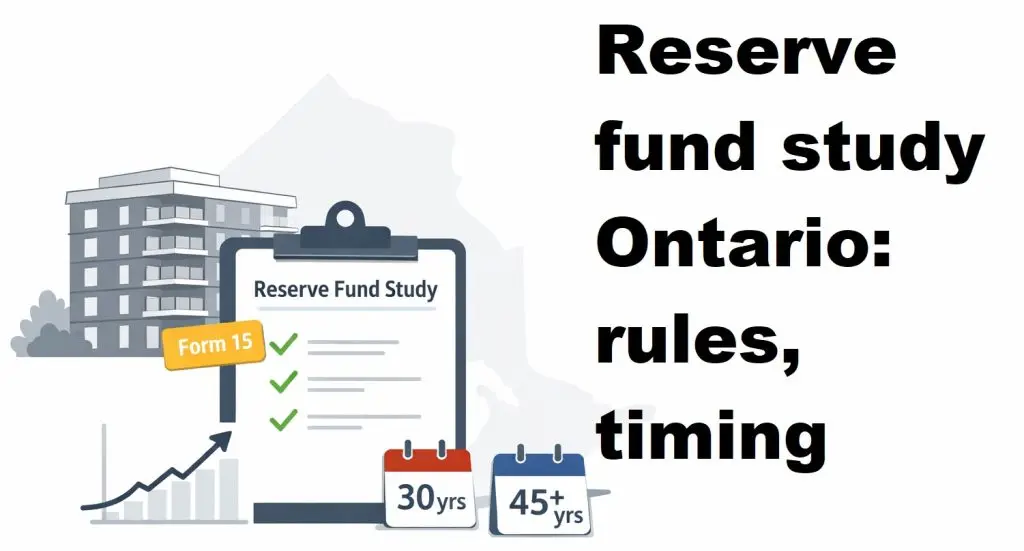
The fast cheat sheet (numbers worth remembering)
- Class 1 study: due within 1 year after the condo corporation is registered
- Updates: at least every 3 years, alternating Class 3 and Class 2
- Projection: 30 years minimum (but 45 years or longer can be a smart request for many buildings)
- Board timeline: propose a funding plan within 120 days after receiving the study
- Owner notice: send the Notice of Future Funding (Form 15) within 15 days after proposing the plan
- Early-stage funding rule: before the first study is done, contributions must be the greater of (1) 10% of the annual operating budget, or (2) what’s reasonably expected to cover major repairs/replacements
Read: OSAP 2025: eligibility, deadlines
What the reserve fund is for (and what it’s not)
In Ontario, a reserve fund is meant for major repairs and replacements of the condo corporation’s common elements and assets. It’s not for regular operating expenses like utilities, cleaning, landscaping, salaries, or day-to-day maintenance.
One simple way to think about it:
- Operating fund = keeping the building running this year
- Reserve fund = keeping the building standing long-term
Also: a high reserve fund balance doesn’t automatically mean “healthy.” What matters is whether the fund can realistically cover what’s coming (and when), without panic funding later.
Read: Best Free Digital Skills for Ontario Students
How often a reserve fund study is required in Ontario
Ontario uses three classes of reserve fund studies.
Class 1 vs Class 2 vs Class 3 (Ontario)
| Study class | Site inspection | What it does | When it’s required (minimum) |
|---|---|---|---|
| Class 1 (Comprehensive) | Yes | Builds the baseline inventory + long-term plan | Within 1 year of registration |
| Class 2 (Update) | Yes | Updates the plan with a fresh on-site review | Within 3 years after a Class 3 |
| Class 3 (Update) | No | Updates numbers using records/interviews | Within 3 years after Class 1 or 2 |
Why the classes alternate: a Class 3 keeps the financial plan current between inspections, and Class 2 forces a return to the building’s physical condition so the plan doesn’t drift away from reality.
Read: Software for Students in Ontario
The “30-year” nuance (and why 45 years can be more honest)
Ontario requires a funding plan that projects at least 30 consecutive years. That’s the legal floor.
But a lot of buildings—especially high-rises with big shared systems and complex garages—can have major components that show a second replacement cycle later on. That’s why CAO best-practices guidance notes it may be beneficial to ask your provider for a 45-year timeline or longer, and to choose a horizon that matches your building’s assets.
Sanity question (board or buyer):
“Does the study show a 45-year view? If not, what expensive items fall just outside the 30-year window?”
What a reserve fund study includes (what to read first)
A strong reserve fund study usually includes:
- Component inventory: what exists, what will wear out, and roughly when
- Repair/replacement timing + cost estimates
- Assumptions: inflation, interest, phasing, and any big constraints
- A recommended funding plan: year-by-year contributions and projected balances
Read: How to study real estate in Ontario
Pro tip: Check the inflation assumption (this is where funding shocks start)
A reserve fund study has to assume how future costs will change. If the study uses an inflation assumption like 1%–2%, it may look “comfortably affordable” on paper—but reality can move faster.
CAO’s Reserve Fund Survey Findings (published 2024, based on 2023 data) shows many corporations and providers have been adjusting assumptions in recent years. To sanity-check your study, compare assumptions with a construction cost index (StatsCan’s BCPI is one option) and, even better, your condo’s own recent quotes for major work.
What to ask for: a quick sensitivity view (example: funding plan at 2%, 4%, 6%) so the board can see how outcomes change if costs rise faster than expected.
Read: Ontario’s free language training
After the study arrives: board deadlines (120 days + Form 15)
Once the corporation receives the reserve fund study:
- Within 120 days: the board must review the study and propose a plan for future funding.
- Within 15 days after proposing the plan: the board must send owners (and the auditor) the Notice of Future Funding of the Reserve Fund — Form 15.
Why “Form 15” matters: In many status certificate packages, owners/buyers can find it faster by searching for “Form 15” than by scanning for generic “notice” language.
Worked example (quick math): why fees jump after a new study
Hypothetical example (not your building), just to show the mechanics:
- 120-unit condo
- Study forecasts a major project of $1,200,000 in ~10 years
- The corporation wants to fund it steadily (instead of a sudden special assessment)
Ignoring interest/inflation for simplicity:
- $1,200,000 ÷ 10 years = $120,000/year
- $120,000 ÷ 120 units = $1,000/unit/year
- $1,000 ÷ 12 ≈ $83/month per unit
Real studies are more detailed, but this is the basic reason owners see fee changes after a new study: the plan has to match real future costs.
Is your reserve contribution unusually low?
This one is surprisingly useful for buyers.
CAO’s Reserve Fund Survey Findings report (published 2024) found that among respondent standard condo corporations, the average reported reserve fund contribution was 36% of the total budget in 2023, and 66% contributed more than 30% of their total budget to the reserve fund.
That’s not a legal minimum, and every building is different—but it’s a strong benchmark.
If you’re seeing only 10–15% going to the reserve fund in a standard condo, treat it as a big “why?” moment and cross-check it against:
- the reserve fund study’s recommended contributions,
- upcoming projects in the next 0–10 years,
- and what Form 15 says the board plans to do.
What would make me pause (as a buyer or owner)
- The board’s plan is meaningfully lower than the study recommends, with no clear explanation
- A pattern of deferring major work (roof/garage/waterproofing/mechanical) without a realistic catch-up plan
- Contributions are low even though the next 5–10 years include multiple major projects
- Reserve contributions look unusually low vs. today’s norms (example: 10–15% of total budget) and there’s no clear reason in the study or Form 15
- The study feels generic and light on building-specific detail (weak assumptions, thin inventory, vague timelines)
FAQ
Is a reserve fund study mandatory in Ontario?
Yes. Ontario condo corporations must complete reserve fund studies and follow the required cycle of updates.
What’s the difference between Class 2 and Class 3?
Class 2 includes a site inspection. Class 3 is an update without a site inspection (it relies more on records/interviews plus financial updates).
How far out does a reserve fund study forecast?
At least 30 years. Many corporations request 45 years or longer as a best-practice choice, depending on building type and major assets.
What is “Form 15” in a status certificate package?
Form 15 is the Notice of Future Funding of the Reserve Fund. It summarizes the study and the board’s proposed plan, and it must be sent within 15 days of proposing that plan.
Key takeaways
- Ontario condos must complete reserve fund studies on a set schedule (Class 1 within 1 year, then updates at least every 3 years).
- Form 15 is the legally required “Notice of Future Funding” and is often the quickest way for buyers to see what’s coming.
- 30 years is the legal minimum, but a 45-year (or longer) horizon can reveal expensive second-cycle replacements.
- A low reserve contribution (like 10–15%) is a real red flag in many standard condos—especially if the study shows big projects ahead.
Have a reserve fund study Ontario question? Leave a comment with your building type (townhouse, mid-rise, high-rise) and what you’re seeing (fee increase, Form 15 notice, special assessment talk), and we’ll point you to what to check next.
