

Turning 20 is the moment a lot of Ontario students suddenly start paying more than they should—usually because their PRESTO card is still set to the wrong fare type, or because they didn’t realize “post-secondary” works differently depending on where they ride.
This guide breaks down Youth vs Post-Secondary, what changes on your 20th birthday, exactly where to set it, and the renewal dates that catch people every year.
If you want the bigger picture across Ontario agencies, start with our student transit discounts in Ontario guide.

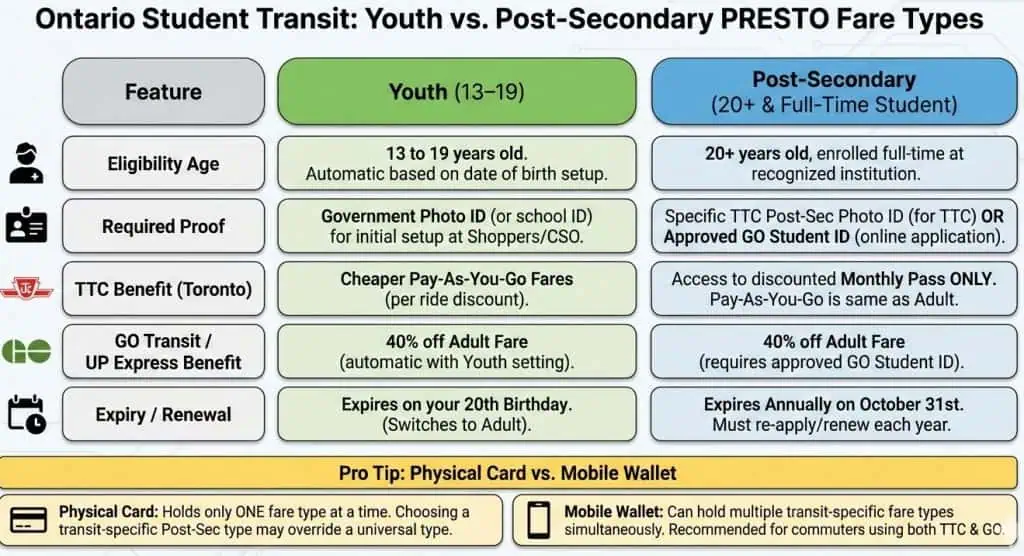
Youth vs Post-Secondary: the difference in plain English
Youth fare type (the “age-based” discount)
- Built for riders 13–19.
- It’s mainly about paying a cheaper fare when you tap (including Youth pricing on agencies like TTC) and getting the GO/UP youth discount.
- Key point: it’s not tied to being in college or university. It’s tied to your age.
Post-Secondary fare type (the “student-status” setup)
- Built for full-time post-secondary students.
- It often doesn’t change pay-as-you-go fares on some systems (example: TTC pay-as-you-go is the same as adult), but it can unlock student-specific passes or GO/UP discounts.
- It usually requires proof (a student ID process) and has an annual expiry date.
Read: TTC Post-Secondary Photo ID + PRESTO setup
What changes at age 20 (the part that surprises people)
1) Your Youth fare type ends on your 20th birthday
If your card is set to Youth, that Youth status expires when you turn 20. After that, your taps can default to Adult pricing unless you set something else.
2) You may need a different setup depending on where you ride
This is the big “gotcha”:
- If you mostly ride TTC, Post-Secondary is mainly about being able to buy a TTC Post-Secondary Monthly Pass (not cheaper pay-as-you-go).
- If you ride GO Transit / UP Express, Post-Secondary is about keeping the student discount after you’re no longer eligible for Youth.
3) If you commute using more than one system, your card type matters
- Physical PRESTO cards can only hold one fare type (either a universal one like Youth/Adult, or a transit-agency-specific one).
- PRESTO in Mobile Wallet can hold a universal fare type plus multiple transit-agency-specific fare types.
That single detail can decide whether you need one card or you’ll be stuck choosing between benefits—especially if you’re working while studying in Ontario and commuting across systems.
Quick comparison table: which one should you use?
| Situation | Best fare type to set | Why |
|---|---|---|
| You’re 13–19 (high school or even first-year college) | Youth | Cheapest + simplest until you turn 20 |
| You just turned 20 and mainly ride GO / UP | GO Post-Secondary | Keeps the student discount past 19 |
| You just turned 20 and mainly ride TTC with a monthly pass | TTC Post-Secondary | Needed to buy the TTC post-secondary pass |
| You ride both GO + TTC and want both student benefits | Mobile Wallet PRESTO (recommended) | Lets you carry multiple fare types on one card |
Practical verdict:
If you’re a commuter who uses more than one system, switching to PRESTO in Mobile Wallet is often the cleanest way to avoid “I fixed GO but broke TTC” problems.
“Where to set it” (step-by-step)
Step 1: Check what your card is set to right now
Check your fare type using any of these:
- PRESTO app (card info)
- PRESTO website (card settings)
- A PRESTO fare vending machine
- Some retail/customer service locations
Do this first—most people assume they’re on Youth, but they’re already on Adult.
Step 2: If you’re 13–19, set Youth
To set Youth, you typically do it in person:
- Go to a participating Shoppers Drug Mart or a PRESTO Customer Service Outlet
- Bring proof of age (often a government photo ID; some outlets accept a Canadian school-issued ID)
After it’s set, your taps should charge the Youth fare where it applies.
Step 3: If you’re 20+, set Post-Secondary based on your transit use
A) TTC Post-Secondary (Toronto)
If you want to buy a TTC post-secondary monthly pass:
- Get a TTC Post-Secondary Photo ID (TTC runs this through their Photo ID process)
- Go to a Shoppers Drug Mart and ask them to set your PRESTO card to TTC Post-Secondary Fare Type
- Keep your TTC Post-Secondary Photo ID with you when using the TTC post-secondary pass
Important: TTC pay-as-you-go for post-secondary is typically the same as adult—the value is mostly in the post-secondary monthly pass.
B) GO Transit / UP Express Post-Secondary
If you want the post-secondary discount on GO/UP:
- Apply online for a GO Transit Student ID
- Once approved, follow the instructions you receive (often involves a voucher code step for GO; in some cases you’ll set it in-person for UP or specific needs)
- Re-check your fare type after the change so you know it actually applied
Tip: If you’re still 13–19 and already have Youth, GO specifically tells youth riders not to bother applying until Youth is no longer valid, since the discount is the same.
Read: PRESTO Student Discounts in the GTA + Hamilton
Renewal timing (don’t get caught mid-semester)
Youth
- Ends on your 20th birthday.
If you’re turning 20 during the school year, set a reminder to switch your fare type that week.
Post-Secondary (TTC + GO/UP)
- Typically expires every year on October 31.
- Applications for the next school year often open in late August (you’ll see “Aug 30” come up frequently for GO/UP).
Real-life strategy:
Reapply/renew in late August or early September, then confirm your card is set correctly well before October 31 so you don’t lose the discount during midterms.
Two common mistakes (and how to avoid them)
Mistake #1: Paying with debit/credit tap and expecting a student discount
Student/youth fare types apply to PRESTO cards (physical or mobile wallet PRESTO). Contactless debit/credit taps are generally charged as Adult.
Mistake #2: Setting one transit discount and accidentally losing another
If you’re on a physical PRESTO card, switching to a transit-specific post-secondary fare type can affect how other agencies charge you.
If you regularly use multiple systems, consider PRESTO in Mobile Wallet so you can hold multiple fare types—this comes up a lot for students who are also renting their first apartment in Ontario and commuting farther than expected.
Mini example (quick numbers, easy decision)
You’re 19 and commuting on GO twice a week: you set Youth and get the youth discount.
You turn 20 in October: your Youth fare expires on your birthday. If you do nothing, you can start paying Adult fares.
So you apply for GO Post-Secondary in late August/September, set it, and keep the discount going through the school year.
If you also buy a TTC post-secondary monthly pass, that’s when Mobile Wallet PRESTO becomes the easiest “one card, both settings” approach.
FAQ
Do I need Post-Secondary if I’m in university but under 20?
Usually no—if you’re 13–19, Youth is the simplest setup and you can switch when you turn 20.
Does TTC Post-Secondary make single TTC rides cheaper?
Generally, TTC pay-as-you-go for post-secondary is the same as adult. The main benefit is access to the TTC Post-Secondary Monthly Pass.
Can I have TTC Post-Secondary and GO Post-Secondary on the same card?
Physical card: usually not (one fare type limit).
Mobile Wallet PRESTO: often yes (multiple fare types supported).
When do I have to renew post-secondary?
For TTC and GO/UP post-secondary, the expiry is typically October 31 each year, and applications open around late August.
I turned 20 and my fare changed—where do I fix it?
Start with a fare type check in the PRESTO app/website, then set the correct fare type via Shoppers / customer service outlets (or the GO student ID + voucher process, depending on the system).
