

Ontario’s 2026 allocation for international student applications just got smaller again—and it matters because it affects how fast you can get a Provincial Attestation Letter (PAL), and how competitive some intakes may become. The key point: the cap is about how many study permit applications IRCC will accept into processing for most new students, and provinces control the PAL “slots” inside that cap.
Below is what changed, who needs a PAL in 2026, and what to do if you’re applying to an Ontario college or university.
The Ontario numbers you actually need to know
IRCC publishes two different—but connected—numbers:
- Application spaces (PAL/TAL-required): how many capped study permit applications a province can send into IRCC processing (this is where PALs come in).
- Study permit target (PAL/TAL-required): how many permits IRCC expects will ultimately be issued for that capped group after refusals/withdrawals.
Ontario international student cap: 2025 vs 2026 (PAL-required cohorts)
| Year | Ontario application spaces (PAL-required) | Ontario study permit target (PAL-required) |
|---|---|---|
| 2025 | 181,590 | 116,740 |
| 2026 | 104,780 | 70,074 |
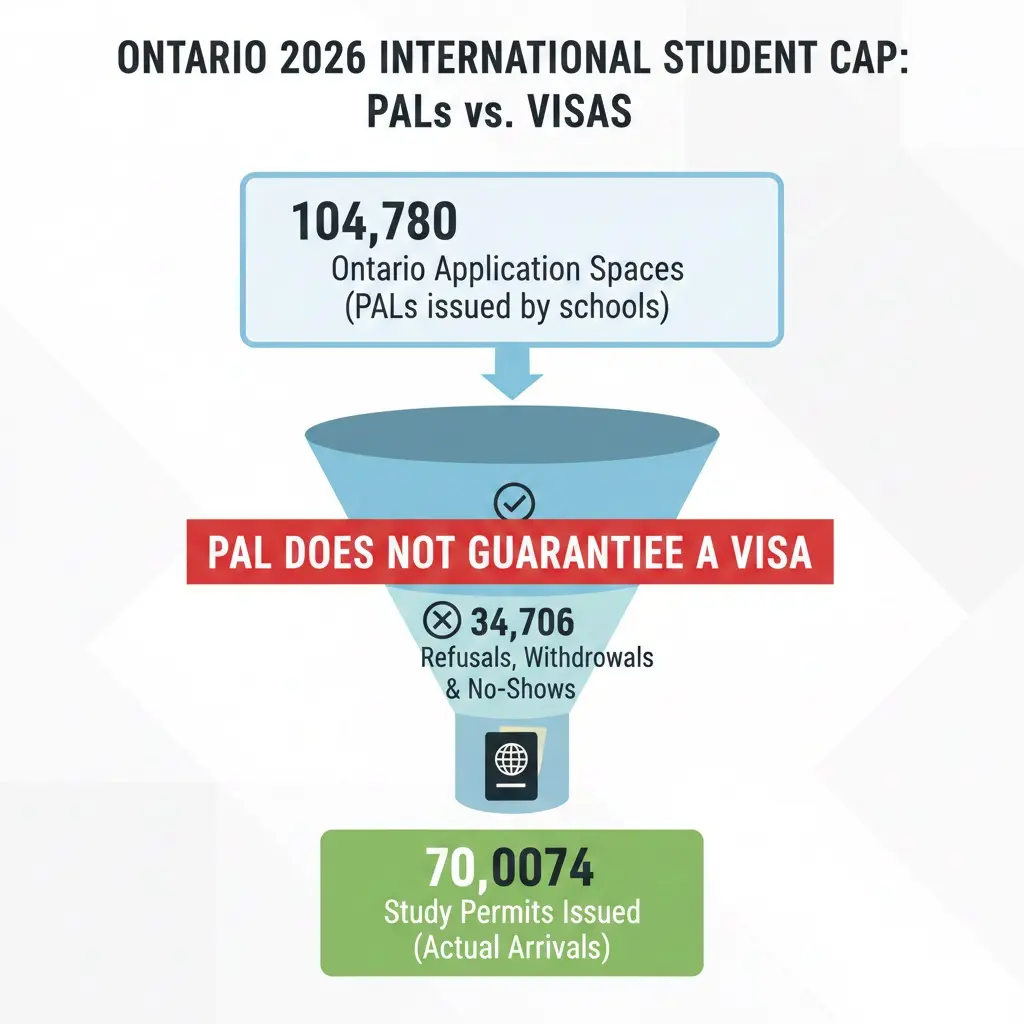
A simple way to read that: Ontario has far fewer “application seats” to hand out in 2026, which usually means schools have less room to issue PALs for many programs—especially if demand stays high.
Why 104,780 PAL “spaces” doesn’t mean 104,780 arrivals
You’ll notice Ontario’s 2026 application spaces (104,780) are higher than the permit target (70,074). That gap—34,706—is basically the built-in buffer for refusals, withdrawals, and people who change plans before arriving.
Who needs a PAL in 2026 (and who doesn’t)
A PAL is a province-issued letter confirming you’ve been counted inside the cap for the province where you plan to study. For most people, the PAL must be submitted with the study permit application (not later). In practice, you usually get it through your school after you’re admitted.
In 2026, many applicants still need a PAL
You generally need a PAL if you’re a new post-secondary student applying to study in Ontario—this can include prerequisite or language pathways tied to admission, depending on your situation.
Common PAL exemptions (important for planning)
These exemptions can make a huge difference in how stressful your timeline feels:
- K–12 students
- Certain priority/vulnerable cohorts (as defined by IRCC)
- Current study permit holders extending at the same school and same level
- New for 2026: Master’s and doctoral students at public DLIs are PAL/TAL-exempt as of January 1, 2026 (you still need a study permit—just not the PAL step)
One detail people miss: PAL rules are “cap-year” specific. A PAL issued in one cap year generally can’t be reused in a different cap year. So timing matters.
Read: Free PSW program Ontario
How Ontario plans to distribute PAL spaces
Ontario typically divides its PAL capacity across different kinds of schools. For the 2026 allocation reported this week:
- Most spaces go to public colleges and universities
- A smaller share goes to private institutions and language schools
Ontario has also indicated it may reclaim or reallocate unused PALs mid-year, which is a polite way of saying: if some schools can’t use their allotment, the province may shift those spaces elsewhere.
Read: How to get a police check in Ontario
What this means if you’re applying to an Ontario college or university
This doesn’t mean “you can’t study in Ontario.” It means your timing and program choices matter more.
A realistic application game plan for 2026 intakes
- Apply earlier than you think you need to. Some programs may hit their PAL limits faster.
- Treat the PAL step as a timeline risk. You can have a Letter of Acceptance and still get stuck waiting for the PAL process at the school/province level.
- Have a backup intake or program. If September fills, January/May intakes (where available) can be a pressure release valve.
- If you’re eligible for a PAL exemption, double-check it in writing. Especially for master’s/PhD programs and extensions—rules are specific.
Read: OSAP 2025: eligibility, deadlines, and how to apply
Quick PAL checklist (so you don’t lose weeks)
- Confirm your school’s PAL process right after admission
- Make sure your personal details match exactly across documents
- Submit the PAL with your study permit application
- If your application is refused, assume you may need a new PAL before reapplying (depending on the reason and timing)
Read: Cheapest Phone Plans for Ontario Students
Why schools are sounding the alarm (and why you should care)
The policy fight isn’t just politics—it affects programs, staffing, and student supports.
- Colleges Ontario says colleges have already cut $1.8 billion, suspended 600+ programs, and cut 8,000+ positions, while Ontario reviews the funding formula.
- The Council of Ontario Universities says universities face a projected $265 million annual deficit (2025–26) and warns continued PAL reductions can weaken talent pipelines, research capacity, and services for students.
If you’re applying, this can show up as: fewer program seats, fewer intakes, tighter admissions timelines, and pressure on housing/support services around campuses.
Read: Buying Your First Car in Ontario
What to watch next
A few “next steps” will shape how 2026 feels on the ground:
- School-by-school PAL distribution details (some institutions may be hit harder than others)
- IRCC’s promised list of public DLIs eligible for the master’s/PhD PAL exemption
- Ontario’s funding formula review outcomes and whether it changes how public institutions manage program offerings
FAQs
Do I need a PAL for a master’s or PhD in 2026?
If you’re enrolling in a master’s or doctoral program at a public DLI, IRCC says you won’t need a PAL starting January 1, 2026. You still need a study permit.
Do I need a PAL for a post-grad certificate or undergraduate program?
In most cases, yes—those are typically PAL-required unless you fall under a specific IRCC exemption.
I’m already in Ontario—do I need a PAL to extend my study permit?
If you’re extending at the same school and the same level of study, IRCC lists this as an exemption from the PAL requirement.
Can I use a PAL from last year?
Usually no. PALs are tied to a cap year and must be valid when you apply.
If I change schools, do I need a new PAL?
Often yes. Changing schools or changing your level of study can trigger a need for a new PAL.
Key takeaways
- Ontario’s 2026 PAL-required application spaces drop to 104,780, with a 70,074 permit target for PAL-required cohorts.
- Most new post-secondary applicants still need a PAL, but public master’s/PhD students become PAL-exempt in 2026.
- Expect tighter timelines for some intakes—apply earlier and keep a backup plan.
- Ontario colleges and universities say the cuts amplify a funding crunch already driving program suspensions and layoffs.
