
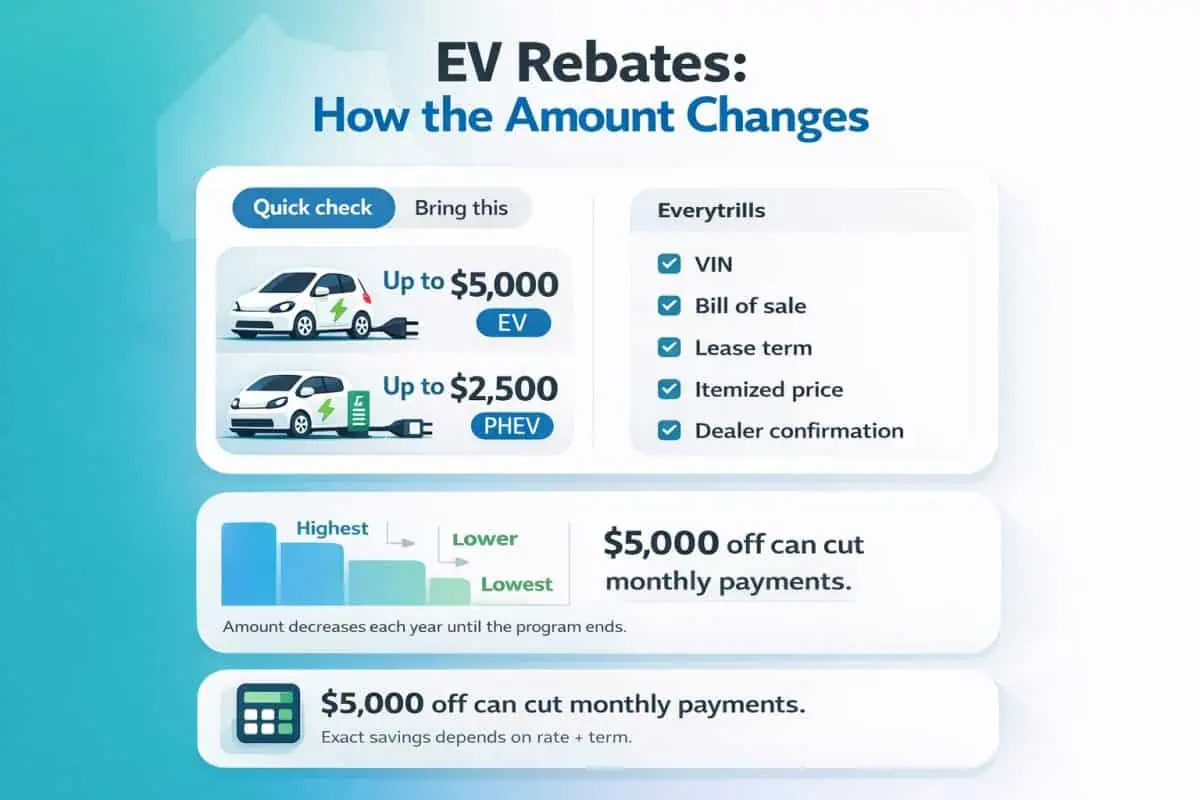
Prime Minister Mark Carney announced a major reset to Canada’s EV policy on February 5, 2026 — and the “headline” change for most Ontario shoppers is simple: a federal purchase/lease incentive is coming back, up to $5,000 for eligible battery-electric and fuel-cell vehicles, plus up to $2,500 for eligible plug-in hybrids.
For Ontario specifically, this matters more than it might in provinces with extra rebates, because Ontario hasn’t had a provincial EV purchase rebate since 2018. That makes the federal incentive one of the biggest “instant discounts” available to Ontario buyers who are trying to make the math work.
What changed today (and why it’s a big Ontario story)
Carney’s plan does two things at once:
- Drops the EV sales mandate approach (the Electric Vehicle Availability Standard) and replaces it with tougher vehicle greenhouse gas (GHG) standards for future model years — while letting automakers decide how they hit those targets (EVs, plug-in hybrids, more efficient gas vehicles, etc.).
- Brings back consumer (and business) rebates through a new five-year incentive program, and pairs it with a big charging investment.
The announcement was made in Vaughan, Ontario, in the middle of a wider “auto strategy” pitch focused on jobs, supply chains, and trade pressure on Canada’s auto sector.
Ontario quick impact (who should care most)
This matters most if you are:
- Shopping for an EV or plug-in hybrid in 2026–2030 and want to reduce monthly payments
- A commuter who needs more reliable charging on highway and regional routes
- In (or connected to) Ontario’s auto/parts economy and watching federal supports tied to production and tariffs
How much is the rebate, and how does it shrink each year?
The program’s maximum rebates are highest at the start, then taper down.
Maximum incentive schedule (as reported):
| Year | Battery-electric / Fuel-cell EV | Plug-in hybrid (PHEV) |
|---|---|---|
| 2026 | $5,000 | $2,500 |
| 2027 | $4,000 | $2,000 |
| 2028 | $3,000 | $1,500 |
| 2029 | $3,000 | $1,500 |
| 2030 | $2,000 | $1,000 |
A quick Ontario affordability example:
If you finance $5,000 less over 5 years at 6%, that’s roughly $97/month lower payments (before taxes/fees and your actual rate). Even if you pay cash, it’s still $5,000 you don’t need to borrow.
Who qualifies for EV rebates(the rules Ontario buyers should watch)
From the federal announcement, the key filters are:
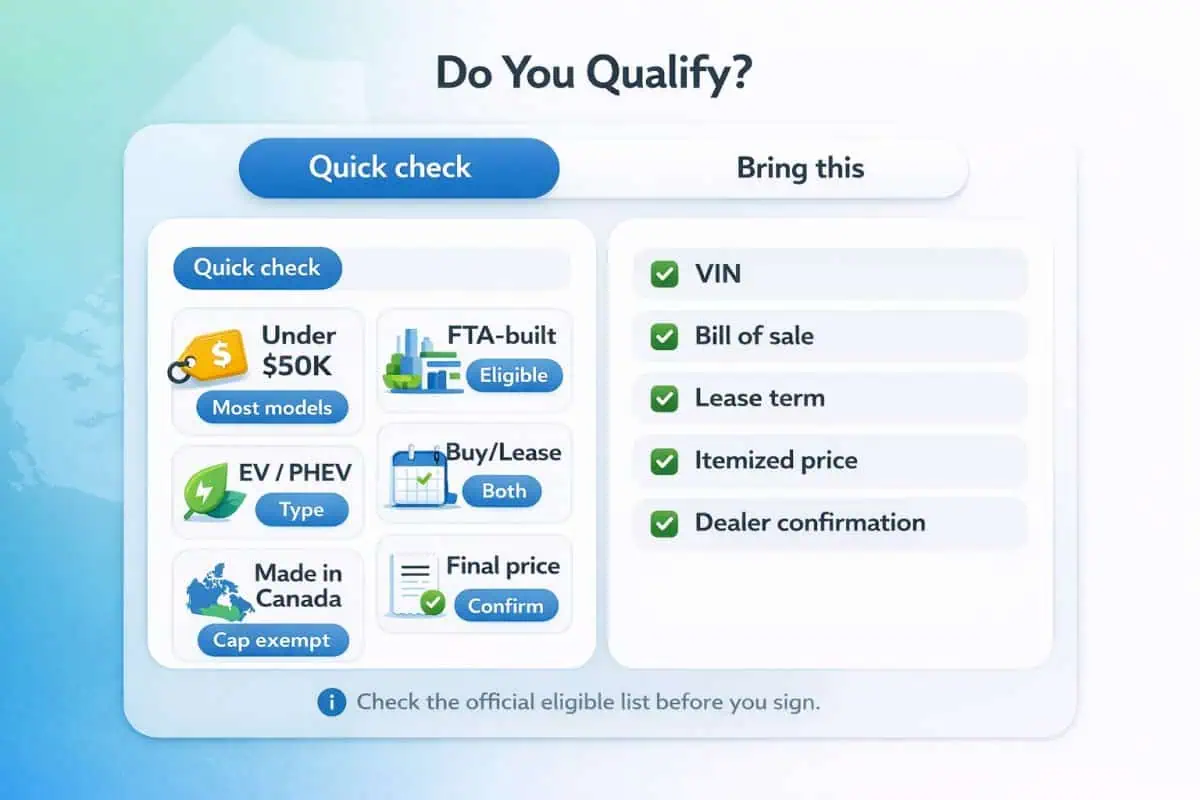
- Vehicle type: incentives apply to battery-electric and fuel-cell EVs, and plug-in hybrids (PHEVs).
- Price cap (big one): up to $50,000 “final transaction value” for qualifying vehicles made in countries Canada has free trade agreements with.
- Made-in-Canada exception: the $50,000 cap will not apply to Canadian-made EVs and PHEVs (important for vehicles assembled in Canada, including Ontario).
- Timing: the program is described as five years, and the maximum rebate declines over time.
“Final transaction value” — what to be careful about
The phrase “final transaction value” can be more strict than “MSRP.” Depending on how Ottawa defines it, it might include items like freight, dealer fees, or add-ons. Until the official program page spells it out, assume this:
- If the sticker says $49,xxx, you’re probably fine
- If it’s $50,xxx, you need to confirm exactly how the government measures “final transaction value”
Use our Ontario paycheque calculator to estimate your take-home pay and see what an EV payment would feel like after rent and groceries.
The Ontario angle: the made-in-Canada cap exception
Ontario is a manufacturing and parts hub. The most practical takeaway for Ontario shoppers is that the “Canadian-made” exemption could keep some domestically built plug-in vehicles eligible even if their price is above $50,000.
Two important caveats:
- “Canadian-made” needs a clear definition (assembled here vs. parts here vs. final assembly here).
- Eligibility usually depends on an official eligible-vehicle list (not just what a dealer says).
More charging stations: what Ontario drivers might notice first
Carney’s plan includes $1.5 billion (via the Canada Infrastructure Bank initiative) aimed at expanding charging and hydrogen refuelling infrastructure.
For Ontario, the earliest “felt” improvements (if projects move quickly) would likely be:
- More fast chargers along major corridors used for work + weekend travel
- Better coverage gaps outside the GTA (where range anxiety is still real)
- More reliable uptime (which matters as much as the number of plugs)
What about jobs and Ontario’s auto sector?
Beyond rebates, today’s auto strategy also includes:
- New funding pools to help the sector adapt/diversify
- A push to reward production and investment in Canada (including through a strengthened remission framework and trade-related measures)
- Worker supports and reskilling tied to the strategy
For Ontario, this is part climate policy, part industrial policy: the federal government is trying to keep production, parts, and investment anchored here while trade conditions stay shaky.
If you’re financing, building credit as a student in Ontario can help you qualify for a better rate and reduce the total cost over time.
If you’re shopping in Ontario:
- Decide 2026 vs later. If you can buy in 2026, the max rebate is highest.
- Ask for the eligibility proof in writing. Don’t rely on “it should qualify.”
- Confirm the price measure. “Final transaction value” can make or break eligibility near $50k.
- Check the vehicle’s build origin. The FTA rule matters, and “Canadian-made” may change the cap outcome.
- Keep your paperwork. Bill of sale/lease agreement, VIN, and itemized pricing.
Before you commit, run a quick plan in the student budget planner to compare “buy now with the bigger rebate” vs “wait and save longer.” If the eligible models under the cap feel limited, use this used-car buying checklist for Ontario to compare a used EV (or hybrid) safely before signing.
EV rebates FAQs
Will Ontario add its own EV rebate too?
Ontario ended its provincial EV purchase incentive program in 2018. Today’s announcement is federal; any Ontario rebate would be a separate provincial decision.
Does this apply to leases?
Yes — the federal announcement describes purchase or lease incentives, but the minimum lease term and claim process still need to be confirmed in official program details.
Is the EV mandate completely gone?
The plan is to repeal the EV availability standard and replace it with stricter GHG emissions standards for future model years, aiming for EV adoption equivalents over time.
