

The LSAT isn’t the kind of test you “grind for a weekend” and magically fix. It’s closer to training: you build a repeatable way to read, reason, and stay calm when the clock is loud.
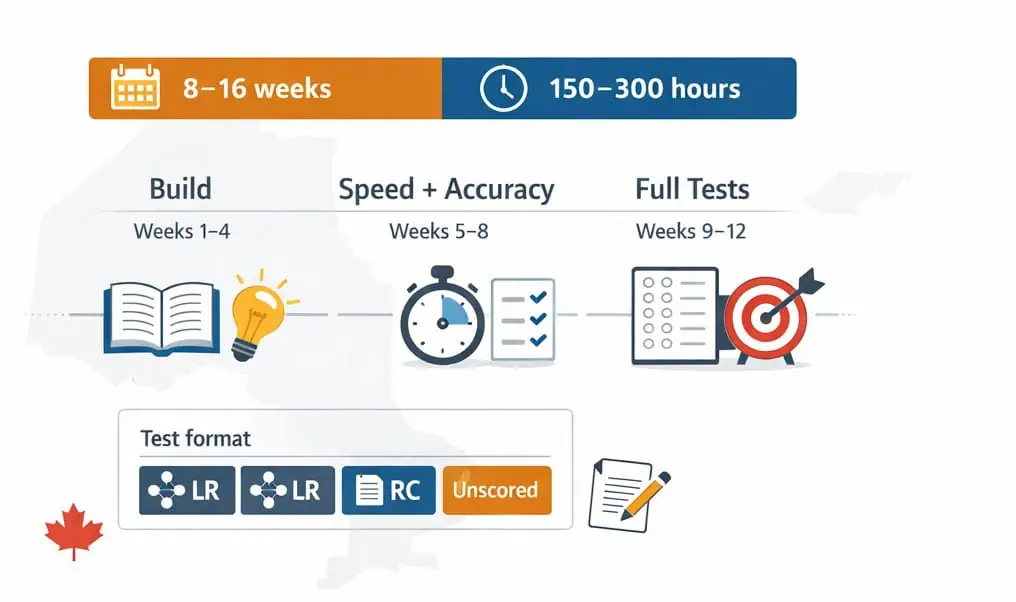
For most people, a realistic prep window is 8–16 weeks. If you like numbers, many prep companies put the “healthy” range around 150–300 total hours—but you don’t need to hit a magic hour count to be ready. You need your practice-test average to settle where you want it.
What the LSAT looks like now (so you study the right things)
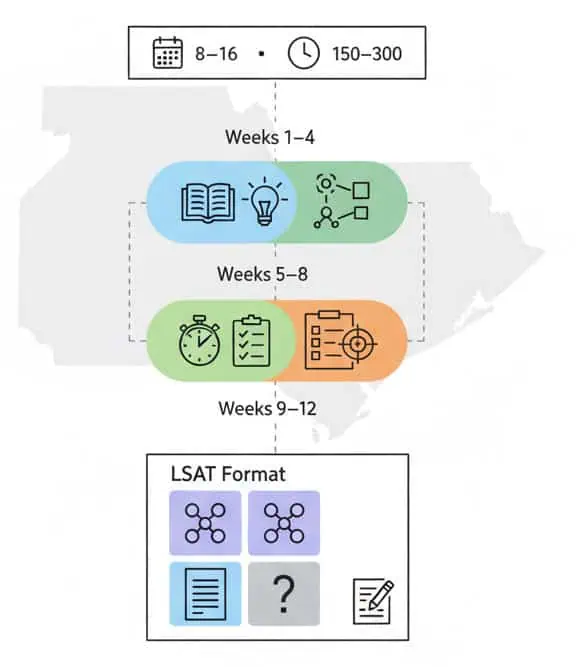
The multiple-choice part is four 35-minute sections: three scored and one unscored (the experimental section). Starting with the August 2024 format, that means two scored Logical Reasoning sections and one scored Reading Comprehension section, plus an unscored section that can be either. There’s also a 10-minute intermission between sections 2 and 3. Writing is separate and unscored (LSAT Argumentative Writing).
Why this matters: your study time should mostly go to Logical Reasoning + Reading Comprehension, and your stamina needs to handle two LR sections.
So… how long does it take to study for the LSAT?
If you’re asking “how long does it take to study for the LSAT” (or “LSATs”), here’s the honest way to decide:
- Start with your diagnostic. One timed full test tells you more than any blog post.
- Pick a weekly schedule you can keep for two months. Consistency beats hero weeks.
- Plan in totals. Most people can manage 10–15 hours/week without burning out.
A few realistic examples:
- 10 hours/week for 12 weeks = 120 hours
- 15 hours/week for 12 weeks = 180 hours
- 12 hours/week for 16 weeks = 192 hours
If you can only do an hour a day on weekdays and a longer session on Saturday, that’s fine. It’s slower, but it’s steady—and steady is what moves scores.
LSAT prep can get expensive fast, so it helps to run your numbers with our Ontario student budget planner before you buy courses or extra practice tests.
A 12-week LSAT plan that doesn’t feel robotic
I’m keeping this simple on purpose. Your plan should feel like something you’d actually follow on a Tuesday night.
Weeks 1–4: Build the engine
- Logical Reasoning (main focus): learn question families (strengthen/weaken, assumptions, flaws) and practice slowly first.
- Reading Comprehension: do a few passages per week with deep review—don’t just “check answers.”
- Timing: one short timed set per week so the clock isn’t scary later.
Weeks 5–8: Add speed without losing accuracy
- Do timed LR sets, then spend at least the same amount of time reviewing.
- RC: practice keeping a quick “map” of the passage (main point, role of each paragraph).
- Start taking full timed tests more regularly (even 1/week helps).
Weeks 9–12: Turn practice into test-day performance
- More full tests (often 1–2/week, depending on school/work).
- Review is the real work. Every missed question needs a reason:
- “I rushed and didn’t spot the conclusion,” or
- “I fell for a tempting answer that was too strong,” or
- “I ran out of time on comparative RC and guessed.”
A small but powerful habit: keep a “mistake list” by type. If you keep missing necessary assumption questions, you don’t need more tests—you need that one skill to click.
If you’re studying while working, use the Ontario paycheque estimator to see what your take-home pay actually looks like.
How long should you take if you’re aiming for 170 (or 175)?
If your goal is high (and “how long to study for LSAT to get 170” is a super common question), the timeline is less about grinding longer and more about finding your exact leaks.
A practical way to plan it:
- If your diagnostic is around 155–160 and you want 170+, many people need 3–5 months of steady work.
- If you’re starting around 145–150 and you want 170+, expect 4–6+ months.
For 175, the bar is tight. You’re not just learning concepts—you’re training “no freebies”: fewer careless misses, better time control, and RC endurance that doesn’t collapse in section 4.
If you want a distinctive “170+” move: stop asking “why is the right answer right?” and start asking “why are the wrong answers tempting?” That’s where the test lives.
How long to study for LSAT retake
A retake can be quick—or it can need a reset. It depends on why your score didn’t match your practice.
- If nerves or pacing wrecked you: 3–6 weeks of test-day simulation (same start time, same break, same snacks, no pausing).
- If timing is the problem: 4–8 weeks focused on timed sections + review.
- If fundamentals are shaky: 8–12 weeks rebuilding LR/RC basics (and doing fewer full tests).
Also, LSAC has retake limits, so don’t burn attempts while your practice average is still bouncing around.
How long to study for LSAT (Ontario / OLSAS timing)
Ontario applicants get squeezed by deadlines if they start late.
OLSAS first-year JD applications are due on November 1 for admission the following September (the cycle usually opens in late August). That means the deadline for fall 2027 admission is expected to be November 1, 2026 (11:59 pm ET).
LSAT timing is school-specific. For example, Osgoode says you must complete the LSAT no later than January of the year you intend to start—so January 2027 would be the last acceptable sitting for a fall 2027 start (other schools may set earlier “latest accepted” dates). Treat this like a checklist item: confirm your target schools’ latest LSAT date for your year on their admissions/OLSAS pages.
The stress-free strategy is simple: pick a test date that gives you time to study properly and still leaves room for a retake.
How long to study for LSAT Reddit? What to trust
Reddit is great for motivation and community. It’s also a highlight reel. You’ll see someone say they studied for three weeks and crushed it, and someone else say they studied for a year.
Use Reddit for:
- resource ideas,
- study routines you can steal,
- mindset reminders.
Don’t use it for:
- predicting your timeline,
- deciding you “should” be at 170 by month two.
(And yes—people even type “how long to.study for LSAT” in panic searches. You’re not alone.)
FAQs
How long does it take to study for LSATs?
Most people improve with 2–4 months of consistent prep. If you mean multiple attempts across a cycle, add time between tests to fix the specific issues that held you back.
How long should you give to study for the LSAT?
Long enough for your practice-test average to stabilize near your target score. For many, that’s roughly 150–300 hours spread across a few months.
How long do you need to study for the LSAT if you work full-time?
Plan 12–20 weeks at 8–12 hours/week. It’s slower, but it’s sustainable—and sustainable wins.
How long to study for LSAT 170?
If you’re starting mid-150s, plan 3–5 months. If you’re starting lower, plan longer. The big jump usually comes from fixing repeat mistake patterns, not adding random extra hours.
