

A “free PSW program” in Ontario is real — but you want to be clear on what’s free and what isn’t. In most cases, tuition is covered through a school board initiative, a government funding program, or an employer-sponsored program.
You might still pay for placement requirements like a police check, CPR training, and health documentation. This guide shows the legit routes, how long they usually take, and how to line up Ontario’s 2025–26 incentives without missing the eligibility dates.
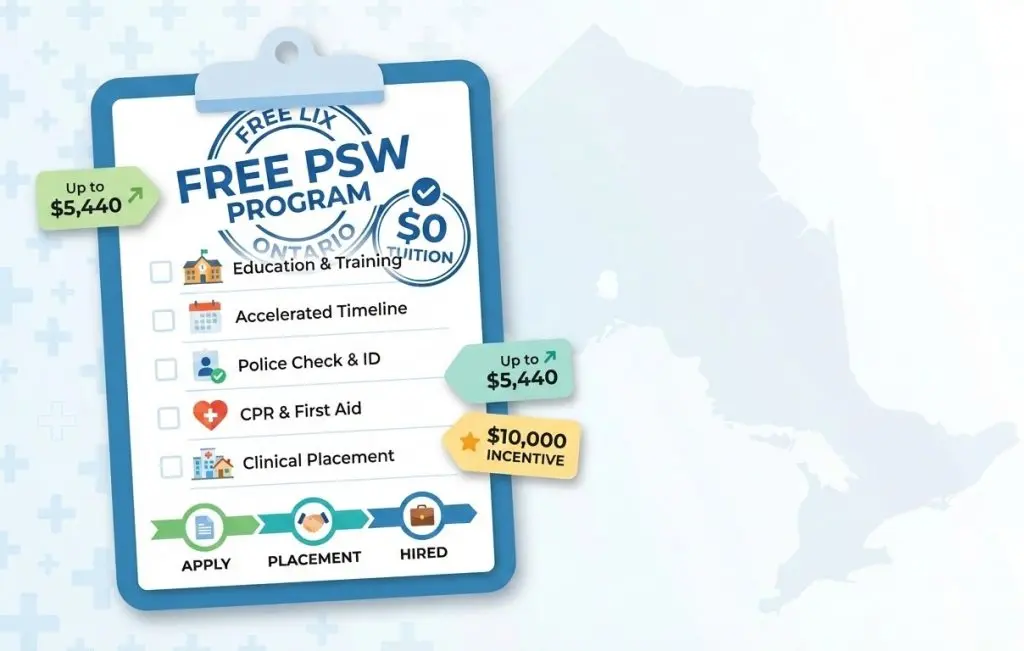 Tuition’ with a PSW training checklist and Ontario-themed icons. Free PSW program Ontario" fetchpriority="high" decoding="async" title="Free PSW program Ontario: how to train with tuition 1" data-lazy-src="https://learnontario.ca/wp-content/uploads/2025/12/PSW-free-program-1024x651.jpg.webp" >
 What “free” usually covers (and what it doesn’t)
When programs say “free,” they’re typically talking about tuition and sometimes core course fees.
Costs that often still land on students:
- a Vulnerable Sector Check (or other police check required for placement)
- CPR/BLS training (and sometimes First Aid, depending on the program/employer)
- immunization records and TB screening required by placement sites
- uniform/scrubs and proper footwear
- transit/commute costs to placement
It’s not “gotcha” stuff — it’s just how placements work in health care. The best programs tell you the extra costs up front.
Three legit ways to do a free PSW program in Ontario
1) Tuition-free PSW programs through Ontario school boards
This is the cleanest place to start if your main goal is $0 tuition.
Ontario’s school board PSW initiative promotes training “through your local school board” and says you can get certified in as little as five months (intake dates vary). Ontario’s provincial PSW page also notes some certificate programs can be done in about 5 to 8 months depending on the provider and schedule.
What you get with school board programs (typical):
- PSW training aligned to Ontario’s current standard
- in-person skills labs and clinical placements
- an adult-learning setup that often works well for career changers
What to watch:
- some boards have waitlists or limited intakes
- “tuition-free” can still come with small required costs (placement items)
Read: OSAP 2025: eligibility, deadlines, and how to apply
2) Better Jobs Ontario funding (if you qualify)
Better Jobs Ontario can help pay for training costs if you’re eligible (often people who are unemployed, laid off, or in a low-income situation). Ontario’s program page lists funding caps that can go up to $28,000 for training that is one year or less, and higher for longer programs.
This option makes sense when:
- your local tuition-free cohort isn’t running soon
- you’re choosing a public college program and need support beyond tuition
- you need help with related costs (books, transportation, basic living allowance can be part of support depending on your plan and eligibility)
How it works in real life: you usually apply through an Employment Ontario service provider, and the process can take time. If you’re trying to start training soon, apply early.
3) Employer-paid PSW programs
Some employers (especially in home and community care) run “train and hire” pathways. The details vary a lot:
- some cover tuition fully
- some pay you during training
- many come with a work commitment after graduation
These can be a great deal if you want a job lined up quickly — just treat it like a contract. Ask what happens if you can’t complete the program, or if the job offered is part-time instead of full-time.
Which option fits you best?
Here’s a simple comparison that usually matches what people care about: cost, speed, and job certainty.
| Route | Best for | What’s typically covered | What to confirm before you start |
|---|---|---|---|
| School board tuition-free PSW | Lowest tuition cost, straightforward path | Tuition and core program costs | Intake dates, any required fees, placement requirements you must pay |
| Better Jobs Ontario-funded training | People who need financial support to make training possible | Training-related costs (varies by plan/eligibility) | Eligibility, timeline to approval, which PSW program they’ll fund |
| Employer-paid training | People who want training + job bundled | Tuition (often) and sometimes paid training | Work commitment, schedule expectations, penalties or repayment terms |
The Ontario incentives that can add up in 2025–26
Ontario Health’s PSW Initiatives list funding that can be available through participating long-term care homes and home/community care employers:
- Clinical placement stipend: up to $5,440 if your eligible clinical placement begins between April 1, 2025 and March 31, 2026 and the placement is with a participating employer.
- Recruitment incentive: $10,000 if you complete an eligible PSW program on or after April 1, 2023, begin employment with a participating employer between April 1, 2025 and March 31, 2026, and commit to 12 months of full-time work.
- Rural/remote/northern supports: $10,000 relocation (requires relocating at least 100 km) and a $10,000 rural/remote/northern community incentive for eligible roles in Northern Ontario or communities with a Rurality Index for Ontario score of 40+.
A good way to think about it: the incentives are tied to dates and participating employers, not just to being a PSW student in general.
Mini timeline example (so you don’t miss the dates)
- Sept 2025: Start a tuition-free school board program
- Jan 2026: Start clinical placement with a participating employer → potential stipend window is still open
- Mar 2026: Graduate and start full-time with a participating employer → recruitment incentive window is still open
- Mar 2026–Mar 2027: Complete the 12-month commitment
Before you apply, ask these five questions (copy/paste)
Send this to the program contact (school board, college, or employer program):
- Is tuition fully covered for this intake?
- What required costs are not covered (police check, CPR/BLS, uniforms, vaccines/TB paperwork)?
- Do you confirm your program meets Ontario’s current PSW standard?
- When do placements start, and do you place students with employers participating in Ontario Health’s incentives?
- What’s the next intake date, and when do applications close?
If they can’t answer clearly, that’s a sign to slow down and compare options.
Read: Personal Support Worker (PSW) in Ontario: Step-by-step
Common mistakes that cost people time (and money)
- Waiting too long on the police check or immunization paperwork, then losing a placement spot
- Assuming every placement is “eligible” for the stipend
- Signing an employer-sponsored agreement without reading the work commitment details
- Choosing a program without verifying it aligns with Ontario’s PSW program standard
Also Check : PSW job responsibilities and duties in Ontario
FAQ
Are school board PSW programs really free in Ontario?
Many are promoted as tuition-free, but availability depends on the board and intake. Always check the specific cohort details and ask for a written fee breakdown.
How long is a free PSW program in Ontario?
Some options are advertised as as little as five months, while others run closer to 5–8 months depending on schedule and placements.
Can I get the $5,440 stipend if my program is tuition-free?
Possibly. The stipend is tied to an eligible clinical placement with a participating employer and the placement start date falling within the eligibility window.
Does Better Jobs Ontario cover PSW training?
It can, if you qualify and the training fits program rules. You’ll usually apply through an Employment Ontario service provider and build a plan around an in-demand job goal.
Key takeaways
- “Free PSW program Ontario” usually means tuition covered, not zero costs overall.
- Start with the Ontario school board PSW directory, then compare Better Jobs Ontario and employer-paid training.
- Ontario Health incentives can be significant, but they depend on participating employers and eligibility dates.
- Get your placement paperwork moving early so you don’t miss an intake or placement start.
