
The Ontario Learn and Stay Grant helps students pay for certain healthcare programs in Northern, Eastern and Southwestern Ontario. It can cover tuition, books, compulsory fees and other approved education costs.
In return, students agree to work in an approved region after graduation.
For the 2026–27 academic year, the grant supports selected nursing, paramedic and medical laboratory programs. Ontario also has a separate grant for eligible family medicine residents who agree to practise in the province.
The funding does not have to be repaid if you meet the conditions. But if you leave your program or fail to complete your work commitment, some or all of the grant could become a repayable loan.
Here’s who qualifies, which programs are eligible and how to apply.
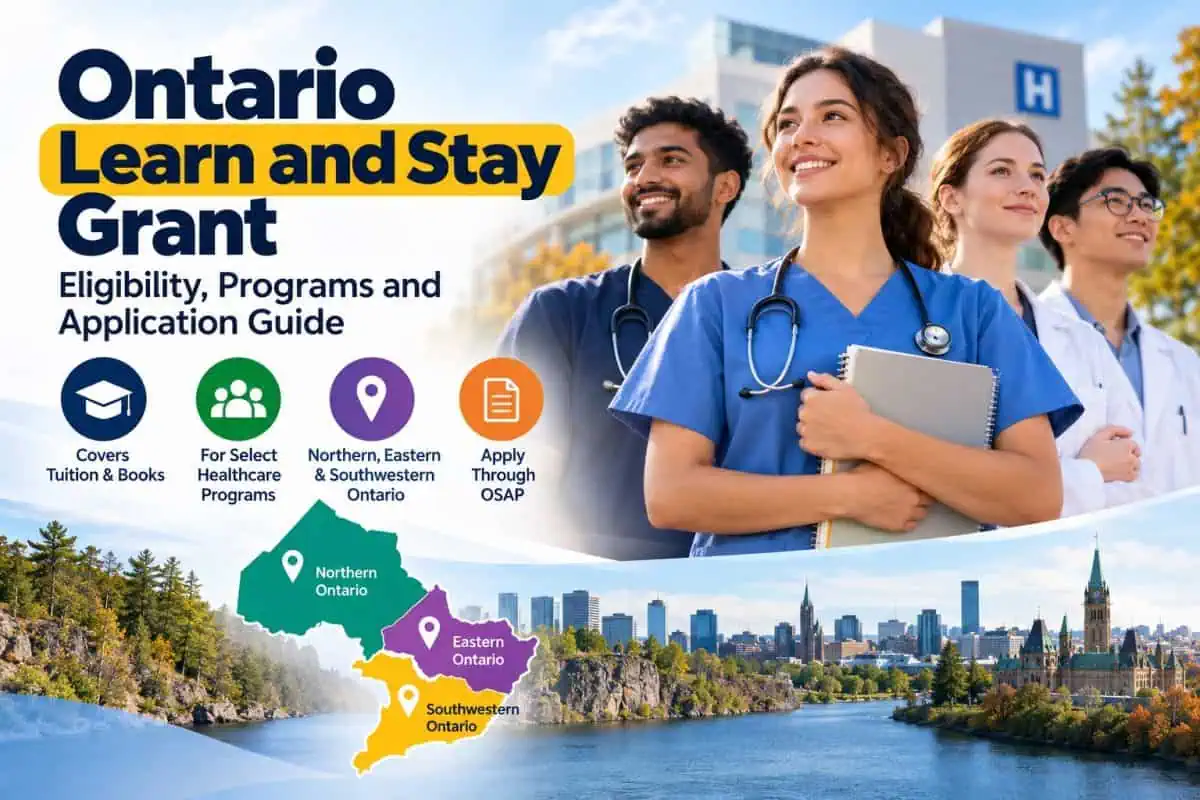
What is the Ontario Learn and Stay Grant?
The Ontario Learn and Stay Grant is a provincial student funding program. Its goal is to help train healthcare workers in communities that need them.
There are two funding streams for 2026–27.
| Funding stream | Who it supports | Work commitment |
|---|---|---|
| Health Human Resources | Students in approved nursing, paramedic and medical laboratory programs | Generally 180 days for each funded study period at a full course load |
| Medical Education | Eligible postgraduate family medicine residents | Five years of comprehensive primary care practice in Ontario |
The two streams have different eligibility rules, applications and service agreements.
Most college and university students looking for healthcare education funding will use the Health Human Resources stream.
Who is eligible for the Ontario Learn and Stay Grant?
To qualify for the Health Human Resources stream, you must:
- Be an Ontario resident.
- Be a Canadian citizen, permanent resident or protected person.
- Apply to and enrol in an approved program at an eligible institution and campus.
- Meet the program’s required course load and academic conditions.
- Agree to work in the approved service region after completing your studies.
- Meet the other conditions in your funding application and service agreement.
You cannot receive this grant while also receiving funding from the BEGIN Initiative, Better Jobs Ontario or the Skills Development Fund.
Can international students apply?
International students studying in Ontario on a study permit alone are not eligible.
The grant requires Canadian citizenship, permanent residence or protected person status, along with Ontario residency and the other program requirements.
Do all nursing students qualify?
No. Even if your school offers an eligible type of healthcare program, your specific campus may not be approved.
For example, a college might offer Practical Nursing at several locations, but the grant may only cover selected campuses.
Check the official list before making an admission or financial decision.
Which programs qualify for the grant in 2026–27?
The Health Human Resources stream supports selected programs at the diploma, undergraduate, graduate and postgraduate levels.
| Healthcare program | Eligible regions |
|---|---|
| Practical Nursing | North, East and Southwest |
| Approved bachelor’s and graduate nursing programs | North, East and Southwest |
| Paramedic diploma | North only |
| Medical Laboratory Technology / Medical Laboratory Science | North and Southwest |
Nursing eligibility includes selected practical nursing diplomas, Bachelor of Science in Nursing programs and graduate nursing or nurse practitioner programs.
Not every nursing program or campus is covered.
Check the official 2026–27 list of eligible programs, institutions and campuses before applying.
The list includes approved locations for each program and is updated when program eligibility changes.
Two medical laboratory programs added in Northern Ontario
On January 20, 2026, Ontario announced that two more Northern Ontario medical laboratory programs would qualify for the grant.
| Institution | Program | Campus |
|---|---|---|
| Canadore College | Medical Laboratory Technology | North Bay |
| St. Lawrence College, partnered with Confederation College | Medical Laboratory Science | Thunder Bay |
These programs help prepare medical laboratory professionals for communities in Northern Ontario.
The 2026–27 approved list also includes Medical Laboratory Technology at Cambrian College in Sudbury and Medical Laboratory Science at St. Clair College in Windsor.
The partnership detail matters. Ontario’s announcement names Confederation College, while its approved program list identifies St. Lawrence College as the partner institution for the Thunder Bay program.
Confirm the exact program and campus with the college before accepting an offer.
If you’re comparing education options, our Ontario certificate, diploma and degree guide explains how these qualifications differ.
Which Ontario regions qualify?
The grant uses three service regions for Health Human Resources students.
North region
Includes public health units covering areas such as Thunder Bay, Sudbury, North Bay-Parry Sound, Northwestern Ontario, Northeastern Ontario and Algoma.
Approved programs include nursing, paramedic and medical laboratory training.
East region
Includes Ottawa, Eastern Ontario, Renfrew County, South East and Lakelands public health units.
Approved programs are in nursing.
Southwest region
Includes public health units covering Middlesex-London, Windsor-Essex, Chatham-Kent, Lambton, Grey-Bruce, Grand Erie and other designated areas.
Approved programs include nursing and medical laboratory training.
Do you have to work in the same city where you studied?
Not necessarily.
The service agreement generally allows you to work in the public health unit where you studied or elsewhere within the same approved service region.
For example, a graduate from an approved nursing program in London may be able to complete the service commitment with an eligible employer elsewhere in the Southwest region.
However, you cannot assume that every employer or location qualifies.
Check your service agreement and confirm the employer’s eligibility before accepting a position.
How much does the Ontario Learn and Stay Grant cover?
Eligible Health Human Resources students can receive funding for approved direct education costs.
These include:
- Tuition
- Compulsory school fees
- Books
- Required supplies
- Required equipment
- Other approved direct educational expenses
There is no single grant amount that applies to every student.
Your funding assessment depends on the eligible costs associated with your approved program and study period.
Does the grant cover living expenses?
The grant is designed to cover direct educational costs. It is not intended to cover every living expense.
You may still need money for rent, groceries, transportation, phone bills and personal expenses.
Eligible students can also apply for OSAP to help with other approved costs, including living expenses.
Read our OSAP 2026 application guide to understand how student assistance works.
You can also use the Ontario Student Budget Planner to estimate how much money you’ll need during school.
How long must you work after graduation?
The Health Human Resources grant comes with a service commitment.
Under the 2026–27 Service Commitment Agreement, students generally must work 180 days for each funded study period completed at a full course load.
| Funded study periods at full course load | Service commitment |
|---|---|
| 1 | 180 days |
| 2 | 360 days |
| 3 | 540 days |
| 4 | 720 days |
For example, a student who receives the grant for four normal study periods at a full course load would generally need to complete 720 days of approved service after graduation.
What counts as a study period?
For this grant, an academic year runs from August 1 to July 31.
A study period is the normal period of study set by your college or university for the approved program. It may contain one or more academic terms.
In many programs, a study period roughly corresponds to a normal school year. However, the terms are not automatically interchangeable.
Your service requirement is calculated using your actual funded study periods and course load.
If you receive funding at less than a full course load but still meet the minimum eligibility requirements, your service commitment may be calculated proportionally.
How many hours must you work?
For each complete 180-day service period, you must work:
- At least 400 hours during the 180 days.
- At least 20 hours in every full month of that service period.
Simply remaining employed for six months is not enough if you fail to meet the minimum working-hour requirements.
When must you start working?
You must begin eligible employment within six months of completing your approved program.
You must also meet any professional licensing or certification requirements for your occupation.
The grant does not guarantee you a job after graduation.
What kind of employment qualifies?
Your job must meet the location, occupation and employer requirements in your service agreement.
Depending on your approved program, eligible employment may include working as a:
- Registered practical nurse
- Registered nurse
- Nurse practitioner
- Primary care paramedic
- Medical laboratory technologist
The employer must also qualify.
Approved settings can include eligible public healthcare organizations, hospitals, long-term care homes, public health services and other organizations listed in the service agreement.
Employment serving First Nations, Métis or Inuit communities may also qualify when it meets the agreement’s conditions.
Do private healthcare jobs count?
Not always.
The Health Human Resources service agreement specifically excludes employment with privately funded employers from fulfilling the service commitment, even when those employers provide healthcare in the approved region.
This means the type of employer matters, not just the location and job title.
For example, an eligible nursing graduate should not assume that working at a privately funded clinic will satisfy the grant requirements.
Confirm the employer’s status before accepting a job.
How to apply for the Ontario Learn and Stay Grant
Applications for the Health Human Resources stream are handled through Ontario’s OSAP system.
Step 1: Check your program and campus
Start with Ontario’s official list of approved healthcare programs and campuses.
Make sure your program, institution, campus and academic year are included.
Step 2: Apply to the school
Apply to your chosen college or university.
You must be accepted into and enrol in an approved program to qualify for the grant.
Step 3: Sign in to OSAP
Go to the official OSAP website.
If you already have an OSAP account, use your existing login information.
If you’re a new applicant, register for an account.
Step 4: Complete the grant application
Follow the instructions for the Ontario Learn and Stay Grant.
Read the Service Commitment Agreement carefully. This document explains your future work obligations and when funding may become repayable.
Step 5: Submit any required documents
Upload or provide the documents requested through your application or financial aid office.
Missing information can delay your assessment.
Step 6: Check your application status
Sign in to your OSAP account to see whether your application has been processed, whether additional information is required and when approved funding may become available.
What is the application deadline?
For the Health Human Resources stream, Ontario states that students can apply up to 60 days before the end of their study period.
Treat this as an important application deadline, not a recommended time to start.
Apply as early as possible after confirming your enrolment so that you have enough time to provide documents and resolve any problems.
The exact study-period end date depends on your institution and program.
What if you’re already receiving the Learn and Stay Grant?
Students who started an eligible program in the 2023–24 academic year or later may remain eligible for the grant in subsequent academic years.
You must submit a new application for each year in which you want additional funding.
What is the Continuation of Status form?
If you previously received the Ontario Learn and Stay Grant and continue studying in an eligible program without applying for new grant funding, you must confirm your enrolment.
Ontario provides a form called Continuation of Status for the Ontario Learn and Stay Grant for this purpose.
Completing the form helps prevent your earlier grant funding from being converted into a repayable loan because your continued enrolment was not confirmed.
The form does not replace a new grant application if you want funding for another academic year.
Returning students can use their existing OSAP credentials.
Ontario Learn and Stay Grant for Medical Education
Ontario introduced a separate Medical Education stream for the 2026–27 academic year.
This stream is intended for eligible postgraduate family medicine residents, not students entering ordinary nursing or college healthcare programs.
It provides funding for approved direct educational costs from the recipient’s undergraduate medical education.
These can include tuition, compulsory fees, books, supplies and equipment.
Who qualifies for the Medical Education grant?
For the 2026–27 application cycle, applicants generally must:
- Be Canadian citizens, permanent residents or protected persons.
- Meet Ontario residency requirements, including the applicable 12-month residency test.
- Have completed an undergraduate medical degree at an eligible Ontario medical school.
- Be enrolled in the first year of an approved postgraduate family medicine residency program in Ontario.
- Agree to practise comprehensive primary care as a family doctor in Ontario for five years.
Approved Ontario medical schools include McMaster University, NOSM University, Queen’s University, Toronto Metropolitan University, the University of Ottawa, the University of Toronto and Western University.
The grant does not extend to other medical specialties, current undergraduate medical students or residents who completed medical school outside Ontario.
Where must family doctors work?
Unlike the Health Human Resources stream, eligible family medicine graduates can fulfil their service commitment anywhere in Ontario.
However, they must practise under an approved comprehensive primary care model or with an eligible employer.
Examples include:
- Family Health Organization
- Family Health Network
- Family Health Group
- Comprehensive Care Model
- Blended Salary Model within a Family Health Team
- Community Health Centre
- Indigenous Primary Health Care Organization
- Rural Generalist Model
Ontario also recognizes other specified practice models and employers. The official Medical Education program page contains the complete list.
How long is the service commitment?
Recipients must commit to five years of comprehensive primary care practice in Ontario.
This is a different requirement from the 180-day-per-funded-study-period system used by the Health Human Resources stream.
If recipients do not meet their conditions, Medical Education grant funding may become a repayable Ontario Medical Education Loan.
How do medical residents apply?
Applications are completed through the Medical Education section of an OSAP account.
The University of Ottawa states that, for the 2026–27 application cohort, the application period runs from July 1, 2026, to June 30, 2028, covering the standard two-year residency period.
These are the dates published in the university’s guidance, rather than a separate application window confirmed on Ontario’s general grant page.
The university also states that:
- Applications must be submitted at least 60 days before the two-year residency program ends.
- Supporting documents and requests for review must be received at least 40 days before the program ends.
These deadlines are important even though the broader application period extends across the residency.
Medical residents should follow their OSAP application instructions and confirm deadlines with their university’s financial aid office.
What happens if you don’t complete your work commitment?
The Learn and Stay Grant does not normally need to be repaid when students complete their studies and meet the required employment conditions.
However, all or part of the funding may become a loan if you:
- Withdraw from an approved program.
- Drop below the required minimum course load.
- Transfer to a program or institution that is not approved.
- Fail to complete the required service commitment.
- Do not provide required employment verification documents.
- Become ineligible after your grant application is reassessed.
For the Health Human Resources stream, converted funding becomes an Ontario Student Loan.
It is administered through the National Student Loans Service Centre (NSLSC). If you already have OSAP loans, the converted amount may be added to your existing loan balance.
The Medical Education stream uses a separate Ontario Medical Education Loan framework.
If you face serious circumstances that could affect your studies or service commitment, contact your financial aid office or the responsible ministry as soon as possible.
Do not assume that stopping work or changing programs has no effect on your funding.
Is the Ontario Learn and Stay Grant worth it?
The grant can be valuable for someone who wants to work in healthcare and plans to remain in an eligible region after graduation.
It can cover major education costs without creating a regular student loan, provided you meet the requirements.
But it’s not the right choice for everyone.
If you expect to move away immediately after graduation, change careers or work for an employer that doesn’t qualify, you should think carefully before accepting the grant.
Before signing your agreement, make sure you understand:
- Whether your exact program and campus qualify.
- What education costs the grant will cover.
- Where you must work after graduation.
- Which employers and occupations are accepted.
- How long you must work and what happens if you cannot complete the commitment.
The best time to check these conditions is before you accept the funding.
Frequently asked questions
Is the Ontario Learn and Stay Grant free money?
It is grant funding, not a regular loan. You generally do not have to repay it if you complete your approved studies and meet your service commitment. If you fail to meet the conditions, some or all of the grant may become a repayable loan.
Can I apply for OSAP and the Learn and Stay Grant together?
Yes. Eligible Health Human Resources students can also apply for OSAP to help with other approved costs, such as living expenses. Each program has its own assessment rules.
Do I have to work in the city where I studied?
Not necessarily. Health Human Resources recipients can generally work in the same public health unit or approved service region where they studied. The occupation and employer must also qualify.
Can I receive the grant again next year?
Yes, if you remain eligible and your program continues to qualify. You must apply again to receive new funding. If you continue eligible studies without applying for new grant funding, you may need to submit the Continuation of Status form.
Before you apply
The Ontario Learn and Stay Grant can make healthcare training much more affordable, especially for students who want to start their careers in Northern, Eastern or Southwestern Ontario.
But the work commitment is a major part of the agreement.
Start by checking your exact program and campus. Then review where you’re expected to work, how many days and hours you must complete, and which employers qualify.
If you’re unsure about any condition, speak with your school’s financial aid office before accepting the funding.
