
TORONTO — August 25, 2026
Ontario manufacturing sales reached $32.9 billion in June, giving the province another month of solid factory activity just as a renewed trade fight with the United States threatens some of its biggest industrial employers.
Statistics Canada put Ontario’s seasonally adjusted manufacturing sales at $32.928 billion, up 0.3 per cent from May and 10.8 per cent higher than June 2025.
The numbers cover everything from food processing to machinery, but the immediate concern is transportation manufacturing. Ontario’s auto plants and their suppliers are facing another round of uncertainty after U.S. President Donald Trump threatened a 50 per cent tariff on Canadian-made cars, trucks and auto parts beginning January 1, 2027.
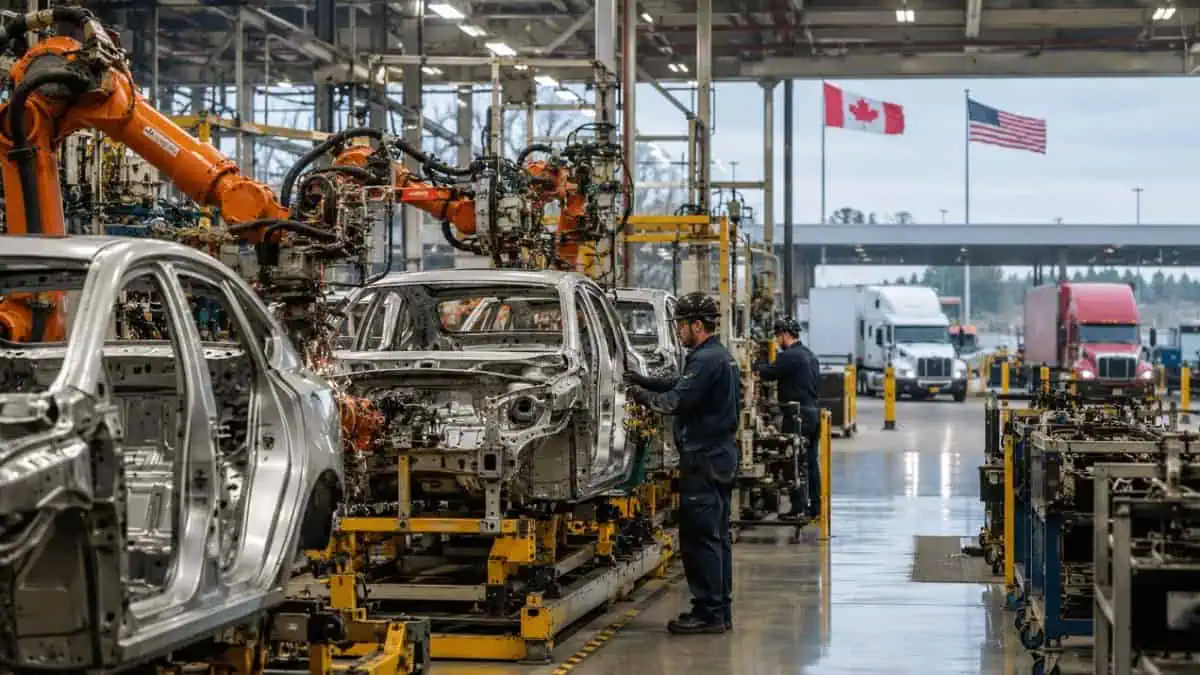
That leaves Ontario heading into the fall with two very different pictures: factory sales have been rising, while the trade rules governing the province’s largest export market are becoming less predictable.
Read: Ontario Unveils New 130-Point OINP Scoring System
June sales reach $32.9 billion
Ontario manufacturers recorded $29.7 billion in sales in June 2025. One year later, that figure had climbed by more than $3.2 billion.
The province’s June increase was modest compared with May, at 0.3 per cent, but the year-over-year gain was considerably stronger.
Nationally, manufacturing sales increased for a fifth consecutive month in June, reaching $78.8 billion. Transportation equipment rose 2.8 per cent across Canada, while chemical manufacturing increased 6.0 per cent.
Ontario had already posted stronger growth in May, when provincial manufacturing sales increased 2.0 per cent. That month’s gains included a 12.2 per cent jump in motor vehicle manufacturing sales to $4.2 billion.
The recent data put Ontario factories in a relatively strong position heading into summer.
Trade negotiations with Washington will help determine whether that momentum carries through the fall.
Read: Doug Ford vs. Trump: Ontario Premier Fires Back as Tariff Fight Turns Personal
Auto plants face another tariff threat
The latest escalation came on August 24 after Canada-U.S. trade negotiations failed to produce an agreement.
Trump threatened to raise tariffs on Canadian cars, trucks and auto parts to 50 per cent starting January 1. The White House has also been targeting Canadian steel and other products as part of the wider trade dispute.
Ontario has more at stake than any other province in the auto dispute.
Ford, General Motors, Stellantis, Honda and Toyota operate major vehicle or manufacturing facilities in Ontario. Those plants support a much larger network of parts makers, tool-and-die shops, transportation companies and other suppliers.
Ontario is currently the second-largest vehicle-producing jurisdiction in North America, according to Invest Ontario. The province has more than 800,000 manufacturing workers and over 20,000 advanced manufacturing firms.
The Canadian and American auto industries are also difficult to separate neatly at the border. Components can move between the two countries several times before a finished vehicle reaches a dealership.
A tariff on Canadian vehicles therefore reaches well beyond the assembly line.
Manufacturers want predictable trade rules
Business groups have been warning that uncertainty itself is becoming a problem.
A June survey from Canadian Manufacturers & Exporters found more than nine in 10 manufacturers supported extending CUSMA, while 97 per cent were concerned about current U.S. tariff conditions.
CME president and CEO Dennis Darby described the trade agreement as the “backbone of North American manufacturing.”
For manufacturers deciding where to put their next production line, tariffs can change investment calculations long before they show up in monthly sales figures.
Equipment purchases, factory expansions and new vehicle programs are often planned years ahead. A company choosing between Ontario and a U.S. location has to consider what it will cost to move its product across the border once production begins.
That has made trade certainty almost as important as labour costs, electricity, taxes and government incentives in the competition for new manufacturing projects.
Job numbers show an uneven industry
Ontario’s manufacturing employment increased by about 3,300 jobs in the second quarter of 2026 compared with the same quarter last year, a gain of 0.4 per cent.
Employment in manufacturing and utilities occupations increased by 19,200 over the same period.
Those province-wide figures look relatively stable, but conditions vary sharply between plants and industries.
General Motors is one example.
When Unifor opened contract negotiations with GM on August 10, the union represented more than 4,600 workers at Ontario facilities in Oshawa, Ingersoll, St. Catharines and Woodstock.
About 30 per cent of Unifor’s GM members in Canada were on layoff when negotiations began.
That contrast helps explain why rising manufacturing sales do not automatically mean every Ontario factory or worker is benefiting equally.
Windsor, for example, recorded a particularly strong June. Manufacturing sales in the Windsor metropolitan area reached about $2.14 billion, up 6.1 per cent from May and 36.3 per cent from a year earlier.
Kitchener-Cambridge-Waterloo was up 22.1 per cent year over year, while Hamilton manufacturing sales increased 3.9 per cent.
Toronto moved in the other direction on a monthly basis, with sales falling 3.1 per cent from May, although they remained 6.6 per cent above June 2025.
The regional numbers make the picture less uniform than the provincial headline suggests.
Ontario still has an investment advantage
Despite the trade fight, Ontario remains one of Canada’s main destinations for large industrial projects.
Its manufacturing base, skilled workforce and access to the North American market have helped attract investment in automotive production, aerospace, food manufacturing and advanced industrial technology.
Linamar, for example, has committed more than $1 billion across six Ontario projects, with plans that Invest Ontario says will create more than 2,300 jobs.
Projects like that matter because manufacturing investment has a long life. A plant or production line built today can support jobs and suppliers for years.
The concern is whether companies preparing their next round of investments will make the same decisions if tariffs become a lasting feature of Canada-U.S. trade.
Two September dates could shape the next update
The first major date comes on September 8, when Canada is expected to introduce retaliatory tariffs on U.S. goods following the breakdown in negotiations with Washington.
Six days later, Statistics Canada is scheduled to release its full July manufacturing report on September 14.
That report will show whether Ontario’s $32.9-billion June performance carried into July and provide the next detailed look at factory activity by province and industry.
By then, manufacturers will also have a clearer view of Canada’s tariff response — and whether Ottawa and Washington are moving back toward negotiations before Trump’s January 1 auto tariff deadline.
