
Ontario’s next move on school cellphones may not stop at the classroom door.
Education Minister Paul Calandra said Tuesday the Ford government is considering a wider ban that could cover cellphone use across school property, not just during lessons. The province already tightened cellphone rules in 2024, but Calandra said the problem has not gone away.
“We’re reflecting on a wider ban on cellphones,” he told reporters near London, Ont., where the government was announcing new school construction.
The comment puts Ontario back into a debate that many families thought had already been settled last school year: phones away during class, with limited exceptions. A school-wide ban would be different. It could reach into lunch periods, hallways, washrooms, schoolyards and other parts of the day where students, especially in high school, may still have access to their devices.
Ontario considers school-wide cellphone ban
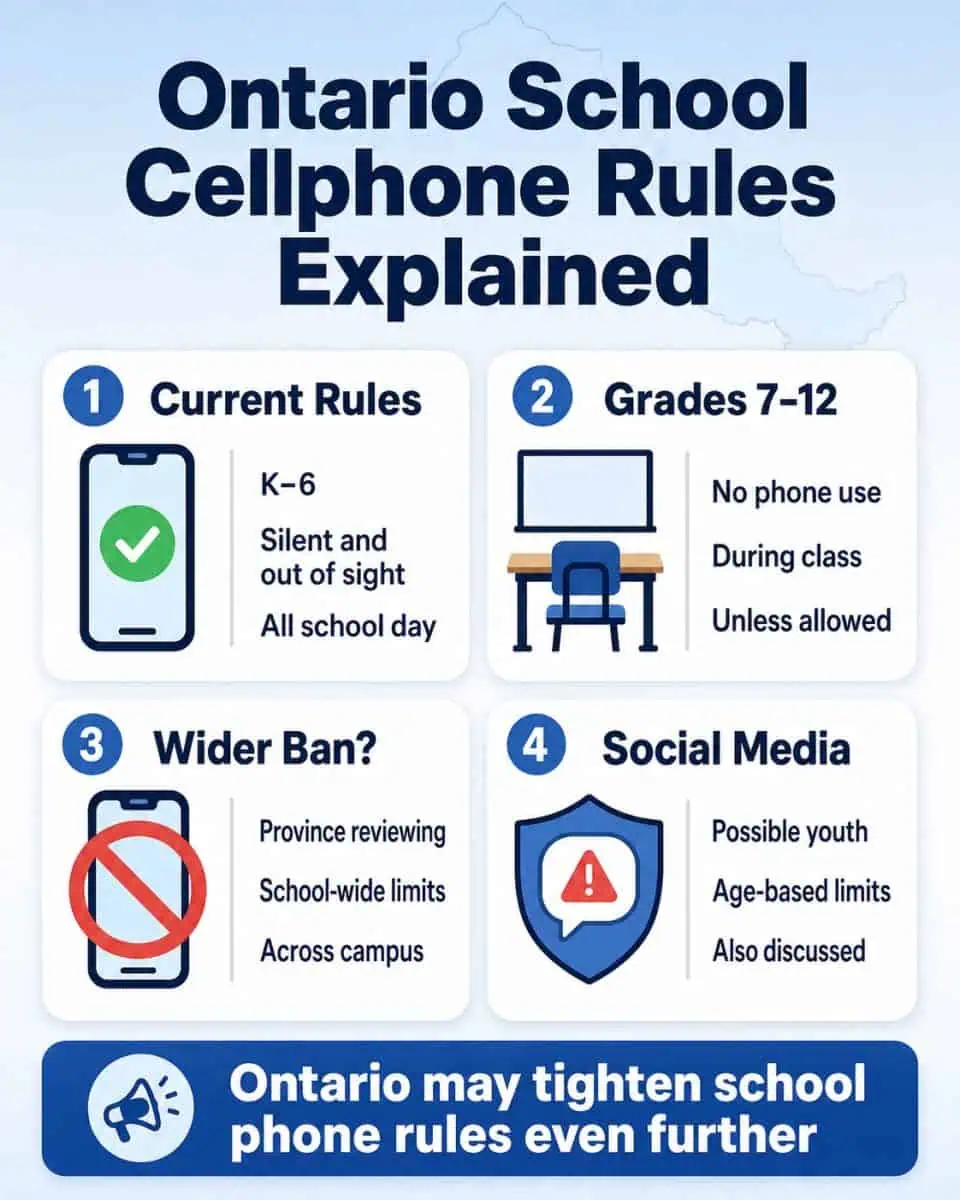
Calandra said the government is looking at the issue in both elementary and secondary schools. He also said any broader rule would need exemptions for health needs and other valid reasons.
For now, nothing has changed. Ontario’s current rules still apply. Students from Kindergarten to Grade 6 must keep phones silent and out of sight for the full school day. Students in Grades 7 to 12 cannot use phones during instructional time unless a teacher allows it for learning, medical, special education or another approved reason.
The harder question is what happens outside class.
In many Ontario schools, especially in larger urban and suburban boards, phones are not just entertainment devices. Parents use them to check whether a child made the bus, arrived at school, left for work, or picked up a younger sibling. Students use them for transit alerts, after-school plans and part-time jobs.
That is where the proposed idea could face resistance, even from people who agree that phones have become a problem.
Read: AI study tools students may already be using
Ontario NDP Leader Marit Stiles said more action is needed to protect children from the effects of social media, but she questioned whether a full cellphone ban would be workable.
“Having that cellphone is a connection for parents,” Stiles told CP24.
Her concern was not about defending phone use in class. It was about the daily logistics around school life, especially for students who travel long distances or have family responsibilities after the bell rings.
The government’s answer to that concern is not clear yet. A province-wide ban would likely need rules on where phones are stored, who enforces the policy, what happens when a student refuses, and how quickly parents can reach a child in an emergency.
The cellphone discussion also widened Tuesday into social media.
Calandra said Ontario is reviewing Manitoba’s move toward youth social media limits and is interested in working with the federal government on a broader restriction for children under a certain age. Asked whether Ontario would look at something similar, he said, “absolutely.”
Manitoba has not released all details of its plan. Australia is the larger example now being watched by governments elsewhere. Its under-16 social media law took effect in December 2025 and requires age-restricted platforms to take reasonable steps to prevent under-16 users from having accounts. Australia’s eSafety Commissioner has described the policy as a delay to account access, not a penalty on children or parents.
Ontario has not said what age it would choose, which platforms would be covered, or whether any rule would apply only in schools. Those details would decide whether this becomes a classroom policy, a child-safety law, or a much bigger fight over privacy and platform responsibility.
Age checks are also politically difficult. A weak system may do little. A strict system may raise privacy concerns. A school-only rule may be easier to announce but harder to square with what students do once they leave the building.
Read: Students who struggle to stay focused while studying
The pressure on governments is real. Parents and teachers have been dealing for years with distraction, cyberbullying, group chats, filmed fights, anonymous accounts and late-night scrolling that follows students into the next school day. But turning that frustration into a rule that works at every school, from small-town elementary schools to large GTA high schools, is where the policy gets complicated.
Calandra’s comments came during a tense period for Ontario’s education system. The province is also pushing Bill 101, the Putting Student Achievement First Act, 2026, which would change school board governance. The bill would make the director of education at English-language district school boards the chief executive officer of the board and would change trustee structures and ministerial powers.
Calandra also said Tuesday he does not plan to reinstate suspended trustees at supervised boards anytime soon. He said trustees will return only when the province believes those boards are ready to move away from supervisors.
Read: Cheaper phone plans for Ontario students
That puts the cellphone debate inside a wider shift at Queen’s Park. The government is not only talking about student behaviour. It is also moving to take a firmer hand over how school boards are run.
For parents, the cellphone issue will likely be the part that feels most immediate. If Ontario does move ahead, the next policy will have to be more specific than “phones away.” It will need to explain where the phone goes, when a student can use it, how medical and accessibility needs are handled, and what schools do when the rule collides with real family routines.
Until then, Ontario students remain under the rules already in place.
