
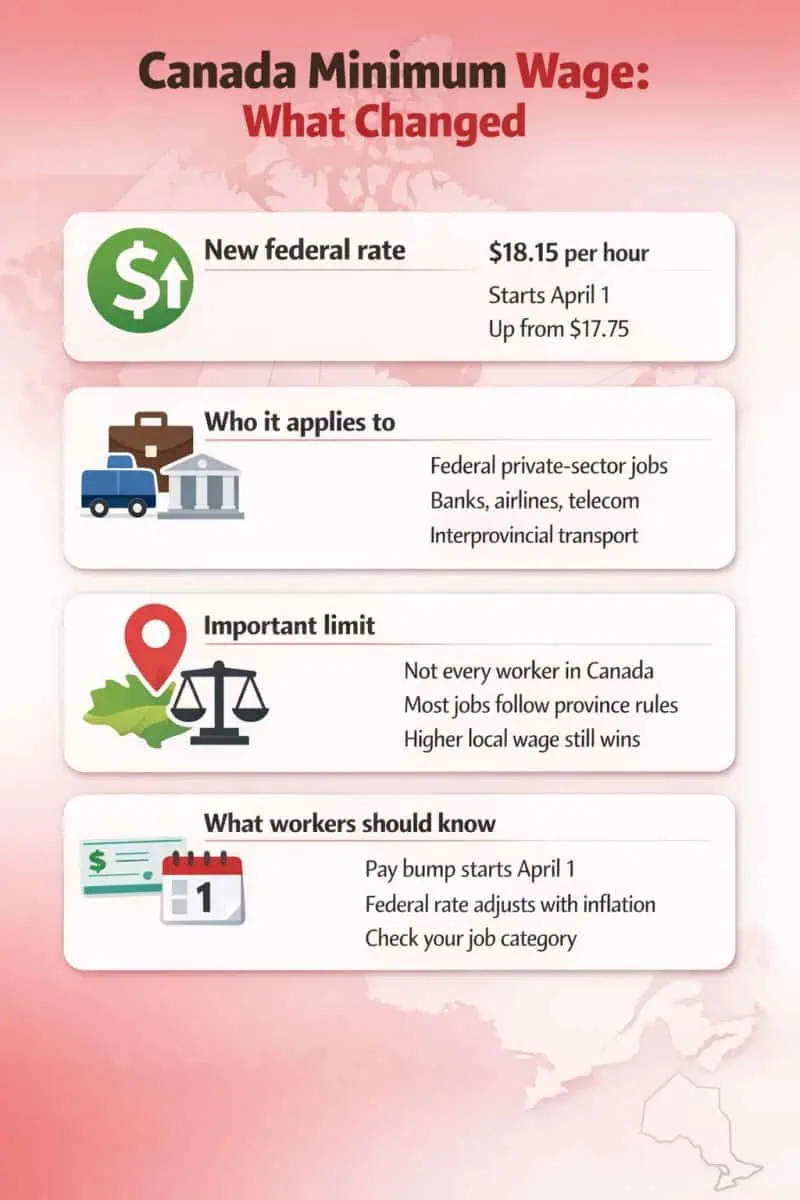
Canada has announced a new federal minimum wage increase. Starting April 1, 2026, the federal minimum wage will move from $17.75 to $18.15 an hour, after the government’s March 24 announcement. The change is tied to inflation and applies to workers in the federally regulated private sector.
That scope matters. This is not a blanket wage change for every worker in every province. In Canada, most jobs are covered by provincial or territorial employment rules, while the federal labour regime covers about 1.02 million workers across roughly 19,150 employers, or about 6% of employees in Canada.
What changed on March 24
The federal government said the new rate will take effect on April 1, 2026. The increase is 40 cents an hour, which works out to about $16 more a week on a 40-hour schedule, or roughly $832 more over a full 52-week year, before deductions. The government also said the new rate represents a 21% cumulative increase since the standalone federal minimum wage was introduced in 2021.
Why the wage is going up
The federal minimum wage is adjusted every year on April 1 using Canada’s annual average Consumer Price Index from the previous calendar year, then rounded up to the nearest $0.05. For this increase, the government said the relevant inflation figure was 2.1% in 2025.
Who actually gets the new Canada minimum wage
This rate applies to employees in the federally regulated private sector. That includes sectors such as banks, airlines, airports, interprovincial trucking and buses, railways that cross borders, telecommunications, postal and courier services, some Crown corporations, marine shipping, and pipelines crossing provincial or international borders.
There is another key rule: if the provincial or territorial minimum wage where the employee works is higher than the federal rate, the employer must pay the higher local wage instead.
What this means for workers
For workers already paid at the federal minimum, this is a direct pay bump starting April 1. For others, it is more of a signal than a personal raise. Many workers in retail, food service, salons, and local businesses are under provincial rules, so whether they see a wage change depends on their own province or territory, not this federal announcement.
Federal minimum wage timeline
Since the standalone federal minimum wage began, the rate has moved like this: $15.00 in 2021, $15.55 in 2022, $16.65 in 2023, $17.30 in 2024, $17.75 in 2025, and now $18.15 in 2026.
Why this story matters
The March 24 update is important because headlines can make it sound like all minimum wages in Canada changed at once. They did not. What changed today is the federal wage floor. For workers in federally regulated jobs, the increase is real and immediate on April 1. For everyone else, the next move still depends on their province or territory.
FAQs
Is Canada’s minimum wage now $18.15 everywhere?
No. The new $18.15 rate is the federal minimum wage, not a single Canada-wide wage for every job. Most workers are covered by provincial or territorial rules.
When does the new federal minimum wage start?
It starts on April 1, 2026.
What was the old federal minimum wage?
The current federal rate before this change is $17.75 an hour, which took effect on April 1, 2025.
What if my province pays more than $18.15?
Your employer must pay the higher provincial or territorial rate if it is above the federal rate.
Sources: Government of Canada news release on the March 24, 2026 federal minimum wage increase; Canada Labour Program federal wage rules; Government of Canada pages on federally regulated industries and federal labour standards.
