
The next Bank of Canada rate announcement is set for March 18, 2026. For homeowners, buyers, and anyone carrying variable debt, this is the update that could shape the next few months of borrowing costs.
The most likely outcome is no change. The Bank held its policy rate at 2.25% in January, and recent reporting suggests economists still broadly expect another hold in March while policymakers watch inflation, growth, and global risks.
That does not mean the decision is simple. Inflation is close to target, but growth remains modest, the labour market is not especially strong, and a fresh jump in oil prices has made the near-term inflation picture less comfortable.
What happens on March 18
The Bank of Canada’s next scheduled rate decision is Wednesday, March 18, 2026. Unlike January and April, this is not one of the dates paired with a full Monetary Policy Report, so the release will be more limited than a major forecast day.
That matters because markets and borrowers may get a clear decision, but not the same depth of updated projections they would see in an MPR release. In practice, that means the statement language and Governor Tiff Macklem’s tone will carry more weight than usual. This is an inference based on the Bank’s 2026 release schedule.
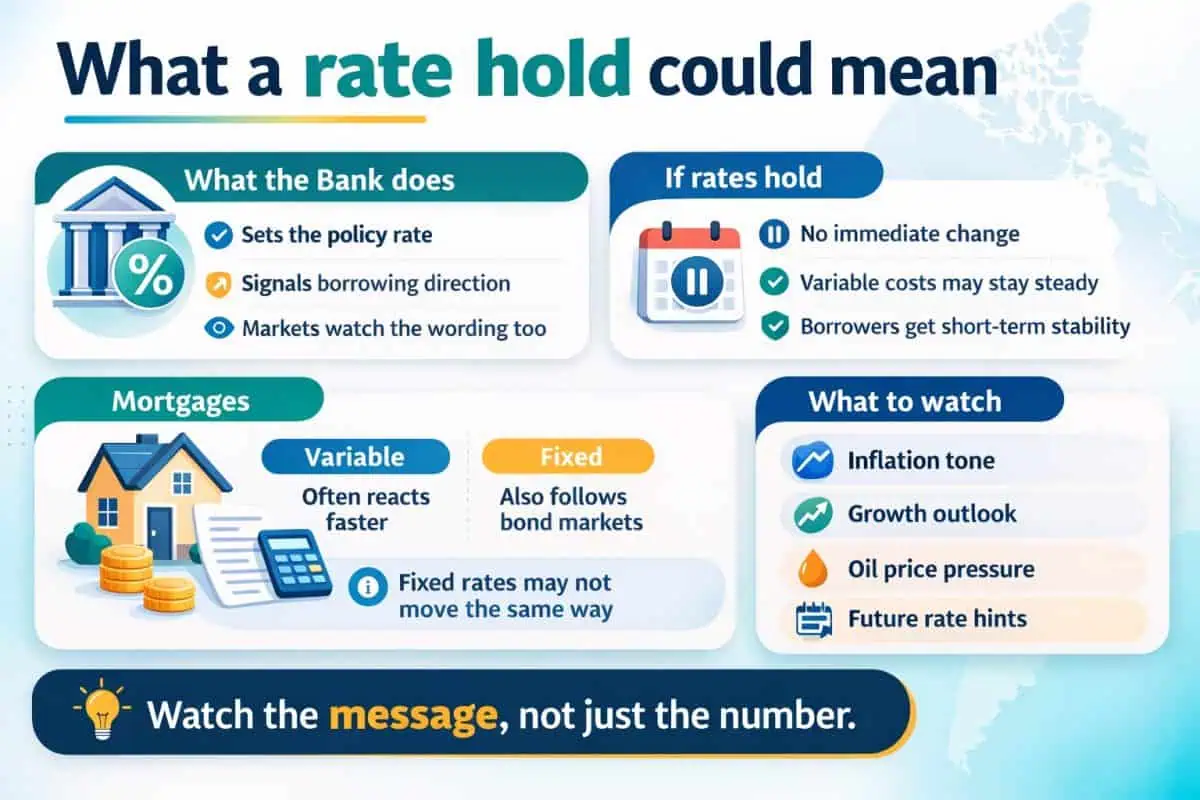
The case for a hold
The Bank’s January message was that 2.25% looked about right if its forecast held up. It said the outlook for Canada and the global economy was little changed, while also warning that trade policy and geopolitical risks made the path ahead harder to read.
Since then, inflation has not given the Bank a clear reason to rush into another cut. Statistics Canada said the Consumer Price Index rose 2.3% year over year in January, down from 2.4% in December, while CPI excluding food and energy was 2.4%.
Shelter inflation also continued to cool, with shelter costs up 1.7%, rent up 4.3%, and the mortgage interest cost index up 1.2% year over year.
At the same time, the economy still does not look strong enough to make a hike likely. The Bank’s January Monetary Policy Report said growth should remain modest and inflation should stay near 2%, while Statistics Canada’s latest GDP release said real GDP by industry grew 1.6% in 2025 and that the advance estimate pointed to a flat January 2026.
The labour market also gives the Bank a reason to stay cautious rather than aggressive. In January, employment edged down by 25,000 and the unemployment rate fell to 6.5%, largely because fewer people were looking for work. Private-sector employment also fell.
Put together, that mix still looks more like a pause than a move.
The new complication: oil and global risk
What changed in the last few days is energy. Reuters reported on March 11 that a Middle East conflict-driven oil spike is making it harder for central banks to keep leaning toward easier policy, because higher energy prices can feed inflation even when growth is fragile.
That does not automatically mean the Bank of Canada will turn hawkish next week. But it does mean the “easy case” for future rate cuts looks less clean than it did when January inflation came in slightly softer than expected.
Reuters reported in mid-February that cooler Canadian inflation had boosted rate-cut bets, but the latest oil shock has pushed markets back toward caution.
For readers, the practical takeaway is simple: even if March ends in a hold, the statement could sound less relaxed about inflation than borrowers were hoping.
What this could mean for mortgages
Variable-rate mortgages and HELOCs
Variable-rate products are the most directly exposed to the Bank of Canada’s policy rate because lenders use prime as a reference point, and variable mortgages are often priced as prime plus or minus a spread. The Financial Consumer Agency of Canada says this is often how variable mortgages are structured.
So if the Bank holds on March 18, many borrowers with variable-rate mortgages or lines of credit should expect their rate to stay where it is, at least immediately. If the Bank surprises with a cut, these products would likely feel the change first.
Fixed mortgages
Fixed mortgages are different. The Bank of Canada explains that mortgage pricing depends on lenders’ funding costs and profit margins, and fixed mortgage rates do not move one-for-one with the overnight rate. Buyers comparing new-build costs can also read about Ontario’s planned HST relief on qualifying new homes, including the proposed eligibility limits.
CMHC’s 2026 Housing Market Outlook says variable mortgage rates are expected to stay stable in early 2026, but fixed rates are more likely to rise because long-term bond yields remain high.
That is why some Canadians may not get the relief they expect even if the Bank sounds softer later this year. A calm rate decision can still come with stubborn fixed mortgage pricing.
If higher mortgage or loan payments are squeezing your budget, it also helps to check what Ontario benefit payments you may qualify for.
What this could mean for other borrowing
For borrowers outside housing, the March decision still matters.
A hold would usually mean no immediate relief for variable-rate lines of credit and similar borrowing tied closely to prime. Credit cards are less directly linked to the Bank’s overnight rate, so don’t expect a March decision to suddenly make card debt cheap.
The broader benefit of a hold would be stability, not a dramatic drop in monthly costs. This borrowing-cost interpretation is based on FCAC’s explanation of prime-linked lending and the Bank’s own description of how policy rates flow through to household borrowing costs. Student borrowers can compare the rate structures in our OSAP versus private loans guide.
For businesses, the same logic applies. Holding at 2.25% keeps the cost backdrop more predictable, but it does not erase tighter financing conditions that built up during the higher-rate period.
What Canadians should watch in the statement
Borrowers should focus on four things on March 18:
1. Any change in the Bank’s inflation tone
If policymakers sound more worried about energy and global supply shocks, markets may start pushing expected rate cuts further out.
2. Any signal on growth weakness
If the Bank leans harder on modest growth, soft jobs data, and weak momentum, that would support the case that rates are on hold for now because the economy cannot absorb more pressure.
3. Mortgage language
Shelter inflation has cooled, but rent is still rising faster than overall CPI. That makes housing a tricky part of the inflation story.
4. What the Bank says about the next move
The March decision may matter less than the wording around April 29, when the next full Monetary Policy Report is due.
New vs. known
What’s new now:
A fresh oil shock has made the inflation outlook noisier right before the March meeting.
What was already known:
The Bank was already signalling caution, inflation was close to target, and growth was expected to stay modest.
Impact box
If the Bank holds at 2.25%
- Variable mortgage holders likely see no immediate change.
- HELOC and other prime-linked borrowers likely stay roughly where they are.
- Fixed mortgage shoppers may still face stubborn pricing because fixed rates follow broader market conditions, not just the Bank’s overnight rate.
If the tone turns more cautious on inflation
- Markets may price out near-term cuts.
- Fixed rates could stay firm even without a formal rate increase.
Borrowing costs are only one part of the monthly budget, so drivers may also want to compare ways to lower car insurance costs in Ontario.
Numbers to know
- Current Bank of Canada policy rate: 2.25%
- Next rate decision: March 18, 2026 at 9:45 a.m. ET
- January 2026 CPI: 2.3% year over year
- January 2026 unemployment rate: 6.5%
- 2025 GDP by industry growth: 1.6%
Timeline
- January 28, 2026: Bank of Canada holds at 2.25% and says the current setting should keep inflation near target if forecasts hold.
- February 17, 2026: Statistics Canada reports January CPI at 2.3%.
- February 27, 2026: Statistics Canada says GDP by industry grew 1.6% in 2025; advance estimate points to a flat January 2026.
- March 11, 2026: Oil-price shock adds fresh inflation uncertainty.
- March 18, 2026: Next Bank of Canada rate decision.
For many workers, rate changes matter because money stress at home often spills into the job, especially when workplace pressure and financial pressure start building at the same time.
