
People try to guess a number (like “10 mistakes” or “15 mistakes”), but the G2 road test doesn’t work like that. There’s no official, public “mistakes allowed” number. Examiners use a standardized scoresheet and decide whether you demonstrated safe, consistent driving overall.
What this means in real life:
- A few small slip-ups can still be a pass.
- One unsafe or illegal move can still be a fail, even if the rest was perfect.
Before you book, it helps to map out your costs (test fees, fuel, a lesson or two) using our student budget planner.
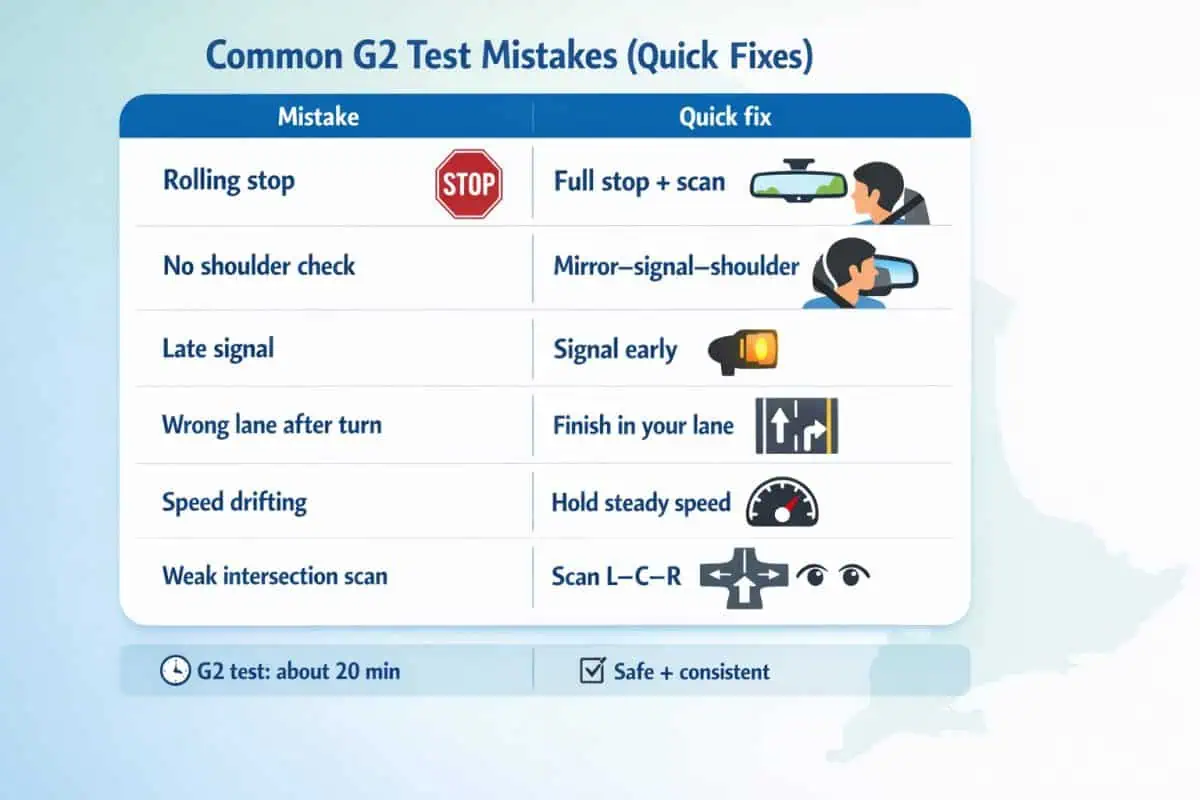
What you’re actually being judged on (not “mistake count”)
DriveTest uses predefined routes and driving tasks, and examiners score what happens during the drive using set categories (observation, turns, lane changes, speed control, stopping, parking, and overall safety).
For the Class G2 road test, it’s a basic “city skills” test that usually takes about 20 minutes.
So instead of asking “How many mistakes can I make?”, the better question is:
“Did I drive safely, legally, and consistently—with good observation?”
The mistakes that can fail you fast
Even though there isn’t a simple published “automatic fail list,” examiners can stop (or fail) a test when safety is at risk.
These are the common high-severity errors that often lead to fails because they create danger or break traffic rules:
- Not yielding when you must (pedestrians, right-of-way situations, turning conflicts)
- Rolling stops or not stopping properly at stop signs
- Running a light or entering when it’s unsafe
- Dangerous lane changes (especially without blind-spot checks)
- Speeding in a way that’s unsafe for conditions
- Forcing other drivers to brake or react because you went when you shouldn’t
- Hitting something (curb hard enough to show loss of control, or any collision)
You don’t need to be “perfect.” You do need to be predictable and safe.
If you like learning with a checklist, this approach is similar to how people prep for the Ontario boating licence test—repeat the same core steps until they’re automatic.
Common mistakes on the G2 road test (and how to fix them)
Here’s what shows up again and again on G2 scoresheets—because it’s easy to miss under stress.
Observation mistakes (most common)
| Mistake | What the examiner sees | Fix that works |
|---|---|---|
| No shoulder check | You change lanes/turn without confirming blind spot | Mirror → signal → shoulder check → move |
| Staring straight ahead | You miss hazards at intersections | Scan: left–centre–right, then move |
| Weak mirror use | You don’t monitor traffic behind | Quick mirror checks every ~5–8 seconds (when safe) |
Stops + intersections
| Mistake | What the examiner sees | Fix that works |
|---|---|---|
| Rolling stop | Wheels don’t fully stop | Stop fully, pause, then creep only if needed |
| Turning too fast | You’re not in control | Slow before the turn, smooth steering, steady speed |
| Cutting corners | You drift into the wrong lane | Aim to land cleanly in your lane after the turn |
Lane position + speed control
| Mistake | What the examiner sees | Fix that works |
|---|---|---|
| Too close to curb/parked cars | Risky spacing | Give parked cars room; watch for doors opening |
| Inconsistent speed | You speed up/slow down randomly | Hold steady speed; adjust early, not last-second |
| Late decisions | Sudden braking/turning | Plan early: signal + position well ahead |
Parking (parallel / reverse / 3-point)
| Mistake | What the examiner sees | Fix that works |
|---|---|---|
| Poor observation while reversing | No checks before moving | Check mirrors + shoulder, move slowly, keep scanning |
| Rushing | Jerky steering/braking | Go slow. You’re graded on control, not speed |
If you’re booking around peak travel weekends, check Ontario statutory holidays so you don’t get stuck with long lines and limited test slots.
A simple “pass-minded” routine for your next practice drive
Do this for 3–5 drives before your test. It builds the habits examiners want to see.
- Every lane change: mirror → signal → shoulder check → change
- Every stop sign: full stop → scan → proceed only when clear
- Every turn: slow first → correct lane → smooth turn → straighten
- Every reverse movement: look all around → move slowly → keep scanning
If you do those four things consistently, you remove a huge chunk of common fails.
Once you pass, your first few solo drives feel easier if you start with short routes—our guide to camping near Toronto has simple highway-adjacent trip ideas you can use as low-stress practice drives. Before buying a vehicle after your test, use the Ontario used-car checklist to review the ownership paperwork.
Test-day checklist that saves people
- Arrive at least 30 minutes early.
- Your vehicle has to meet minimum requirements and be in good working order (or the test can be marked “out-of-order”).
- No recording devices (dashcams/action cams) unless disabled as required.
- No extra passengers (only the examiner).
If you fail: what happens?
You can take the road test again as long as your licence is valid. Retests are typically booked after a waiting period (commonly about 10 days), depending on availability and the type of test.
Use your scoresheet feedback as a practice plan. Don’t just “try again”—target the exact categories you lost marks in.
Not sure how retests affect your budget and timing? This G1 to G timeline and costs guide for Ontario breaks down the full path.
How many mistakes are allowed on the G2 road test FAQs
Is there a set number of mistakes allowed on the G2?
No. There isn’t a publicly posted number. It depends on what the mistakes were and whether your driving stayed safe and legal overall.
How long is the G2 road test?
About 20 minutes (typical).
Can I use a dashcam during the test?
Recording devices aren’t permitted unless they’re disabled per the testing rules.
