
In Ontario (and all of Canada), what most people mean by a “boating licence” is your proof of competency, usually the Pleasure Craft Operator Card (PCOC). This guide is designed for solo prep: actual buoy meanings, key rules, required equipment basics, emergency actions, and practice questions.
1) Do you need a boating licence in Ontario?
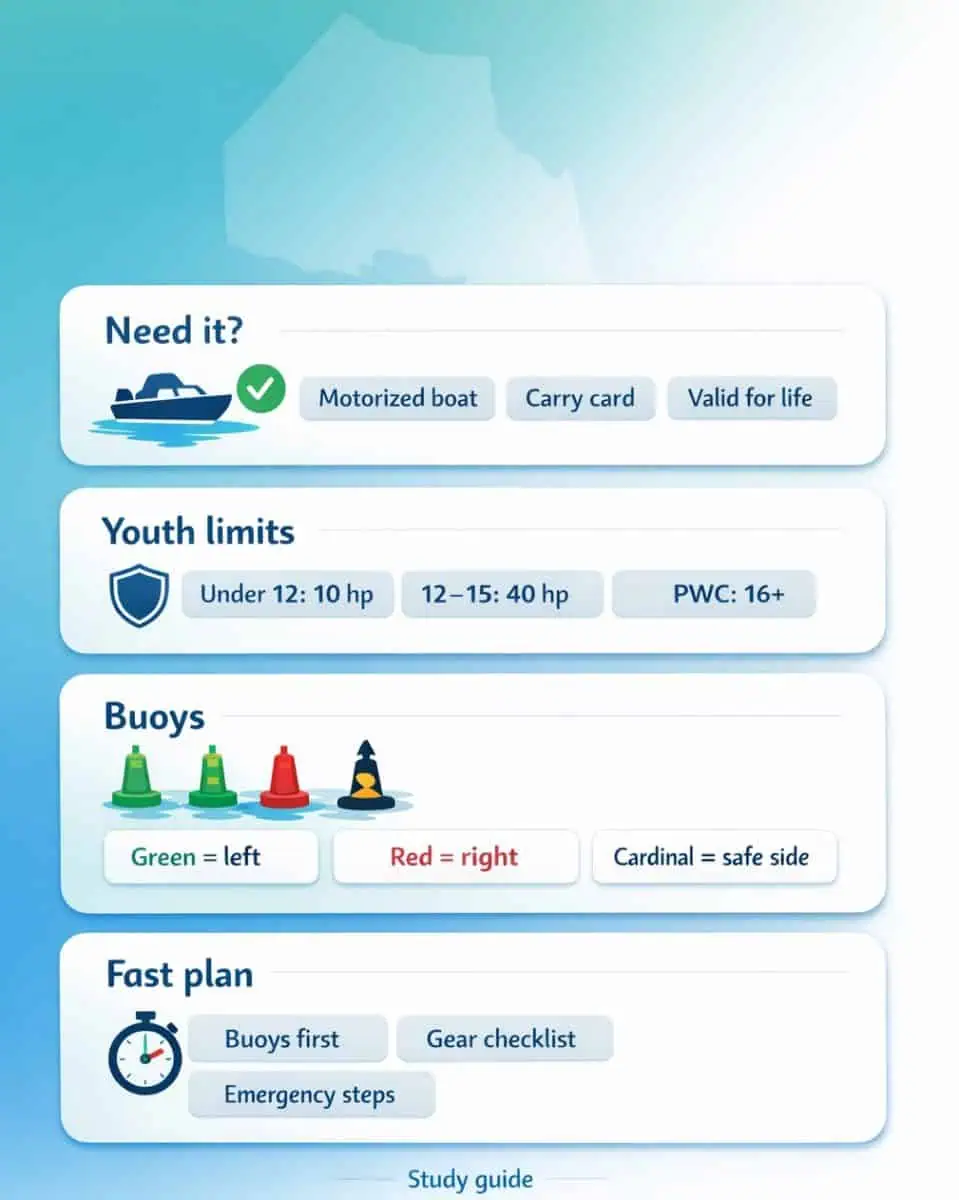
You generally need proof of competency if you operate a recreational boat with a motor (including electric trolling motors)—and that includes cases where the motor is off (example: sailing with an auxiliary motor installed).
Two things people miss:
- PCOC is valid for life.
- Copies don’t count as proof (so don’t rely on a photo or screenshot). Carry the actual card.
2) Youth rules to memorize (these show up a lot)
If you’re under 16, horsepower limits apply unless directly supervised, and PWC rules are stricter:
- Under 12 (not supervised by someone 16+): up to 10 hp (7.5 kW)
- Age 12–15 (not supervised by someone 16+): up to 40 hp (30 kW)
- Personal watercraft (PWC): only 16+, even if supervised
“Direct supervision” means a person 16+ is in the boat and actively supervising.
3) Buoys and markers: what they mean (the testable part)
Canada is in Region B, where red = starboard-hand and green = port-hand (when travelling in the “upstream” direction).
Lateral system (red/green channel buoys)
Think: “Upstream direction” = heading inland / into a harbour / up a channel.
| What you see | What it means | What you do |
|---|---|---|
| Green buoy with odd number | Port-hand marker | Keep it on your left when heading upstream |
| Red buoy with even number | Starboard-hand marker | Keep it on your right when heading upstream |
| Red/white vertical stripes | Fairway / safe water (often channel entrance or centre) | Generally indicates safe water; common exam answer: keep it to port (left) |
| Bifurcation (junction) buoy | Channel splits | Top/dominant colour shows preferred channel (mostly green = preferred channel on port side; mostly red = preferred channel on starboard side) |
Cardinal buoys (black + yellow): “safe water is to the…”
These tell you which side is safe, not “left/right of channel.”
- North cardinal: safest water is north of it
- East cardinal: safest water is east of it
- South cardinal: safest water is south of it
- West cardinal: safest water is west of it
Quick memory trick:
- North = 12 o’clock
- East = 3 o’clock
- South = 6 o’clock
- West = 9 o’clock
Isolated danger buoy (black with a red band)
Marks a danger with navigable water all around (example: a rock/shoal you can go around).
Common Ontario “special” buoys (orange symbols)
- Keep out: you may not enter the area
- Hazard: hazard symbol inside an orange diamond (rocks, shoals, etc.)
- Information: info symbol inside an orange square
- Cautionary: warns of special hazards/areas (pipelines, ranges, race courses, seaplane base, etc.)
If you’re boating mainly to fish, make sure you also have the right fishing licence in Ontario before you head out.
4) Required safety equipment (what questions target)
Questions often test whether you understand that equipment rules vary by boat type and length, and that gear must be accessible and usable (not buried under luggage).
For a very common scenario—small recreational boats—expect questions on:
- Lifejacket/PFD for each person (proper size, good condition)
- Reboarding device (ladder/steps) when needed
- Buoyant heaving line (often tested as 15 m)
- Bailer or manual bilge pump
- Sound-signalling device
- Navigation lights
- Watertight flashlight or flares (depending on boat setup)
- Paddle OR anchor + line
- Fire extinguisher when risk factors exist (like inboard engine / fixed tank / fuel-burning appliance)
A practical rule that often appears in scenarios: if it’s hard to climb back in from the water, you need a real way to reboard (not “I’ll just pull myself up”).
If your fishing plan includes camping, Ontario Parks reservations can be the difference between a last-minute scramble and an easy launch.
5) Core “rules of the road” ideas (how exams frame them)
You’re usually being tested on judgment:
- Safe speed depends on visibility, traffic, hazards, and stopping distance. Poor visibility = slow down.
- Wake responsibility: if your wake puts others at risk or damages property, you’re responsible. Near swimmers/docks = reduce wake.
- Keep a proper lookout (eyes + ears), and assume others make mistakes.
6) Emergency actions you should be able to say out loud
Person overboard (sequence)
- Shout and alert everyone
- Throw something that floats (also marks the spot)
- Assign a spotter who keeps eyes on the person
- Approach carefully and recover from a safe side (don’t run them over)
- Use a heaving line / lifebuoy on a line for recovery
Cold water reality check
Cold water can cause a fast breathing “gasp” response and quick fatigue. The safe mindset is: float first, control breathing, conserve energy, then act.
Fire on board (high-level)
Get everyone in PFDs, use an extinguisher aimed at the base of the fire, and keep smoke/flames away from you if possible.
7) Practice questions (with answers)
Q1. You’re travelling upstream and see a green buoy marked “7.” What does it mean and where do you keep it?
A) Starboard-hand; keep right
B) Port-hand; keep left
C) Fairway; pass either side
D) Isolated danger; keep away
Answer: B.
Q2.You’re travelling upstream and see a red buoy marked “12.” What do you do?
Answer: Keep it on your right.
Q3. A buoy has red and white vertical stripes. What is it?
A) Port-hand
B) Fairway / safe water
C) Hazard buoy
D) South cardinal
Answer: B.
Q4. A south cardinal buoy means the safest water is:
A) North of it
B) East of it
C) South of it
D) West of it
Answer: C.
Q5. A buoy is black with a broad red horizontal band. What does it warn you about?
Answer: An isolated danger (danger near it; navigable water all around).
Q6. What does a keep out buoy mean?
Answer: You may not enter the marked area.
Q7. Which statement is true about proof of competency?
A) Only gas motors count
B) Electric trolling motors don’t count
C) If your motor is off, you don’t need it
D) Motor-equipped boats generally require proof of competency for recreation
Answer: D.
Q8. Is a photo of your PCOC on your phone acceptable as proof?
Answer: No.
Q9. A 14-year-old is boating without direct supervision. What’s the maximum engine power allowed?
A) 10 hp
B) 40 hp
C) 90 hp
D) No limit
Answer: B.
Q10. Who can operate a personal watercraft (PWC)?
A) Anyone with a PCOC
B) Anyone 14+ with supervision
C) Only 16+
D) Only 18+
Answer: C.
Q11. List two things you do immediately when someone falls overboard.
Answer (any two): Throw something that floats, assign a spotter, slow/stop, shout/alert.
Q12. A “safe speed” depends on visibility, traffic, hazards, and how your boat handles. True or false?
Answer: True.
Planning for long weekends? Check Ontario statutory holidays to avoid packed launches and busier water.
8) Solo study plan (fast + effective)
Session 1 (45–60 min): Buoys
- Lateral (red/green + odd/even), fairway, bifurcation
- Cardinal + isolated danger + orange regulatory buoys
- Redo Q1–Q6 until you answer instantly
Session 2 (45–60 min): Equipment
- Memorize the common “small boat” items
- Do scenarios: night boating, fog, passengers, reboarding
Session 3 (30–45 min): Emergencies + rules
- Person overboard sequence
- Safe speed + wake responsibility
- Do Q7–Q12 and explain answers out loud
If you’re trying to keep it close, this list of camping near Toronto spots pairs well with a simple fishing-and-boating weekend.
