
If you want one “works-for-most-people” answer, Ottawa usually wins: it’s big enough for solid job options and city life, but it’s not priced like the GTA. That said, Ontario doesn’t have one perfect city—your “best” depends on whether you care most about rent, commute, career options, or day-to-day vibe. For a rental budget, the Ontario rent increase guide explains how to assess a future increase notice.
Below is a practical way to pick your city, plus a comparison table using:
- Rent + vacancy (Oct 2025) from CMHC’s Rental Market Survey (purpose-built rentals; “Total” across unit sizes)
- Crime Severity Index (CSI, 2024) from Statistics Canada (CMA-level)
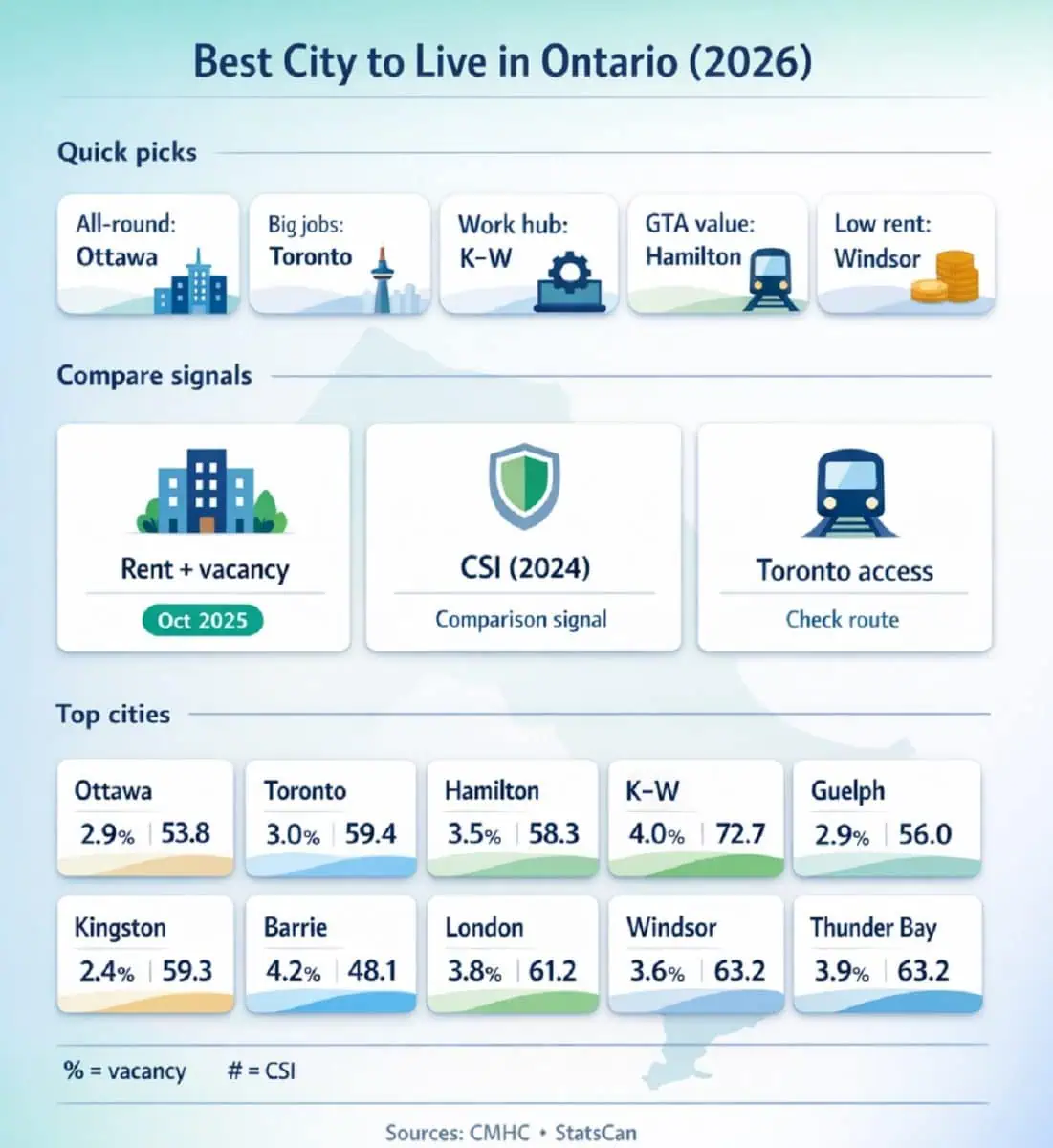
Quick picks (so you can stop scrolling)
- Best all-rounder: Ottawa
- Best for “live + work” with tech/office careers: Kitchener–Cambridge–Waterloo
- Best if you want the biggest job market + transit: Toronto (and the GTA)
- Best value near the GTA: Hamilton
- Best student-city feel: Kingston or Guelph
- Best affordability (bigger city): Windsor
- Best outdoors + smaller-city pace: Thunder Bay (but check winter + safety signals)
What CSI is (and what it isn’t)
CSI = Crime Severity Index. It’s a Statistics Canada measure that reflects both the volume and the seriousness of police-reported crime, indexed to 2006 = 100. Lower CSI generally means less severe police-reported crime compared with places above 100. It’s still just a signal:
- it doesn’t tell you what a specific neighbourhood feels like
- reporting and policing practices can affect numbers
- use it as a comparison tool, not a “safe/unsafe” label
Comparison table: rent, vacancy, and CSI (Ontario)
How to read this table
- Avg rent = CMHC purpose-built rentals, total across unit sizes (Oct 2025)
- Vacancy = CMHC vacancy rate (Oct 2025)
- CSI = StatsCan Crime Severity Index, CMA-level (2024)
| City / Region | Avg rent (Oct 2025) | Vacancy (Oct 2025) | CSI (2024) | Best fit if you… |
|---|---|---|---|---|
| Ottawa | $1,743 | 2.9% | 53.8 | want balance + stable “big city” life |
| Toronto | $1,917 | 3.0% | 59.4 | want the biggest job market + transit |
| Hamilton | $1,552 | 3.5% | 58.3 | want GTA access without GTA pricing |
| Kitchener–Cambridge–Waterloo | $1,716 | 4.0% | 72.7 | want a strong work hub + mid-sized pace |
| Guelph | $1,759 | 2.9% | 56.0 | want calm, clean, “easy living” vibes |
| Kingston | $1,713 | 2.4% | 59.3 | want a walkable student city + history |
| Barrie | $1,697 | 4.2% | 48.1 | want space + a Toronto commuter option |
| London | $1,551 | 3.8% | 61.2 | want a bigger student city at lower cost |
| St. Catharines–Niagara | $1,445 | 3.8% | 62.7 | want “GTA-adjacent” + wineries/outdoors |
| Windsor | $1,293 | 3.6% | 63.2 | want affordability + cross-border economy |
| Thunder Bay | $1,395 | 3.9% | 107.7 | want low costs + nature + smaller city pace |
Verdict (most people): Ottawa.
It’s the cleanest “middle path” on cost, city amenities, and a CSI that’s well below the 2006=100 benchmark.
Before you pick a city, run a quick Ontario paycheque estimate so your rent target is based on take-home pay, not your hourly rate.
The GTA cities people ask about: Mississauga + Brampton
If you’re deciding between Toronto vs. Mississauga vs. Brampton, treat it like a commute-and-neighbourhood decision, not a “different economy” decision.
A useful 2025 signal: CMHC noted that post-secondary neighbourhoods in Mississauga and Brampton had vacancy rates climb above 4%—that matters if you’re renting near campuses, because more vacancy can mean more choice (and sometimes better deals or incentives).
Commute reality check:
If you’ll be going downtown often, look at GO options. For example, GO’s Milton line has trips around 67 minutes from Milton GO to Union Station on sample schedules (times change—always verify in the trip planner).
If you’re not sure which places count as GTA-adjacent, this guide to Southern Ontario regions and city clusters makes the geography easy.
A simple “City Score” you can copy
Pick the 3 factors you care about most and score each city 1–5.
| Factor | Weight (1–3) | City score (1–5) | Weighted total |
|---|---|---|---|
| Rent + availability | |||
| Commute to Toronto | |||
| Career options | |||
| Transit + walkability | |||
| Safety signal (CSI) | |||
| Lifestyle (outdoors, arts, food) |
Rule of thumb: If a city wins on your top 2 weighted factors, it’s probably your best pick—even if it isn’t #1 overall.
When you compare job offers across cities, it helps to know the Ontario statutory holiday pay basics so you can spot real differences in total compensation.
City-by-city “who it’s best for”
- Ottawa: best for balanced living. Good if you want a real city without full GTA pricing.
- Toronto: best if you want maximum job variety, big-city transit, and you can handle higher costs.
- Kitchener–Cambridge–Waterloo: best if you want a “work-first” city with a strong hub vibe and access to the GTA.
- Hamilton: best value near Toronto; neighbourhood choice matters a lot here.
- Guelph: best for a calmer pace with city convenience and a strong “settle in” vibe.
- Kingston: best if you like a compact core, student energy, and quick access to waterfront/outdoors.
- Barrie: best if you want space and you’ll commute occasionally or seasonally.
- London: best if you want a bigger city at a lower cost, often with student-driven neighbourhoods.
- St. Catharines–Niagara: best if you want a lifestyle mix (outdoors + wineries + access to Buffalo/GTA drives).
- Windsor: best if your #1 goal is affordability in a larger city setting.
- Thunder Bay: best if you’re outdoors-first and okay with a smaller-city lifestyle (and real winter).
FAQs
What is the best city to live in Ontario for most people?
Usually Ottawa, because it balances city jobs, amenities, and costs better than most.
Which city is best to live in Ontario and work in Toronto?
If you’ll commute sometimes, look at Hamilton, Kitchener–Cambridge–Waterloo, or Barrie—then decide based on your actual commute route and neighbourhood.
Is Toronto still the best city in Ontario to live and work?
It’s the best for job variety and transit. It’s not the best if housing costs are your #1 constraint.
Why use vacancy rate at all?
Vacancy is a “how hard will renting be?” signal. Higher vacancy usually means more options (and sometimes incentives).
Should I use CSI to judge a city’s safety?
Use it only as a comparison signal, then check neighbourhood-level realities (and your own routine: transit stops, walking at night, etc.).
