
Southern Ontario is the part of Ontario closest to the U.S. border and the Great Lakes. It’s where you’ll find Toronto, Hamilton, London, Windsor, Niagara Falls, Kingston, and Ottawa—plus most of the province’s biggest campuses, hospitals, airports, and job hubs.
One thing trips people up: “Southern Ontario” doesn’t have a single, universally official border in everyday use. People use it in a few different (and valid) ways—administrative, geographic, and “commuter corridor.” The most accurate answer depends on what you’re trying to do.
Where is Southern Ontario?
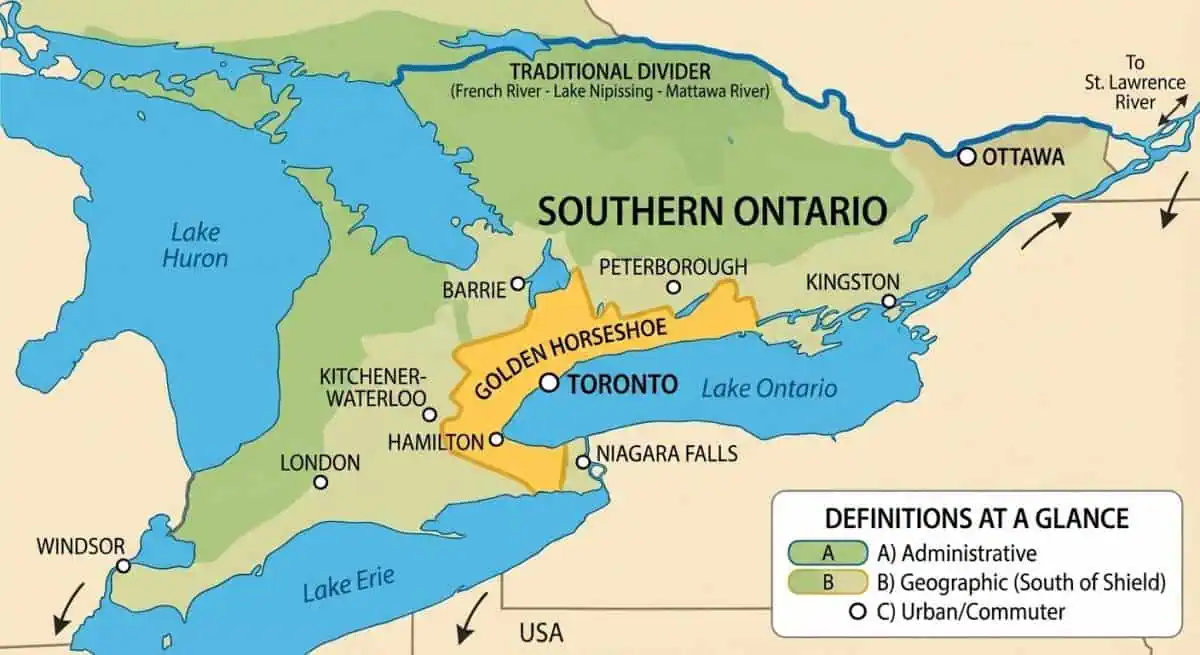
On a map, Southern Ontario is the wide southern arc of the province along Lake Erie, Lake Ontario, Lake St. Clair, and the southern edge of Lake Huron, stretching east toward the St. Lawrence River and Ottawa.
If you want the common “divider” you’ll hear in Ontario: many references describe a traditional boundary running along the French River → Lake Nipissing → Mattawa River corridor. That corridor is also tied to the historic Nipissing Passageway route (a key travel/waterway link used long before modern highways). This line is often used to explain why North Bay is called the “Gateway to the North.”
The 3 common definitions (and which one to use)
| Definition people use | What it includes | Use it when you’re asking… |
|---|---|---|
| A) Administrative (“program boundary”) | “Everything that isn’t Northern Ontario” under a program’s eligibility map | “Do I qualify for a Northern Ontario grant/funding?” “Does this count as Northern for a form?” |
| B) Geographic (“south of the Shield”) | The flatter, farmable lowlands and dense settlement zone south of the Canadian Shield transition | “Will the landscape/climate/roads feel like ‘up north’?” “Is this more farmland/flat or rocky/lake country?” |
| C) Urban/commuter (“corridor”) | The busiest job-and-transit band, often anchored by the GTA + Golden Horseshoe | “Where’s the commuter zone?” “What counts as the GTA-adjacent market?” |
Verdict: If you need the cleanest, least-arguable answer, use Definition A (administrative): Southern Ontario = the part of Ontario that isn’t treated as Northern Ontario for the program you’re dealing with. It’s the definition that matters for funding, eligibility, and a lot of “official” situations.
A quick insider clue: counties/regions vs districts
Here’s a surprisingly reliable giveaway that you’re near (or in) “Northern Ontario” boundaries:
- In Southern Ontario, you’ll constantly see Counties and Regional Municipalities (for example, Peel Region, York Region, Wellington County, Bruce County).
- In much of Northern Ontario, the common large-area term is Districts (for example, Nipissing District, Sudbury District, Algoma District).
It’s not perfect (Ontario is messy), but if you’re reading a map or form and it keeps saying District, you’re often dealing with Northern Ontario geography or Northern-style administration.
The geography difference that makes the border feel “real”
The reason the border feels fuzzy—but also very real when you drive it—is the land itself.
- Much of the “north” sits on the Canadian Shield: older exposed rock, thinner soils, and landscapes heavily shaped by glaciation (lots of lakes, rugged outcrops, and forest).
- Much of the “south” includes the St. Lawrence Lowlands / Great Lakes lowlands: flatter terrain, deeper soils, and the kind of land that supports big cities, highways, and intensive farming.
That’s why some people use “south of the Shield” as their personal definition, even when a funding map draws the line differently.
Golden Horseshoe: the name you’ll hear on the news
You mentioned it already, but it’s worth one plain sentence because locals use it constantly:
The Golden Horseshoe is the U-shaped region wrapping around the west end of Lake Ontario—Niagara → Hamilton → Toronto and out through surrounding commuter communities. You’ll hear it in traffic, housing, and business news because it’s one of Canada’s densest economic regions. There’s also a broader planning term used by the province: the Greater Golden Horseshoe.
Transitional areas: Muskoka, Parry Sound, and “sometimes included”
Muskoka and Parry Sound are the classic “don’t assume” zones.
- Vibe-wise: many people call Muskoka “up north” because it looks and feels like Shield lake country.
- Administrative/funding-wise: Parry Sound and Nipissing are commonly treated as Northern in several political/economic contexts, and Muskoka may be included or excluded depending on the specific program and time period.
So if you’re reading a grant, tax rule, or funding eligibility page, don’t rely on the travel definition—check the program’s map/list.
Southern Ontario cities (grouped so it’s actually useful)
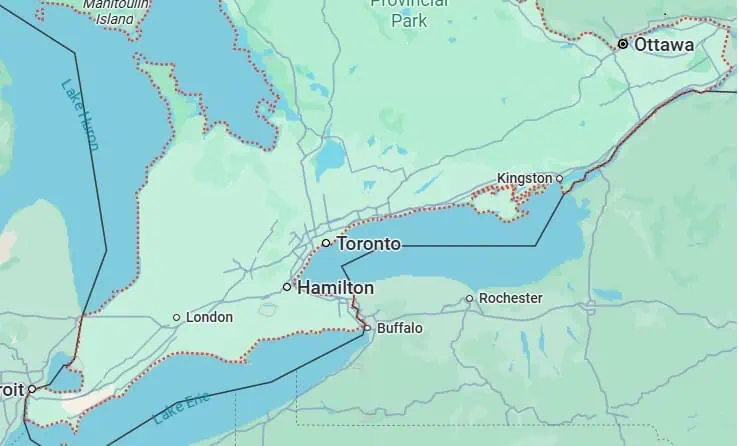
Below are major cities and well-known centres commonly treated as Southern Ontario in everyday use. It’s not an exhaustive list of every municipality. If you are comparing places to settle, the Ontario city guide looks at housing, work and travel trade-offs.
GTA and nearby commuter cities
Toronto • Mississauga • Brampton • Markham • Vaughan • Richmond Hill
Pickering • Ajax • Whitby • Oshawa • Milton • Newmarket • Aurora
Golden Horseshoe and Niagara
Hamilton • Burlington • Oakville
St. Catharines • Niagara Falls • Welland • Grimsby
Brantford
Southwestern Ontario
Windsor • London
Kitchener • Waterloo • Cambridge • Guelph
Sarnia • Chatham-Kent • Stratford • Woodstock
Eastern and Southeastern Ontario
Ottawa • Kingston
Belleville • Peterborough • Cornwall • Brockville
Central / near-north of the GTA (often included, depending on definition)
Barrie • Orillia • Collingwood
(Muskoka/Parry Sound may be treated as “north” for funding even when people casually group them with central Ontario.)
Ottawa’s dual identity (and why it feels separate)
Ottawa is absolutely a “southern-half” city on the map, and many people include it under Southern Ontario. But in everyday talk, it often sits in its own bucket:
- It’s Eastern Ontario, with its own commuting patterns and economy (government, tech, universities).
- It’s also far enough from Toronto—roughly a 4.5–5 hour drive depending on traffic/weather—that it doesn’t feel GTA-adjacent the way Hamilton, Kitchener-Waterloo, or Niagara do.
If someone says “Southern Ontario” and clearly means “Toronto zone,” Ottawa may not be what they’re talking about—even if it’s not “Northern.”
Summary table: definitions at a glance
| Feature | Definition A (Administrative) | Definition B (Geographic) | Definition C (Urban) |
|---|---|---|---|
| Boundaries | Program maps (often north incl. key districts) | “South of the Shield” transition | 401/QEW + major commuter corridors |
| Key vibe | “Where most people live” | “Less rocky forest, more lowlands/farms” | “The commuter zone” |
| Best for | Grants, funding, forms, eligibility | Road trips, hiking, landscape expectations | Jobs, transit, housing markets |
FAQs
Is Toronto in Southern Ontario?
Yes—Toronto is one of the core anchors of Southern Ontario.
Is Ottawa considered Southern Ontario?
Often yes (it’s in the southern half), but it’s also commonly called Eastern Ontario and functions as its own hub.
Where does “Northern Ontario” start?
A very common traditional divider is the French River–Lake Nipissing–Mattawa River corridor, but administrative definitions can shift by program.
Is Muskoka Southern Ontario?
In casual travel talk, it can be grouped with southern/central Ontario. In funding and political/economic contexts, it’s often treated as Northern or “north-adjacent,” depending on the program.
How: Verified geography/terminology and planning-region definitions using Ontario government planning documents and Ontario municipal governance references; checked 2026-01-19.
