
Paramedic pay sounds simple until you try to compare two job postings. One shows an hourly rate. Another talks about “steps,” shift premiums, and overtime. Then you hear someone say, “Don’t use 2,080 hours—use 2,184.” This guide explains Ontario paramedic wages in plain language, with real-world math you can use in two minutes.
Ontario paramedic pay: the quick answer
A reliable public starting point is the Government of Canada Job Bank wage data for Ontario. It reports a typical hourly wage range of:
- Low: about $30.75/hour
- Median: about $42.17/hour
- High: about $50.81/hour
That’s “base wage” data, before overtime and premiums.
If you’re still choosing the path, see how to become a paramedic in Ontario.
What that looks like per year (two ways)
Many people multiply by 2,080 hours (40 hours/week). Paramedic schedules are frequently different, so a lot of services treat 2,184 hours as “one full-time year” because of 12-hour rotations.
Here’s the same median wage ($42.17/hour) converted both ways:
- 2,080-hour year: $42.17 × 2,080 ≈ $87,700/year
- 2,184-hour year: $42.17 × 2,184 ≈ $92,100/year
That gap is why two paramedics with the same hourly rate can quote different “base salaries.”
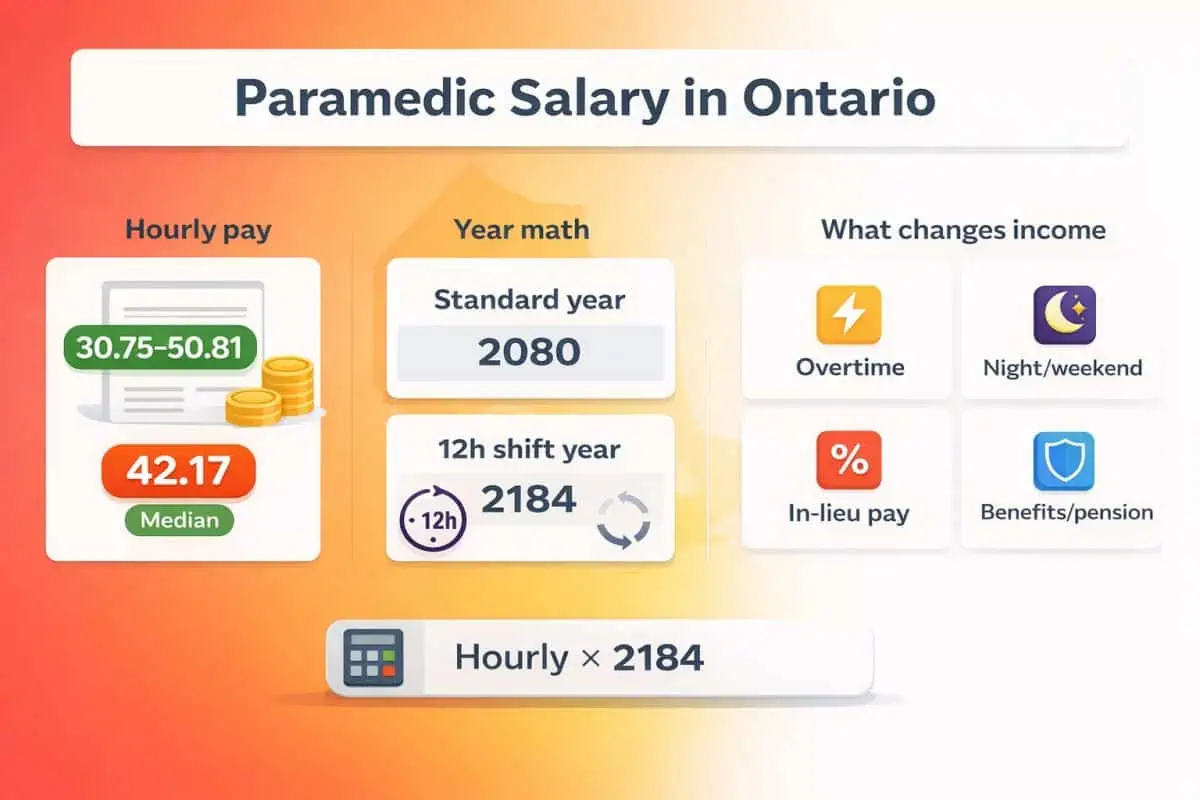
The 12-hour shift math: why 2,184 hours shows up
Many Ontario services use 12-hour shifts with a pattern like 4-on / 4-off (two days, two nights, four off). The math is simple:
- 4 shifts × 12 hours = 48 hours worked
- Those 48 hours happen over 8 days
- Weekly average: (48 ÷ 8) × 7 = 42 hours/week
- 42 × 52 = 2,184 hours/year
Real-world tip: pay grids and step increases may be written around 2,184 hours (not 2,080). Not every service uses the same rotation, so treat 2,184 as a common paramedic-year shortcut, not a rule.
Read: Estimate your Ontario take-home pay
“How much does a paramedic make?” (base pay)
Say a posting (or pay grid) shows $45/hour.
Base pay comparison table
| Calculation type | Hours/year | Total at $45/hr | What it helps you compare |
|---|---|---|---|
| Standard full-time | 2,080 | $93,600 | Quick compare to office jobs |
| “Paramedic year” | 2,184 | $98,280 | Closer to many 12-hour rotations |
| Add ~10% extra shifts | 2,402 | $108,090 | Shows how OT can change the year |
If you want a fast estimate for your own situation:
- Pick your hourly rate
- Multiply by 2,080 (standard) and 2,184 (common paramedic-year)
- Add extras only if they apply: shift premiums, overtime, in-lieu pay
Read: Build a monthly training budget
PCP vs ACP pay: what changes in Ontario
In Ontario, you’ll see roles like:
- PCP (Primary Care Paramedic)
- ACP (Advanced Care Paramedic)
- Some employers also have specialty roles (for example, critical care programs in certain settings)
Pay is employer-specific, but a few patterns show up again and again:
- ACP roles usually post higher rates than PCP in many regions and contracts, because the scope and training requirements are higher.
- “Starting rate” vs “top rate” can be far apart. Job ads may show a range, while the pay grid shows step-by-step increases.
- Experience credit matters. Some employers recognize a number of years from another service for wage placement.
Read: Student loan forgiveness in Ontario
Ontario wages can vary by region (even within the province)
Job Bank also shows regional wage data inside Ontario. The median can look similar across regions, but “low” and “high” values can shift. That’s one reason a job in one area may feel “better paying” even at the same step—especially once premiums and overtime are added.
What job postings don’t tell you (but your paycheque will)
1) Overtime and premiums
A base wage is just the start. A busy service with steady overtime can lift annual income a lot. Premiums may apply for nights, weekends, or holidays depending on the agreement.
2) Benefits vs “in lieu of benefits”
Part-time or casual roles sometimes pay an extra percentage instead of benefits (you’ll see language like “13% in lieu of benefits” plus vacation pay). That can make the hourly number look higher, but it’s replacing health/dental/pension value you might get as full-time.
3) Pension value
Many municipal paramedic roles include a pension plan. That doesn’t show up in the hourly number, but it matters for total compensation.
Three “check it like a pro” ways to verify pay
1) Read the collective agreement or wage schedule
If you can find the wage grid, you can see:
- the exact hourly rates by step
- how fast you move up
- what counts as a “year” (this is where 2,184 hours is commonly stated)
2) Use the Sunshine List as a reality check
Ontario publishes a public-sector disclosure list for employees paid $100,000+. For many paramedics, appearing on the list can reflect overtime-heavy years, senior steps, or higher-paying classifications. It’s not perfect (it’s a threshold list), but it can help you sanity-check what’s possible in a specific region.
3) Watch for market-moving contracts (example: Peel)
Ontario paramedic pay can shift when a large service settles a major contract. For example, reporting on Peel Region’s paramedic agreement described compounded wage growth that pushes hourly rates and base salary notably higher by the end of the term. When that happens, nearby employers may feel pressure to compete for staff.
Read: Severance pay rules in Ontario
Paramedic salary Ontario FAQs
How much does a paramedic make in Ontario per hour?
A common Ontario wage range is about $30.75 to $50.81/hour, with a median around $42.17/hour.
What is the average income for a paramedic in Ontario?
Using the median hourly rate, a simple base estimate is about $87,700/year with a 2,080-hour year, or about $92,100/year using a 2,184-hour “paramedic year.” Overtime and premiums can raise this.
How much does a paramedic make in Canada?
Job Bank reports a Canada-wide wage range of about $25.56 to $49.00/hour, with a median around $38.00/hour.
Why do people use 2,184 hours instead of 2,080?
Many paramedic services run 12-hour rotations that average about 42 hours/week, which converts to 2,184 hours/year. Some pay grids also use 2,184 hours for step progression.
Are paramedic jobs in Ontario salaried or hourly?
Most postings show hourly pay, then your yearly income depends on scheduled hours, the pay grid step, and any overtime/premiums.
Update log: First published 2026-01-12; Last reviewed 2026-01-12; What changed: Added 2,184-hour shift math, improved yearly estimates, expanded verification tips.
