
Ontario’s rent increase guideline for 2026 is 2.1%. That number matters only if your unit is covered by rent control (many are, but not all). The confusing part isn’t the math — it’s figuring out which rules apply to your unit, whether the landlord used the right notice, and what your options are if the increase is more than allowed.
The 2026 guideline in one line
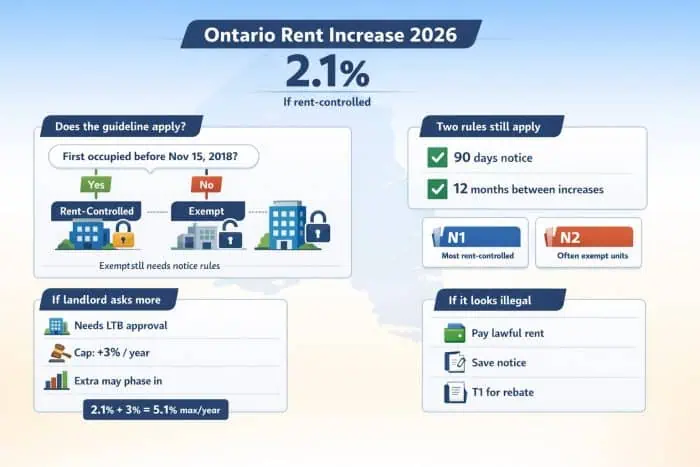
If your rental is rent-controlled, your landlord can usually raise rent by up to 2.1% in 2026 without Landlord and Tenant Board (LTB) approval.
Quick math (worked example)
- Current rent: $2,000/month
- Guideline: 2.1% → 2,000 × 0.021 = $42.00
- New rent: $2,042.00/month
Here are a few more common numbers:
| Current monthly rent | 2.1% increase | New monthly rent |
|---|---|---|
| $1,200 | $25.20 | $1,225.20 |
| $1,800 | $37.80 | $1,837.80 |
| $2,500 | $52.50 | $2,552.50 |
Step 1: Does the guideline apply to your unit?
Most “is this legal?” rent questions are really this question.
A simple decision tree you can screenshot
Did the unit exist / was it first occupied for residential use
ON OR BEFORE Nov 15, 2018?
├─ Yes → Usually rent-controlled → 2026 guideline (2.1%) applies
└─ No → Usually exempt from guideline → no % cap, but notice rules still apply
Why November 15, 2018 matters (real-world context)
Ontario created a major rent-control exemption for newer units first occupied after November 15, 2018. The policy goal was to encourage new rental construction and supply — but for tenants in those newer units, it means the annual guideline doesn’t cap increases. (Your landlord still has to follow timing + notice rules.)
Step 2: Check the two timing rules (these apply in most cases)
Even when your unit is exempt from the guideline, rent increases are not “whenever.”
- At least 12 months must pass since your last rent increase (or since you moved in).
- You must get at least 90 days’ written notice before the increase takes effect.
If either rule isn’t met, the increase can be invalid.
Step 3: Check the notice form (N1 vs N2)
The form is not just paperwork — it signals which legal track your landlord is using.
- N1 (Notice of Rent Increase): Typically used when your unit is covered by the guideline (rent-controlled).
- N2 (Notice of Rent Increase – partially exempt): Commonly used when the unit is exempt from the guideline (often because it was first occupied after Nov 15, 2018).
If you’re staring at a notice and thinking “this looks like something they typed in Word,” that’s a flag. A notice can fail because it’s on the wrong form or missing required details.
Above-guideline increases (AGIs): what they are and the “3% cap” people miss
Sometimes a landlord can apply to the LTB to raise rent above the guideline. This is called an AGI (Above Guideline Increase). The most common reasons include:
- Eligible capital expenditures (major repairs/replacements with multi-year benefit)
- Security services (in specific circumstances)
- Extraordinary increases in municipal taxes/charges (special rules)
Critical AGI detail: the cap is usually “guideline + up to 3%” (and it can be phased in)
When the AGI is based on capital expenditures or security services, the LTB generally cannot allow more than 3% above the guideline in any one year.
- In 2026, that means a “typical max” of 2.1% + 3% = 5.1% in a single year (for those AGI reasons).
- If the landlord justifies more than that, the extra amount is usually spread over the next two years, up to 3% above the guideline per year.
Important practical point: If your landlord is applying for an AGI, you may receive an N1 showing the higher amount — but you don’t have to pay the above-guideline portion unless and until the LTB orders it.
What to do if the rent increase looks illegal
The safest approach is usually:
- Keep paying your current lawful rent on time (don’t withhold everything).
- Don’t pay the extra amount if the increase is clearly not valid (wrong % for rent-controlled units, wrong timing, no proper notice, no LTB order for an AGI).
- Save paperwork: the notice, envelope/email trail, rent ledger, and any texts/emails.
Enforcement options (and why timing matters)
If you already paid an illegal increase, you can ask the LTB for a refund using Form T1 (Tenant Application for a Rebate of Money the Landlord Owes). Many T1 claims are time-sensitive, and Ontario law can treat rent as “lawful” if it goes unchallenged for too long — so acting sooner is better.
You can also contact the province’s Rental Housing Enforcement Unit (RHEU) for certain landlord offences and unlawful behaviour (it’s not a substitute for the LTB, but it can help in some situations).
Rent changes hit harder on part-time income, so it helps to sanity-check your student minimum wage situation and expected weekly hours.
Common scenarios (so you can sanity-check your situation)
Example 1: 2019-built condo, landlord serves N2 with a 5% increase
- If the unit was first occupied after Nov 15, 2018, it’s often exempt from the guideline.
- A 5% increase can be legal if the landlord gave 90 days’ notice and it’s been 12 months since the last increase/move-in.
Example 2: 2015 apartment, landlord serves N1 with a 3.5% increase
- If the unit is rent-controlled, 3.5% is over the 2.1% guideline for 2026.
- That’s not legal unless the landlord has an LTB-approved AGI order (or a valid above-guideline agreement in the narrow situations allowed).
Example 3: “My landlord said repairs mean rent goes up 7%”
- Repairs don’t automatically allow a bigger increase.
- For most AGIs tied to capital work/security, the increase is typically capped at up to 3% above the guideline per year, with any extra phased in (if approved at all).
If you’re thinking of picking up extra hours to cover the increase, check your take-home pay after deductions first.
Quick reference: what to pull up when you’re checking legality
- Your lease + any rent-increase notices from the last 2 years
- The notice form number (N1 or N2) and the effective date
- The “first occupied for residential use” timing (before/after Nov 15, 2018)
- Any LTB paperwork (AGI applications/orders)
- Your rent payment history (bank records or receipts)
Once you know your new rent, plug it into a monthly budget planner so you can see what you’ll need to cut (or earn) before the increase hits.
FAQs
What is the Ontario rent increase guideline for 2026?
It’s 2.1%, and it applies to most rent-controlled units for increases within 2026.
My unit is exempt from rent control. Can my landlord raise rent by any amount?
Often, yes — no percentage cap — but they still must follow the 90-day notice rule and the 12-month timing rule, and use the proper notice form.
If my landlord applies for an AGI, do I have to pay the higher amount right away?
Usually, no. Tenants generally pay the lawful rent unless the LTB issues an order approving the above-guideline amount.
What if I already paid an illegal increase?
You may be able to file Form T1 to seek a rebate/refund. Timing can matter a lot, so don’t sit on it.
For more visit official Ontario’s rent page
