
If you’re returning to school after 25 in Ontario, it’s normal to search for a single “mature student grant” and come up empty. Ontario funding doesn’t work like that. The money is real—but it usually shows up through OSAP-assessed grants, your school’s bursaries, and a few targeted training programs that apply to adults.
The quickest win is knowing where to look first, so you don’t waste weeks hunting for the wrong thing.
What “mature student” means for funding
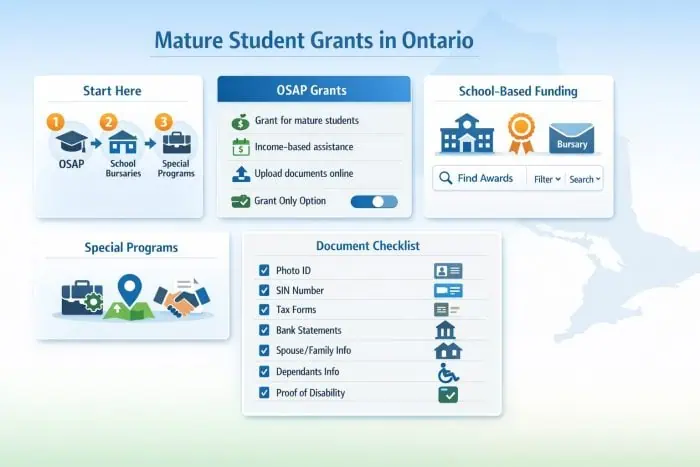
“Mature student” is mostly an admissions label (each school defines it a bit differently). Funding is different. Most grants and bursaries care more about:
- Your financial need (income and household situation)
- Your course load (full-time vs part-time)
- Your program type (certificate/diploma/degree, eligible vs not eligible)
- Whether you have dependants or a documented disability
So instead of chasing one mythical grant, aim to stack what you qualify for.
Start with OSAP (because it unlocks multiple grants at once)
Even if you don’t want loans, OSAP is still the first stop because it’s the main doorway to government grants—and many schools want an OSAP application on file before they assess you for need-based bursaries. If you will study part time, compare the part-time OSAP funding guide with your school’s bursary options.
A few things mature students often miss:
You can take grants without taking the loan
If OSAP assesses you for both grants and loans, you can request grants only and decline the loan portion. There’s also a deadline tied to your study period, so don’t leave this until the end of the term.
Grants can turn into loans in certain situations
This surprises people. Even if you only take grants, OSAP can convert some or all of that grant into a loan if you withdraw early, drop below the required course load, or your file is reassessed because something changed (like income or course load).
Helpful reality check: federal grant amounts change by school year
For example, the Canada Student Grant for Full-Time Students can be worth up to $4,200 per year (or $525 per month of study) through the end of the 2025–2026 school year—but amounts and rules can change, so always confirm for your academic year.
Practical next step: If you’re also comparing program paths (certificate vs diploma vs degree), do that before finalizing OSAP—your program length and course load can change your assessment.
Next: squeeze your school’s funding (where a lot of money gets missed)
Most mature students leave school funding on the table because it’s scattered across:
- Financial aid office bursaries
- Department/program awards
- Student union emergency funds
- Donor awards that don’t get many applicants
How to search your school awards portal without getting overwhelmed
Try keywords people actually get funding under:
- “adult learner” / “mature”
- “returning student”
- “financial need” / “bursary”
- “caregiver” / “single parent”
- “first-generation”
- “emergency bursary”
- “disability supports”
If you only do one thing: apply to the general bursary / needs-based bursary every term you’re eligible. Many awards require that as the starting point.
Email script that gets you a useful answer (copy/paste)
Subject: Funding options for a mature/adult learner in [Program], [Term]
Hi Financial Aid Team,
I’m starting/continuing in [Program] in [Term + Year]. I’m a mature/adult learner and I’m trying to plan funding beyond OSAP.
- Which bursaries/awards are most commonly available for students in my situation?
- Are there separate department awards for my program?
- What deadlines do mature/adult learners usually miss?
- What documents should I prepare so my file isn’t delayed?
Thank you,
[Name] • [Student # if you have it]
This sounds simple, but it works because it forces a concrete reply: programs + deadlines + documents.
Then check the “big-ticket” programs that can cover training
These aren’t for everyone, but when they fit, they can beat a small bursary by a mile.
Better Jobs Ontario (BJO)
If you’re unemployed, laid off, or stuck in unstable work, Better Jobs Ontario can help cover training costs and some related expenses.
What matters right now:
- BJO can support up to $28,000 for training that’s 1 year or less
- And up to $35,000 for programs longer than 1 year (up to two years, depending on the rules and program stream)
BJO is also picky about training choices. Expect to explain why the program you picked is a reasonable, job-linked option (and not the most expensive route without a payoff).
Ontario Learn and Stay Grant
This one is highly specific: it’s tied to eligible programs and eligible Ontario regions, and it usually comes with a commitment to work in the same region after you graduate. Great if you qualify, irrelevant if you don’t—so check eligibility early.
Don’t forget the tax-time “grants” adults actually feel
If you’re working while studying, taxes start to matter more than they did at 18.
Canada Training Credit
If eligible, your Canada Training Credit limit can increase by $250 per year up to a $5,000 lifetime maximum, and you can claim the credit for eligible tuition/fees you paid for courses in the year.
A realistic example: Mature student grants in Ontario
Illustrative example (not a promise):
Sam is 34, returning to school full-time with one child. Tuition and fees are $4,000/term; books and supplies are $500.
- OSAP assesses $2,200 in grants and $3,000 in loans
- Sam chooses grants only (no loan)
- The school awards a $1,000 needs-based bursary after OSAP is on file
- Sam also gets a small department award ($500) because fewer people applied
- Total non-repayable help: $3,700 for the term, before any work income
The point isn’t the exact dollars. It’s the pattern: OSAP first → school bursaries next → program awards last.
Checklist: documents that usually slow mature-student funding
Have these ready before you apply (or you’ll get stuck in “upload requested documents” purgatory):
For OSAP + most school bursaries
- Government photo ID
- SIN (name must match exactly)
- Proof of status in Canada (if needed)
- CRA income info (your latest notice of assessment helps)
- Program details: school, program, start/end dates, course load
- Banking info for direct deposit
If you have a spouse/partner
- Their income details (many assessments are household-based)
If you have dependants
- Dependant details and childcare cost info (if applicable)
If you’re applying for disability-related supports
- Required verification forms (start early)
