
Most “focus advice” is basically willpower advice. This guide takes a different route: environment design + clear next steps + fast recovery—backed by widely cited learning and attention research. I wrote it as a practical checklist you can use on a normal school night, not a perfect schedule.
Studying rarely fails because you’re “lazy.” It fails because your attention keeps getting reset—phone pings, vague tasks, tired brain, or switching tabs. The goal isn’t perfect focus. The goal is fewer resets, and faster recovery when you drift. Choose study support carefully using our AI study tools guide; a tool should help the task you are trying to finish.
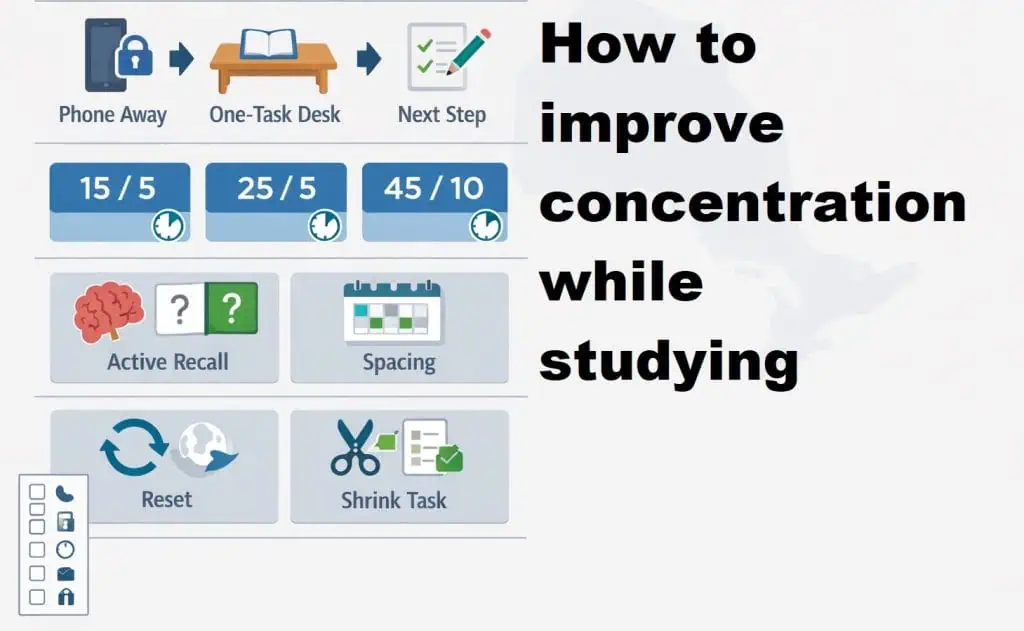
Improve concentration while studying
1) Treat sleep as part of studying
When sleep drops, focus gets expensive: more rereading, more mistakes, more quitting early. Teen sleep guidelines commonly recommend 8–10 hours (and adults generally 7+). [1][2]
If you can’t change much this week, do one thing: set a screens-down time 30 minutes earlier on school nights.
If you’re balancing classes with shifts, your focus plan has to match real life—see our guide to working while studying in Ontario for a realistic schedule approach
2) Stop “study + anything else” (switching has a cost)
Multitasking usually turns into rapid task-switching. Research on task switching shows real time and accuracy costs when you bounce between goals. [3] Even “quick checks” can break the mental thread.
A rule that works in real life:
- One screen for the task.
- Close everything else.
- If you need resources, open them one at a time (not 12 tabs).
Make distraction physically harder
3) Put friction between you and your phone
Willpower fades. Friction doesn’t.
Pick one:
- Phone in another room
- Phone in a bag / drawer (out of reach)
- Do Not Disturb + only family allowed
- If you need a timer, keep it face-down and not within arm’s reach
Optional E-E-A-T anecdote slot (use only if it’s true for you):
When I started putting my phone in another room, my average uninterrupted focus block went from __ minutes to __ minutes over __ days (tracked with a timer).
(Replace the blanks with your real numbers, or delete this.)
4) Keep your desk to one active item
A messy surface invites wandering. Use the “one active item” rule:
- One notebook or one worksheet or one chapter open
- Everything else stacked to the side
You’re not trying to look aesthetic. You’re reducing decision fatigue.
5) Make the next step painfully specific
“Study chemistry” is too vague. Your brain stalls, then escapes.
Replace vague with specific:
- “Do 12 flashcards on reactions.”
- “Write a 6-line summary of today’s notes.”
- “Solve questions 1–8, then check answers.”
If the next step is unclear, focus won’t lock on.
Use a Focus Sprint system that actually starts
6) Study in sprints instead of “until I’m done”
A timer gives your brain a finish line.
Pick one sprint style and repeat it 3–5 times:
| Sprint style | Focus | Break | Best for |
|---|---|---|---|
| Starter | 15 min | 5 min | “I can’t begin” days |
| Classic | 25 min | 5 min | most homework |
| Deep | 45 min | 10 min | hard writing / math |
Break rule: stand up, water, quick stretch. Avoid scrolling—scrolling steals the next sprint.
For a concrete example of how timed blocks stack up over weeks, our LSAT study timeline in Canada shows how to plan focus sprints and review days without cramming.
7) Use a 2-minute “launch sequence”
This prevents the “I’ll start in a minute” loop.
Do this exactly:
- Write today’s target in one sentence
- Set the timer
- Do the first tiny step (open notes, write heading, solve Q1)
Two minutes is short enough that you can’t negotiate with it.
Study methods that hold attention (and stick)
8) Use active recall instead of rereading
Active recall—retrieving info from memory rather than rereading—improves long-term retention in well-known testing-effect research. [4][5] It feels harder (good sign), because your brain is actually practicing the skill exams require.
Fast ways to do it:
- After one page: close it and list the main points
- Turn headings into questions and answer them
- Do practice questions before you “feel ready”
9) Space your review (short repeats beat cramming)
Spacing (distributed practice) reliably improves retention across many studies and a large meta-analysis. [6][7] You don’t need a perfect plan—just revisit the material again later.
A simple spacing pattern:
- Day 1: learn + quick self-test
- Day 3: short quiz (10–15 minutes)
- Day 7: mixed practice
- Pre-exam: weak spots only
Recover fast when you drift or feel overwhelmed
10) Reset—don’t restart
When you notice you drifted, don’t punish yourself. Reset in 30–60 seconds:
- One slow breath in, slower breath out
- Look at your target sentence
- Do the next tiny step (one question, one paragraph, one flashcard set)
If you’re overwhelmed, shrink the task until it’s doable:
- “Just do 3 questions.”
- “Just summarize one slide.”
- “Just set up the flashcards.”
Small starts often restore momentum.
How this works in practice (a simple 2-hour plan)
If you have about 2 hours:
- 25/5 × 4 rounds = 100 minutes of planned work
- Use breaks for water/stretch
- End with a 5-minute active recall recap
The win isn’t “more motivation.” It’s fewer attention resets.
Quick checklist
- Slept enough to function (or planned shorter sprints)
- Phone out of reach / on DND
- Desk: one active item
- Next step written in one sentence
- Timer set
- Study includes recall (not only rereading)
- Breaks don’t include scrolling
FAQs
Why can’t I focus even when I’m trying?
Most often: sleep debt, phone access, vague tasks, or multitasking. Fix the environment and the next step first.
What if I get distracted every 2 minutes?
Start with 15/5 sprints and move your phone away. Keep each sprint goal tiny and specific.
Is music okay while studying?
Sometimes. Lyrics can pull attention. If you notice you replay songs or lose your place, switch to instrumental or silence.
What if anxiety is ruining my focus?
Use short sprints + tiny goals. If anxiety feels constant or intense, talk to a trusted adult or school counsellor—support matters.
What if I’m returning to school after a long break?
Start with shorter sprints (15/5), keep tasks tiny, and rebuild consistency for 2 weeks—our guide for returning to school in Ontario after 25 has practical steps for getting back into study mode.
