
Jackhammers at 7 a.m. can turn your home into a stress test. The frustrating part in Ontario is that “noise rules” aren’t one universal law — they’re mostly municipal. Your best move is to focus on what’s enforceable, build a clean paper trail, and escalate in the right order.
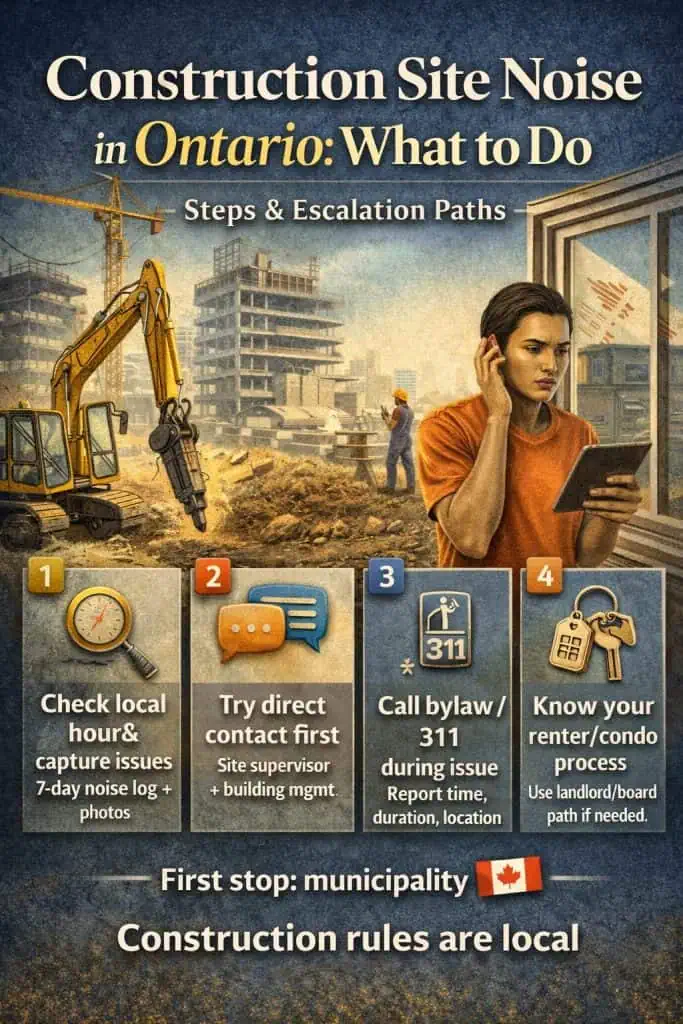
In Ontario, start by checking your city’s construction-noise hours, then document what’s happening (time, duration, type of noise). Ask the site contact or your building/landlord to fix it first. If it’s outside permitted hours or unusually disruptive, report it to municipal bylaw/311. Renters and condo residents may have extra routes through their landlord/board.
Steps to deal with construction site noise
Step 1: Figure out what kind of “construction noise” you’re dealing with
Not all noise is treated the same. The response depends on where the noise comes from:
- Private construction (house renovation, condo build, commercial site)
- City/provincial infrastructure (road work, sewer work, transit)
- In-building work (your landlord’s repairs, condo corporation projects)
Ontario’s own guidance is blunt: if noise is from a home, business, or construction site, the first stop is usually your municipality. (More on exceptions below.)
Step 2: Check your local allowed hours (don’t assume)
Construction hours vary a lot between cities, and exemptions happen.
Examples (to show how different it can be):
- Toronto: construction noise isn’t allowed during specific evening/early-morning windows, and it’s restricted all day Sundays/stat holidays.
- Ottawa: construction equipment has allowed time windows and a separate note for infill construction.
- Mississauga: commercial construction noise is generally allowed Monday–Saturday 7 a.m.–7 p.m. unless there’s an exemption.
Don’t memorize these. Instead, do this search:
“[Your city] noise bylaw construction hours”
Then screenshot the page so you have the official wording handy.
Step 3: Document it like you’re going to need proof
You might not need a formal complaint — but if you do, a good log saves weeks of back-and-forth.
Make a simple log for 5–7 days:
- Date + start time + end time
- What you heard (jackhammer, saw cutting, reversing beeps, shouting)
- Where it’s coming from (address/intersection if you know it)
- How it affected you (woke you up, couldn’t take a call, vibration)
Optional but useful:
- A short video from inside your unit (10–20 seconds)
- Any notices your building posted
- Photos of posted permit/exemption signage (if visible)
Step 4: Try the “fast fix” before you go formal
This sounds obvious, but it often works:
If it’s a big site: look for a posted sign with a site supervisor / community liaison number or email. Many larger projects have one. Send one calm message with your log.
If you’re in a rental building/condo: contact your property manager first. They can often reach the contractor faster than you can.
A message you can copy/paste
Hi — I’m at [address/nearest intersection]. Construction noise has been happening outside the permitted hours (example: [date/time]). I’m attaching a short log. Can you confirm the approved work hours/exemption (if any) and reduce noise where possible (e.g., later start for jackhammering, moving staging area, temporary barriers)? Thanks.
Step 5: Escalate to bylaw/311 the right way
If the noise looks like it breaks your city’s rules, report it through your city’s process (often 311).
Toronto’s 311 guidance even suggests speaking with the responsible party first, then contacting 311 for investigation if it doesn’t resolve. Ottawa and Mississauga both have dedicated “construction noise” reporting pages.
Two quick tips that help enforcement actually act:
- Report during the issue (not three days later).
- Provide exact times and the location (your log becomes gold here).
Step 6: If you’re renting: what “reasonable enjoyment” means in Ontario
If the noise is connected to your landlord’s work (or your landlord ignores a problem in the building), Ontario’s Residential Tenancies Act includes a rule that a landlord must not interfere with a tenant’s “reasonable enjoyment.”
If it turns into a long-running disruption and your landlord won’t take reasonable steps, you may have options through the Landlord and Tenant Board (LTB). The LTB’s T2 (Tenant Rights) materials explicitly include “substantial interference with reasonable enjoyment,” and they talk about situations where the landlord’s work creates interference.
If you’re renting, your next step depends on your lease and building setup—this guide on renting your first apartment in Ontario covers the practical landlord/tenant basics.
This isn’t legal advice, but it’s a practical boundary: your landlord can’t just shrug forever if the disruption is tied to their choices or their contractors.
Step 7: If you’re in a condo: use the condo’s noise process
Condo noise is its own universe because you have:
- condo rules/bylaws, and
- the condominium corporation’s enforcement steps
The Condominium Authority of Ontario (CAO) treats noise as a common issue (including noise from external construction) and outlines a step-by-step approach that starts with identifying the issue and following the condo’s process.
Mini case: what a “good complaint” looks like
Let’s say work starts at 6:20 a.m. for four mornings.
A weak complaint: “Construction is loud and annoying.”
A strong complaint:
- Mon–Thu: 6:20–7:05 a.m., saw cutting + reversing beeps
- Location: rear lane behind [street]
- Impact: woke household, can’t take calls until after 9
- Attach: 7-day log + 15-second clip + photo of site sign (if available)
That second version gives bylaw staff something actionable.
What you can do at home (without pretending it solves everything)
These don’t replace enforcement, but they make the week survivable:
- Put white noise between you and the window (not across the room)
- Move your desk/bed to the quietest interior wall if possible
- Use earplugs for sleep + over-ear protection for short bursts (saws/jackhammers)
If noise triggers headaches, panic, or sleep problems, loop in a trusted adult or healthcare professional. (This guide stays on the practical/reporting side.)
FAQ
Can construction start at 7 a.m. in Ontario?
Sometimes, yes — depending on your city. Toronto, Ottawa, and Mississauga all have different allowed windows. Check your municipality’s construction-noise page.
What if the work is “allowed” but still brutal?
If it’s within permitted hours, you can still:
Ask the site contact for mitigation (barriers, scheduling the worst work later), and
Report it as a concern (some cities log permitted/exempted noise to guide enforcement/policy).
What if it’s road work overnight?
Big infrastructure projects sometimes run overnight and may operate under different rules or exemptions. Ask for the project contact and request the mitigation plan.
I’m renting. Can I ask for compensation?
Rent issues are fact-specific. If the disruption is substantial and connected to your landlord’s actions or contractors, Ontario’s tenant-rights process (including the LTB) discusses “reasonable enjoyment.” Get legal help if you’re considering formal steps.
