
If you’re considering PSW work, you’re probably not asking for a definition. You’re asking what you’ll actually be doing on a shift — and what you’re responsible for if something changes with a client or resident.
In Ontario, the PSW role is hands-on daily support: helping people get through normal routines safely and with dignity, following the care plan, and keeping the rest of the team in the loop.
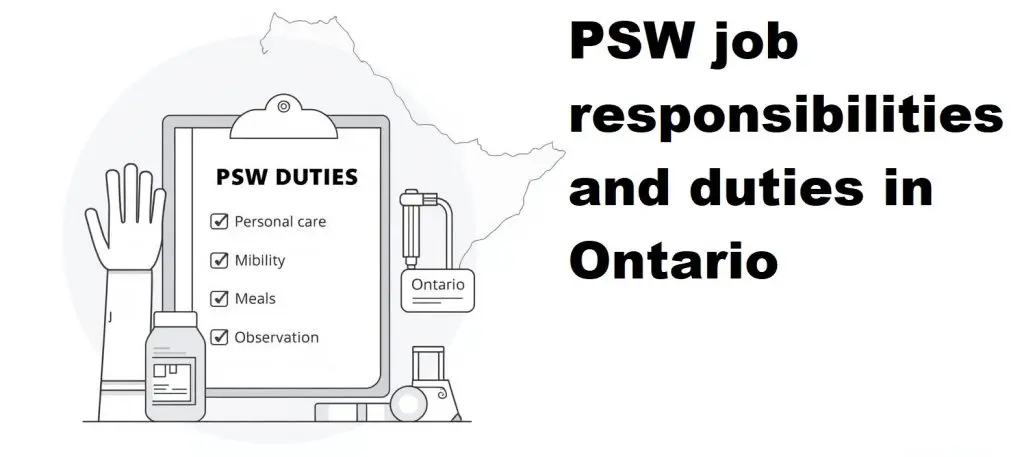
The day-to-day PSW job responsibilities (the real core)
Most PSW shifts come down to three things:
1) Hands-on personal care
You’ll help with the basics people can’t safely do alone:
- bathing or shower support
- dressing and grooming
- toileting and continence care
- oral care and skin care
- helping someone get comfortable (positioning, bedding, simple comfort measures)
2) Safe movement and mobility support
A lot of the job is reducing falls and injuries:
- helping someone transfer (bed ↔ chair, chair ↔ toilet)
- walking support and mobility aids
- regular repositioning for comfort and skin protection
- keeping spaces clear and safe
3) Being the “eyes and ears” of the care team
This part matters more than people expect. You’ll notice things early and report them.
- “This person is suddenly more confused than yesterday.”
- “They’re refusing food and it’s unusual for them.”
- “Their mobility looks worse than last week.”
Even if you’re not the one making medical decisions, you’re often the first person to spot change.
Meals, hydration, and daily routines
Depending on where you work, you may also:
- set up meals and assist with eating
- encourage fluids (as allowed in the care plan)
- support routines like grooming before visitors, bedtime comfort, tidy-up
- help with simple, practical tasks that keep someone living safely (especially in home care)
This isn’t “extra.” For many clients, these routines are the difference between coping and not coping.
Documentation and reporting: keep it simple and factual
Documentation isn’t about writing a novel. It’s about leaving clear breadcrumbs for the next shift and the supervising team.
A good note usually answers:
- What did you observe?
- What did you do?
- Who did you tell (if needed)?
And if you’re ever unsure, your workplace policy is the boss here.
How PSW job responsibilities change by workplace
Same title, different rhythm.
| Where you work | What you’ll do most | What surprises new PSWs | What helps you succeed |
|---|---|---|---|
| Long-term care (LTC) | Personal care routines, toileting schedules, transfers, meal support, charting | Pace is fast; you’re caring for several residents back-to-back | Time management, calm communication, strong transfer skills |
| Home & community care | One-on-one personal care, meal prep, light housekeeping tasks in the care plan, companionship, observation | Boundaries matter (it’s someone’s home); every house is different | Professional boundaries, adaptability, respectful tone |
| Hospital | Basic care support, helping patients move safely, assisting unit flow (transport, set-up, hygiene support) | You’re part of a big team; priorities shift quickly | Teamwork, following unit routines, clear reporting |
If you’re choosing a setting:
- LTC suits people who like structure and teamwork, and don’t mind a busy pace.
- Home care suits people who like one-on-one support and independence.
- Hospital suits people who like a “unit” environment and quick coordination.
“Is this my job?” — what to do when a task feels out of scope
This comes up in real life. A resident/client might ask you for something, or a coworker might assume you can do it.
A safe, normal way to handle it:
“I want to make sure I’m following the care plan and policy — who should I check with for this?”
That line protects the client and protects you.
A small example (what “good PSW work” looks like)
Say you’re helping someone get ready and you notice they’re unusually tired, unsteady, and short-tempered — not like yesterday.
A solid PSW response looks like:
- finish the task safely (don’t rush transfers)
- keep them comfortable
- let the right person know right away
- document what you saw in plain language
That’s the job: care + safety + communication.
Read: Free PSW program Ontario: how to train with $0 tuition
How to talk about your PSW duties in an interview (without sounding scripted)
Instead of fancy phrases, speak like you’ve actually done the work.
- “My focus is safe personal care — hygiene, toileting, mobility — and protecting dignity.”
- “I watch for changes and I report early. It prevents bigger problems later.”
- “I stick to the care plan and workplace policy. If something feels unclear, I check before I act.”
Read: PSW training length, placement checks, and Ontario incentives
PSW job responsibilities FAQs
Do PSWs do the same tasks everywhere in Ontario?
The core is the same (personal care, mobility support, observation, reporting), but the daily flow changes a lot by setting and employer policies.
Do PSWs help with medications?
This depends on the workplace and training rules. If it’s not clearly in your training/policy, treat it as a “check first” situation.
Is housekeeping part of PSW work?
In home care, light housekeeping or meal prep can be part of the care plan. In LTC/hospital settings, it’s usually more limited and policy-driven.
PSW job responsibilities Key takeaways
- PSWs do hands-on daily support: personal care, safe mobility, meals/routines, comfort.
- A big part of the job is noticing change and communicating it clearly.
- The same PSW title feels different in LTC vs home care vs hospital.
- When something feels out of scope, anchor to the care plan and policy — and ask.

My husband is in LTC after spending three months in hospital. While in a teaching hospital he allowed(nursing students) to practice doing his in and out catheters.
His nurse in LTC has allowed four (PSW’s)in three days to watch her doing the catheter
I wonder if this is allowed as being PSW’s they are not qualified to do catheters.
I was present during these events.
Thank you for sharing this. You’re right to ask.
In Ontario, putting a catheter into the bladder (inserting it “beyond the opening of the urethra”) is treated as a controlled act, and it’s normally done by regulated staff like nurses.
PSWs are unregulated care providers, so they generally would not be inserting an in-and-out (intermittent) catheter unless there is a very specific, formal process in place (training + supervision + workplace policy + proper authorization/delegation).
That said, what you described sounds like PSWs watching a nurse, not doing the procedure themselves. Observation can happen for training or to support the care team, but your husband still has rights in long-term care, including the right to privacy during treatment and the right to consent (or refuse) to care/services where consent is required.
If you’re uncomfortable with people watching, it’s reasonable to ask the home:
Why observers are needed,
Who they are and what their role is,
And to have observers present only with your husband’s clear consent (and only when truly necessary).
If you can’t get a clear answer, you can escalate through the home’s process, and you can also contact the Patient Ombudsman for long-term care concerns.
For urgent harm/neglect concerns, CLEO also notes the Ministry ACTION Line route.
If your concern is mainly privacy/confidentiality, Ontario’s privacy regulator is the IPC.