
For most people in Ontario, “police check” first shows up in an email about a job, placement, or volunteer spot. The role sounds great…and then there’s that one line: “Police record check required.”
In this province, that can mean a few different checks, with different levels of detail and different prices. You also can’t shop around anywhere in Ontario; you have to use the police service for the place you actually live.
This guide is mainly for students, newcomers and entry-level job-seekers who need their first police check in Ontario. It explains when police checks tend to pop up, the three main types, who you apply through, and what to expect for cost and timing in 2025. If you’re dealing with high-level federal security clearances, this is not meant to replace that process.
When a police check tends to pop up
You bump into police checks when there’s trust, access or power involved. Three common situations:
Jobs with keys, cash or sensitive info.
Think convenience stores, warehouses, security work, some office roles with access to financial or personal data, and many government jobs. Employers here tend to ask for a Criminal Record Check (CRC) or a Criminal Record and Judicial Matters Check (CRJMC).
Licensing and federal stuff.
Regulators and federal departments sometimes want a more formal, fingerprint-based RCMP certified criminal record check, which is ordered through an accredited fingerprinting company or a police service that offers it.
You should not be paying for police checks for things like OSAP, a SIN, or a basic Ontario Photo Card; those have their own identity checks and forms.
The main types of police checks in Ontario
Under the Police Record Checks Reform Act, Ontario uses three standard types of police record checks.
Quick comparison
| Type | What it looks at | Typical use |
|---|---|---|
| Criminal Record Check (CRC) | Criminal convictions from national and local databases | Basic jobs, many volunteer roles |
| Criminal Record and Judicial Matters Check (CRJMC) | CRC info plus certain current charges and court orders | Jobs where present legal issues matter |
| Vulnerable Sector Check (VSC) | CRJMC-level info plus certain sexual offence records with suspensions | Working or volunteering with vulnerable people |
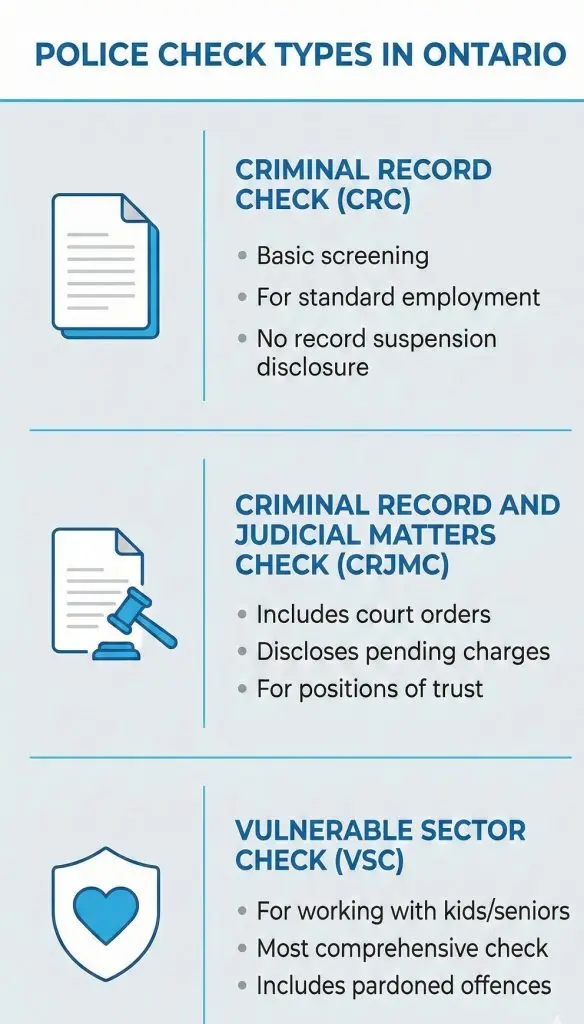
Local services explain it the same way in plain language: CRC is the basic screening, CRJMC is the “deeper” one without vulnerable sector, and VSC is reserved for positions of authority or trust over vulnerable people.
Criminal Record Check (CRC)
A CRC is the “lightest” standard check. It looks for criminal convictions that can legally be released from the national CPIC database and local systems. It’s common for entry-level work, general office jobs and many volunteer roles.
Criminal Record and Judicial Matters Check (CRJMC)
A CRJMC includes everything a CRC would show plus certain outstanding charges, warrants and court orders that police services are allowed to disclose. It’s used when employers want a clearer picture of any current involvement with the courts, not just old convictions.
Vulnerable Sector Check (VSC)
A VSC is for roles where you’re in a position of trust with vulnerable people—kids, seniors, people with disabilities or others who rely on you.
It pulls in:
- Criminal record information
- Local police and court information within set rules
- In some cases, sexual offence records for which a record suspension exists, as allowed by federal law
ECE, nursing, PSW, social work, coaching, camp counselling, and many school board roles land here.
RCMP fingerprint-based checks (separate but related)
A certified criminal record check from the RCMP uses your fingerprints and is treated as the “gold standard” for identity. It’s used for some immigration cases, certain federal jobs and decisions by regulators. The RCMP is clear that fingerprints are used mainly to make sure you’re not being confused with someone else.
Who you actually apply through
You don’t get to pick any random police service in Ontario. Your home address decides.
If you live in a city with its own police service
In places like Toronto, Peel, York, Durham, Halton, Ottawa, Hamilton and similar regions, you apply through that local or regional service’s website or office.
Most of them:
- Offer an online portal for CRC, CRJMC and VSC
- Collect payment by card
- Let volunteers and students upload a letter for reduced or free checks
- Deliver results by secure PDF or by mail.
Fees change over time, but one large regional service lists 2025 fees like:
- Around $73–$90 for online employment checks
- $34 for student checks
- Free CRC/CRJMC for volunteers, with some services charging only for VSC or fingerprints
If you live in an OPP-policed community
If your town or rural area is policed by the Ontario Provincial Police (OPP), you apply through the OPP’s online record check portal instead of a city police site.
The OPP:
- Offers CRC, CRJMC, VSC and a Non-Parent Custody Check
- Charges around $41 for record checks and $90 for fingerprints, with volunteer checks free at the base level
- Delivers results through a secure link, not over the counter
If your postal code puts you in Toronto, Ottawa or another large centre, the OPP will redirect you to your local police instead.
Step-by-step: ordering a police check without overthinking it
You don’t need to memorize rules. Treat this like a to-do list you work through once.
1. Get the exact wording from the employer or school
Ask them to confirm, in writing:
- Which check: CRC, CRJMC, or VSC
- What it’s for: employment, volunteer, or student placement
- How “fresh” it must be (for example, issued within the last 6 or 12 months)
That email becomes your anchor if anyone later questions whether you ordered the right thing.
2. Look at your timeline honestly
Placements and government jobs tend to have firm start dates. CRC or CRJMC results can land in about a week; vulnerable sector checks with big urban services can sit in the queue for much longer, especially late summer and early fall.
If you get your letter in June for a September placement, starting the process in July is gambling.
3. Confirm which police service covers your home address
- Search “[your town] police record check.”
- If nothing obvious comes up, check your municipality’s page under “police services” to see if they use OPP or a regional service.
Still not sure? Call the non-emergency number and ask where to apply for a police record check.
4. Read the record-check page once, properly
On your police service or OPP page, look for:
- Types of checks offered and what they’re for
- ID rules (most want two pieces of government ID; health cards and SIN cards are often not accepted as ID)
- Rules for volunteer and student discounts
- How results will be delivered
Five minutes here can save you a week of back-and-forth.
5. Gather your ID and documents
You’ll usually need:
- Two valid pieces of government ID (at least one with a photo)
- Proof of your current address if it isn’t on your ID
- A letter from your school or volunteer organization if you’re applying at a reduced rate
Take clear photos or scans for your records.
6. Apply online
In most of Ontario you now apply online.
You’ll:
- Create an account or log in
- Enter your personal details
- Choose the correct type of check
- Upload your letter, if you have one
- Pay the fee
- Answer any identity-verification questions
Double-check your email address; that’s where result links and questions go.
7. Wait for processing (and keep proof)
Rough pattern:
- CRC / CRJMC: around a week of business days, sometimes faster or slower
- VSC: can take several weeks, especially with larger services handling thousands of student and volunteer checks at once.
Keep your payment confirmation and application reference handy. If a placement office wants proof you applied, you can send that.
8. Store the result and reuse it when allowed
Results may come as:
- A secure PDF link
- A paper document by mail
- A certificate you pick up in person with ID
Keep the original safe. Take a scan or clear photos. When a second employer asks for a check soon after, show them your recent one and ask if it’s acceptable before you spend money again.
Students, newcomers and youth: what trips people up
This section is less about law and more about how it plays out in real lives.
College and university students
Imagine Jasmin in Brampton starting an ECE program. Her college emails a pre-placement checklist in May that says:
- VSC required for student placement
- Check must be dated within 6 months of first placement
- Processing can take up to 8–10 weeks in busy periods
Jasmin’s best move is to apply through Peel Regional Police in June using the college’s template letter and student category. If she waits until August, she risks missing her September placement even if she did nothing “wrong.”
Most schools now provide clear “how to apply” pages for their local police services, so it’s worth searching “[college name] + police check” before guessing.
Newcomers
If you’ve just landed in Ontario, police checks can feel like one more form on top of SIN, bank and OHIP.
A few points to keep your stress down:
- The check is tied to where you live now, not to your immigration status.
- Some employers or schools may ask for a police certificate from your previous country plus an Ontario check later.
- If instructions aren’t clear, reply with a short question like: “I’ve just arrived in Ontario; do you want a police certificate from my home country first, or should I wait and apply here?”
You’re allowed to ask; good organizations expect it.
Youth and your rights
If you’re under 18, your records are treated differently under youth justice laws, and police services are limited in what they can share with non-government employers.
If someone asks you, as a youth, for a police check:
- Ask what exact type of check they want and who they are (school board, government, private camp, etc.).
- Involve a parent/guardian, guidance counsellor or program lead before you pay any fees.
If the request feels off, that’s a reason to slow down and ask more questions.
Money and timing: quick reality check
This isn’t a full price chart—each police service sets its own fees—but here’s what shows up in real 2024–2025 tables:
- Municipal/regional services charge about $35–$90 for employment checks, depending on type and whether you apply online or in person.
- Many list student CRC/CRJMC/VSC at around $34.
- In OPP-policed areas, record checks sit around $41, fingerprints around $90, and volunteer checks are marked free.
- Since April 1, 2022, the provincial fee for volunteer CRC and CRJMC has been removed, so volunteers pay little or nothing beyond local processing, depending on the service.
For planning, assume you’ll pay something unless you have a clear volunteer or student letter and your local service explicitly lists a free or reduced rate.
Use our free Police record check Ontario: checklist tool and prep guide
FAQ
Do speeding or parking tickets show up on a police check?
Regular parking tickets and most minor traffic tickets don’t show on CRC, CRJMC or VSC results. These checks focus on criminal records and certain court-ordered conditions, not everyday traffic fines.
I was told I need fingerprints. Did I mess up?
No. Name-based checks sometimes flag that your name and date of birth match someone else’s record. The RCMP notes that fingerprints are the most accurate way to confirm identity and prevent you being mixed up with another person.
How long is a police check “good for”?
There’s no law that says “expires after X months.” Each employer or school sets its own rule. Many like checks that are less than 6–12 months old, especially for vulnerable-sector roles. Always ask before re-ordering one you already have.
Can I see what’s on my check before my employer does?
Local policies differ, but many services send the result to you, and you decide how to share it. If you think something looks wrong, contact the issuing police service and, where appropriate, get legal advice before handing copies to employers.
Do I need a police check for OSAP, SIN or an Ontario Photo Card?
No. Those use their own identity and eligibility checks. You don’t buy a separate police record check certificate for them.
